
What Is a Bill of Lading for Moving? A Complete 2026 Guide
- nadineharoon
- Jun 19
- 13 min read
The estimate you received is merely a starting point, but the Bill of Lading is the definitive roadmap that turns a quote into a binding legal obligation. It's common to feel a sense of unease when faced with stacks of paperwork, especially when you're worried about hidden costs or the safety of your family's belongings. Understanding what is a bill of lading for moving is the most effective way to eliminate that stress and ensure your relocation remains transparent and secure.
You deserve a moving experience that feels like a partnership rather than a series of confusing hurdles. We promise to help you master this critical document so you can spot errors before you pick up a pen and feel fully protected from the moment the truck leaves your driveway. This guide covers the latest FMCSA requirements, the shift away from the old Order for Service, and the exact steps you should take to verify your inventory and total charges before the journey begins.
Key Takeaways
Recognize that the Bill of Lading acts as your definitive legal contract, providing a level of protection that verbal quotes simply cannot match.
Identify the mandatory carrier information and pickup windows required by federal law to ensure your relocation stays on track.
Master what is a bill of lading for moving by learning how to reconcile your initial estimate with the final document to avoid unexpected fees.
Implement essential best practices for reviewing and signing your paperwork to maintain a secure and stress-free transit experience.
Gain confidence in your relocation by understanding how meticulous inventorying and clear documentation safeguard your most valued possessions.
Table of Contents
Understanding the Bill of Lading: Your Moving Contract and Receipt
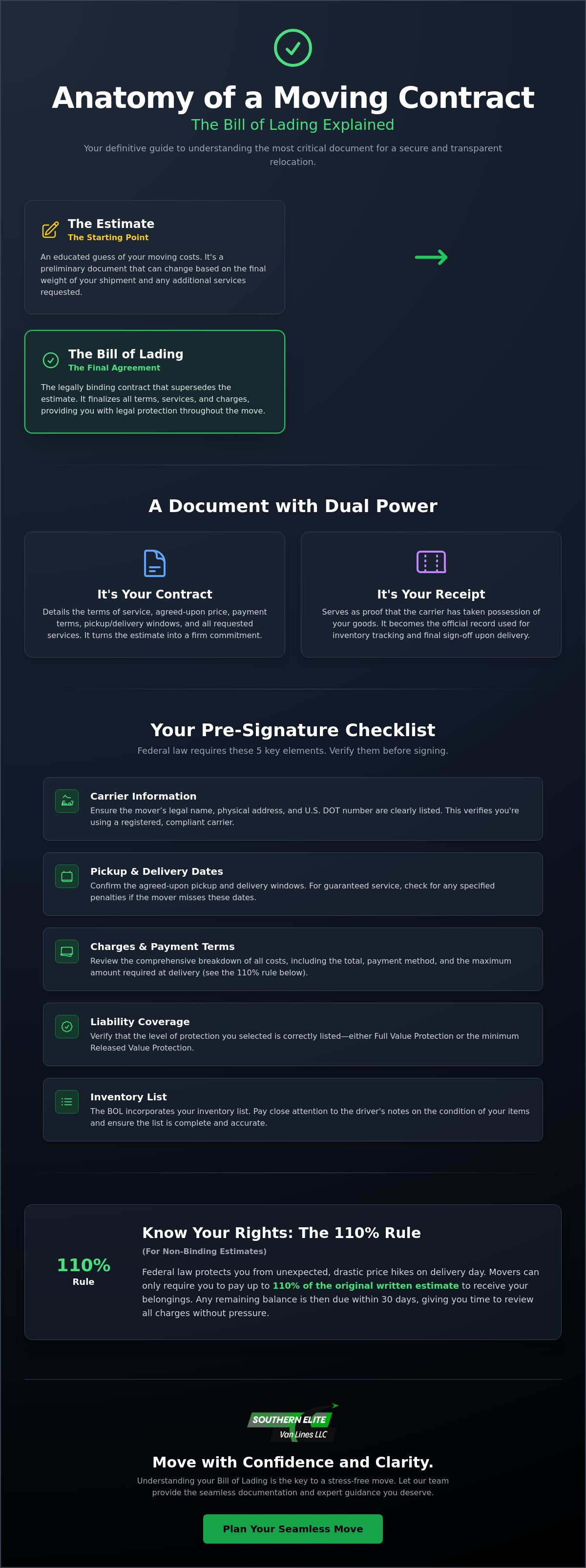
Relocation involves more than just packing boxes; it requires a structured legal framework to protect your interests. The most critical piece of this framework is the Bill of Lading. Often abbreviated as the BOL, this document is the legally binding contract between you and your moving company. For anyone asking what is a bill of lading for moving, it's the definitive agreement that governs every aspect of your shipment. Federal law, specifically through the Federal Motor Carrier Safety Administration (FMCSA), mandates that a mover issues this document for every interstate relocation. It's a non-negotiable requirement. Without a signed BOL, a carrier cannot legally transport your household goods. This document ensures that both parties are on the same page before the truck even starts its engine. Gaining a clear understanding of what is a bill of lading for moving allows you to move forward with confidence.
The Legal Authority of the Bill of Lading
The BOL isn't just paperwork; it carries significant legal weight under the Carmack Amendment. This federal law establishes the liability of carriers for loss or damage to goods during transit. If a dispute arises or items go missing, the BOL serves as the primary evidence used to resolve claims. It outlines the mover's responsibilities and the level of liability protection you've selected. This protection is vital for your peace of mind. The Bill of Lading is the official governing document of the relocation process. By signing it, you're agreeing to the terms that will dictate how your belongings are handled across state lines. It provides the steady, expert hand needed to guide a complex and often emotional process.
Contract vs. Receipt: Why It Is Both
A common point of confusion is whether the BOL is a contract or a receipt. The reality is that it functions as both, providing a dual layer of security. As a contract, it details the terms of service, transforming an informal estimate into a firm commitment. This clarity prevents the anxiety often associated with hidden fees or changing terms. You know exactly what you're paying for and when to expect your delivery. Key contractual elements include:
The agreed-upon price and payment terms.
Specific pickup and delivery windows.
A detailed list of accessorial services requested.
As a receipt, the BOL acknowledges that the carrier has taken physical possession of your property. When the driver signs the document at your origin, they're confirming that the items listed on the inventory are now under their care. This becomes your proof of delivery at the destination. Once the truck arrives and you sign off on the final delivery, the BOL acts as the closing record of a successful move. It's the ultimate tool for transparency, ensuring that what was loaded in one city is exactly what arrives in the next. This methodical approach mirrors a well-planned operation, guiding you from the initial inquiry to the final completion with ease.
What Information Must Be Included in a Moving Bill of Lading?
The Bill of Lading is more than a formality; it's a detailed record of every promise made during your relocation. To understand what is a bill of lading for moving, you must recognize the specific data points that protect your rights. Federal regulations require 17 distinct items to be present on this document. First, the mover's legal name, physical address, and U.S. DOT number must be clearly visible. This ensures you're dealing with a registered, compliant carrier. You'll also find the agreed-upon dates for pickup and delivery. If you've opted for guaranteed service, the BOL will specify any penalties or per diem entitlements the mover owes you if they miss those windows.
A comprehensive breakdown of all moving charges is another essential component. This includes the total cost, payment terms, and the maximum amount you're required to pay at delivery to gain possession of your goods. For non-binding estimates, federal law caps this amount at 110% of the original quote. You'll also see the declared value of your shipment and the liability coverage you've selected, whether it's Full Value Protection or Released Value Protection. Knowing what is a bill of lading for moving ensures you can identify missing information before it's too late. If you're planning a long distance move, verifying these fields ensures a transparent experience from start to finish.
Inventory and Condition Reporting
The BOL doesn't exist in a vacuum; it incorporates your inventory descriptive list by reference. This list tracks every box and piece of furniture loaded onto the truck. You must pay close attention to how the driver notes the condition of your items, especially high-value pieces. If a piano has a pre-existing scratch, it must be noted accurately. Conversely, if an item is pristine, ensure the "condition at origin" column reflects that. Never sign a BOL that contains blank spaces in the inventory section. Leaving gaps invites errors or unauthorized additions later in the journey. This meticulous attention to detail is your best defense against future disputes.
Tariff References and Terms of Service
You might notice references to a "moving tariff" within the document. A tariff is a carrier's official schedule of rates and rules. The BOL cites this to provide a legal basis for the charges applied to your shipment. This section also outlines terms for storage-in-transit (SIT) if your new home isn't ready immediately. It details how your goods will be handled and the costs associated with that temporary hold. Additionally, the BOL includes provisions for items of "extraordinary value," which typically refers to items worth more than $100 per pound. For a deeper look at these legal requirements, consult the FMCSA guide on Your Rights and Responsibilities When You Move. This resource clarifies the standard disclosures every reputable mover must provide.
Reconciling Your Estimate with the Bill of Lading
Many shippers confuse the initial quote with the final agreement. While an estimate provides a baseline for your budget, the Bill of Lading is the final word on price. It incorporates by reference all services included in your estimate, but it effectively supersedes any prior statements or informal quotes. Understanding what is a bill of lading for moving means recognizing that once you sign this document on moving day, you are agreeing to the terms and costs listed right there, regardless of what was discussed weeks prior. As of 2022, the FMCSA simplified this process by consolidating the "Order for Service" information directly into the BOL, making it the singular, authoritative contract for your entire relocation.
Binding vs. Non-Binding Agreements
The type of estimate you received dictates how the BOL handles your final balance. A professional carrier will clearly mark which agreement type is in effect. These categories include:
Binding Estimates: These prices are locked in. The total cost stays the same regardless of weight changes, provided you don't add new items or request additional services after the estimate is issued. The BOL will reflect this guaranteed amount.
Non-Binding Estimates: These are approximations. The final price is determined after the truck is weighed at a certified scale. While the estimate gives you a target, the BOL will outline the per-pound rates that dictate the final cost.
For interstate relocations based on non-binding estimates, federal law provides a critical safety net known as the 110% Rule. You're only required to pay up to 110% of the estimated cost at the time of delivery to receive your shipment. If the actual weight results in a higher total, the mover must bill you for the remaining balance later, giving you at least 30 days to pay. This regulation prevents unexpected financial strain during the final stages of your journey.
Handling Price Discrepancies on Moving Day
If the BOL presents a higher price than your binding estimate, don't sign it immediately. Verify the "Total Estimated Cost" field before the truck leaves your origin. Discrepancies often arise from add-on services like full packing services or specialized crating that weren't in the original quote. If you requested these services on-site, they must be documented clearly as accessorial services on the BOL. However, if the price has increased without a change in the scope of work, address it with the carrier's representative on the spot. A professional mover will provide a clear, logical explanation for any adjustments. Maintaining a steady, expert hand during these negotiations ensures your relocation remains transparent and fair. Knowing what is a bill of lading for moving allows you to act as an informed partner in your own relocation, ensuring every charge is justified and documented.
Best Practices: Reviewing and Signing the Document
Moving day often feels like a whirlwind of activity, but the moment you're asked to sign your documentation requires your total focus. You shouldn't rush this process. The Bill of Lading is your primary shield against misunderstandings, so treating it with the care it deserves is essential for a stress-free relocation. Before the first box is loaded, perform a thorough walk-through with the driver. This shared inspection ensures that the condition of your furniture is recorded accurately. You're effectively establishing the "baseline" for your entire shipment. If you have questions about what is a bill of lading for moving, remember that it's the final opportunity to verify that every detail of your agreement is correct before your belongings leave your sight.
Confirm that every page of the document is present and entirely legible. Blurred text or missing pages can lead to significant issues if you ever need to file a claim. You should also verify that the valuation section matches your chosen level of liability. If you've opted for Full Value Protection, it must be explicitly stated. Additionally, check for a reference number that matches your original quote or service agreement to ensure consistency across your records. For those seeking a partner that prioritizes clear communication, our full packing services include detailed documentation at every step of the journey.
The Danger of Blank Spaces
You have a fundamental legal right to a complete and finished document. You should never sign a Bill of Lading that contains blank spaces or incomplete fields in the inventory and pricing sections. Dishonest operators sometimes use these gaps to inflate prices or add unauthorized services after the truck has departed. A professional mover will ensure every line is filled or crossed out before asking for your signature. This methodical approach protects both parties and maintains the integrity of the contract. If a driver pressures you to sign an incomplete form to save time, stay firm; your signature is the final seal on a binding legal agreement.
Digital vs. Paper Documentation
The moving industry is rapidly shifting toward digital documentation, utilizing e-signatures to streamline the process. This evolution is a significant benefit for transparency. When you sign a digital BOL, you should receive a PDF copy via email immediately. This electronic record is easier to store and harder to lose than a single sheet of paper. Digital records also provide a clear audit trail for tax purposes or in the rare event of an insurance claim. Whether you're dealing with a physical clipboard or a tablet, understanding what is a bill of lading for moving means knowing that the format doesn't change the legal weight of the document. Keep your digital files in a dedicated folder to ensure you can access them at a moment's notice upon delivery.
Seamless Documentation with Southern Elite Van Lines
Relocating across the country requires a partner who understands that clarity is the foundation of trust. Southern Elite Van Lines prioritizes transparency by ensuring every client knows exactly what is a bill of lading for moving before the first box ever enters our truck. We don't just hand you a clipboard and expect a signature. Instead, we guide you through the documentation process with calm confidence, explaining each field to ensure you're comfortable with the terms. This proactive approach eliminates the friction often found in nationwide relocations. By the time you sign your BOL, you'll feel fully informed and emotionally supported, knowing your shipment is governed by a precise and professional agreement.
Our team views the Bill of Lading as a shared roadmap for success. We maintain a high standard of moral character in our business practices, which means we never utilize vague language or hidden clauses. You'll receive a document that is polished, accessible, and reflective of the premium service you expect. We believe that a well-informed customer is a confident customer. This commitment to education transforms the administrative burden of moving into a moment of security. You aren't just signing a contract; you're securing a promise of exactness and care for your most valued possessions.
Professional Inventory and Packing Standards
Our commitment to accuracy starts long before the final signature is required. When you utilize our full packing services, our team creates a meticulous digital inventory that integrates directly into your Bill of Lading. This level of exactness prevents the condition disputes that often plague less organized moves. If your journey requires a pause, our short-term and long-term storage solutions are documented with the same level of detail within your moving contract. We treat every item with meticulous care, ensuring the receipt portion of your BOL is a perfect reflection of your household goods. This methodical attention to detail is what defines a premium service experience and ensures your inventory remains uninterrupted from origin to destination.
Nationwide Support for Your Relocation
Managing an interstate move involves complex logistics that demand a steady, expert hand. Southern Elite Van Lines handles every detail of your long-distance moving needs, from the initial inquiry to the final BOL signature. We project competence at every milestone, ensuring your paperwork is logical, organized, and devoid of unnecessary clutter. This methodical rhythm prevents you from feeling overwhelmed by the technical aspects of the contract. Our goal is to provide more than just transportation; we offer a shared journey where your peace of mind is the ultimate priority. Experience a seamless transition with Southern Elite Van Lines and discover the difference that professional documentation and personalized assistance make for your next move.
Secure Your Journey with Professional Documentation
Mastering the details of your relocation ensures that every phase is protected by the full weight of federal law. You now understand that the Bill of Lading is more than just a form; it's the definitive contract that transforms your initial estimate into a firm legal commitment. By learning what is a bill of lading for moving, you've equipped yourself to verify valuation levels and ensure your inventory is documented with absolute precision before the journey begins.
The right moving partner provides more than just transportation; they offer peace of mind through meticulous organization and clear communication. Southern Elite Van Lines specializes in long distance and interstate relocations, offering climate-controlled secure storage solutions and expert professional packing and unpacking services. We're here to guide you through every logistical detail with the expertise your belongings deserve. Our methodical approach ensures that your paperwork is as secure as your property.
Your next chapter should be defined by excitement rather than administrative anxiety. Get a Professional Quote for Your Nationwide Move and let our team manage the complexities while you focus on your new beginning. We look forward to making your transition effortless, transparent, and entirely secure.
Frequently Asked Questions
Is a Bill of Lading the same thing as a moving estimate?
No, a Bill of Lading is not an estimate. The estimate is a preliminary quote provided before your move, while the Bill of Lading is the final, legally binding contract that governs the actual transport of your goods. It effectively supersedes any prior verbal or written quotes you received during the planning phase of your relocation.
Can I change my mind about valuation coverage once I sign the Bill of Lading?
Changing your valuation coverage after signing is difficult and often impossible once the truck has departed. Your signature on the document confirms your specific choice of liability, such as Full Value Protection or Released Value Protection. You must ensure this field is correct before you sign, as it dictates how any future claims are processed.
What happens if I lose my copy of the Bill of Lading?
If you lose your copy, you should contact your moving coordinator immediately to request a duplicate. Most modern carriers now use digital systems, so an electronic version should be readily available in your email or customer portal. You'll need this document to verify your inventory and total charges when the truck arrives at your destination.
Is the Bill of Lading a legally binding contract?
Yes, the Bill of Lading is the primary legally binding contract between you and the moving company. It serves as both a receipt for your household goods and a formal agreement on the terms of service. Understanding what is a bill of lading for moving helps you recognize the significant legal weight this document carries under federal law.
How much time do I have to review the Bill of Lading on moving day?
You have the right to take as much time as you need to review the document thoroughly. Don't allow anyone to rush you through the signing process during the busy energy of moving day. A professional driver expects you to verify all fields, dates, and inventory notes for accuracy before the loading process begins.
Can a driver refuse to load my items if I do not sign the Bill of Lading?
A driver is legally required to refuse to load your items if the Bill of Lading remains unsigned. Federal regulations prohibit the transportation of household goods without a signed contract in place. This rule protects both the shipper and the carrier by ensuring all terms, including liability and pricing, are agreed upon before transit.
What should I do if the delivery date on the BOL is different from what I was told?
If the delivery window on the document contradicts your previous agreement, stop and contact the moving company's office before signing. Do not provide your signature until the dates reflect what you were promised in your original service agreement. The document you sign on moving day holds the final legal authority over the delivery timeline.
Does the Bill of Lading include the inventory of my items?
The Bill of Lading typically incorporates your inventory list by reference rather than listing every individual item on a single page. It should include a specific identification number that links to your inventory descriptive list. This connection is a vital part of understanding what is a bill of lading for moving and how it protects the physical count of your belongings.


Comments