
What is a Shuttle Fee in Moving? Understanding Accessorial Charges in 2026
- nadineharoon
- 1 day ago
- 12 min read
You have spent weeks packing every box with care, only to watch a massive 53-foot tractor-trailer pull up and realize it can't physically navigate your narrow, tree-lined street. At this moment, many homeowners find themselves asking: what is a shuttle fee in moving? It is a common point of confusion, but this charge isn't a penalty. Instead, it acts as a vital logistical bridge, utilizing a smaller vehicle to safely transport your items when the primary truck lacks access.
We understand that seeing unexpected terms on a moving contract can feel overwhelming. You deserve a relocation process that is transparent and predictable. In this guide, we'll show you exactly why these fees occur, how they are calculated in 2026, and how to identify if your specific home requires one before you ever sign a contract. By understanding the mechanics of a shuttle, you can verify the necessity of the charge and ensure you're paying a fair price. We will break down the physical requirements and industry regulations that trigger these services, giving you the confidence to manage your move with ease.
Table of Contents
Defining the Shuttle Fee: Why Moving Companies Use Secondary Vehicles
Understanding exactly what is a shuttle fee in moving begins with the technical term "accessorial charge." This is a specific classification for any service performed by a mover that goes beyond the standard loading, transport, and unloading of a truck. While a typical relocation involves a single vehicle traveling from point A to point B, a shuttle introduces a secondary, smaller vehicle to complete the journey. It isn't a hidden penalty or a surprise cost; it's a specialized logistical service required when the primary transport vehicle cannot physically reach your home.
Long-distance van lines prioritize efficiency to keep consumer costs manageable, which is why they utilize 75-foot tractor-trailers for interstate hauls. These massive 18-wheelers can carry the contents of multiple residences, significantly lowering the price per pound for each family on board. However, this efficiency creates a fundamental conflict with residential neighborhood design. Most modern suburbs and historic city centers weren't built to accommodate 80,000-pound vehicles. When a street is too narrow or a corner is too sharp, the shuttle acts as a logistics bridge. It allows the long-haul driver to park in a safe, accessible location while a smaller crew transfers your belongings to a more agile truck for the "last mile" of the delivery.
The Difference Between Line-Haul and Shuttle Equipment
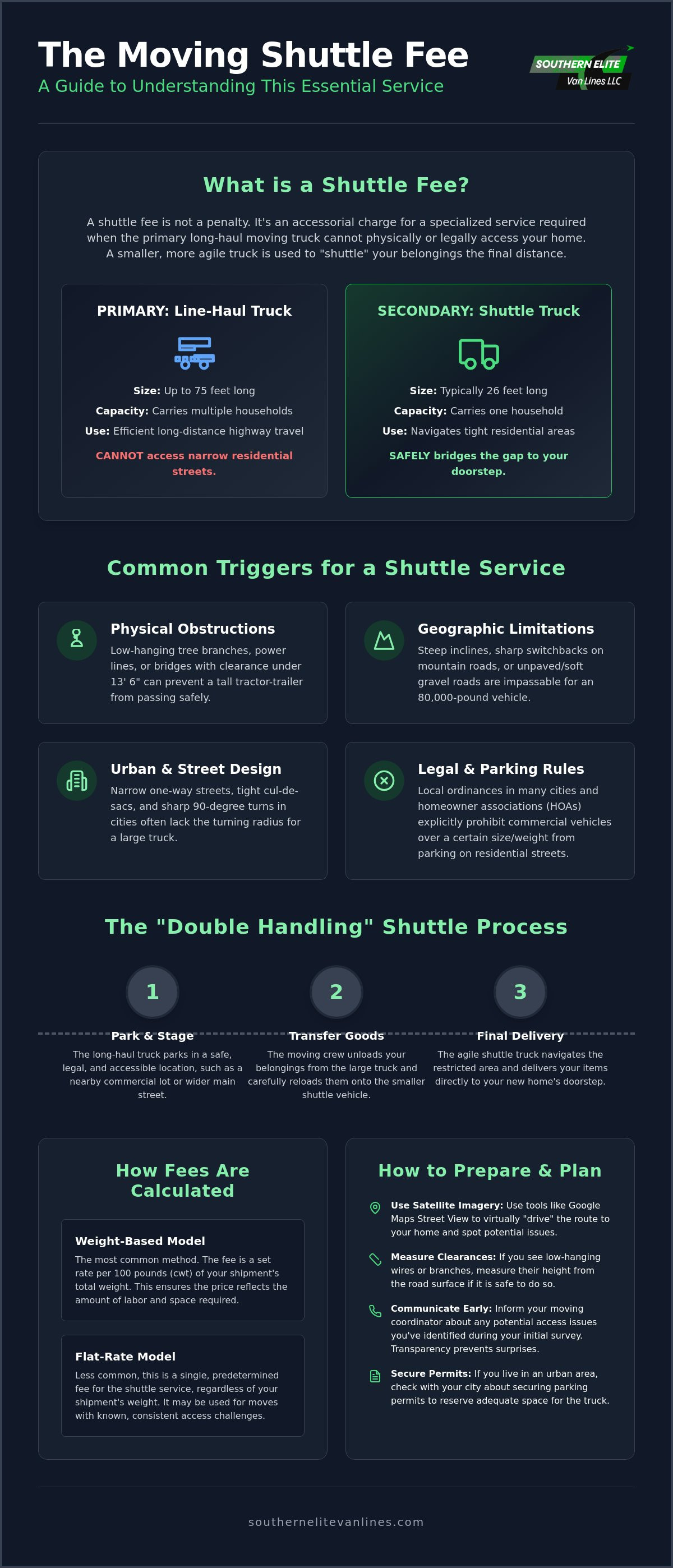
Visualizing the scale of the equipment helps clarify the necessity of the fee. A line-haul truck is a heavy-duty vehicle designed for highway stability and maximum cargo volume. In contrast, a shuttle vehicle is typically a 26-foot box truck, much like the ones used for local moving company services. Movers can't simply use these smaller trucks for the entire cross-country journey because it would require more fuel, more drivers, and significantly more time. The shuttle serves as a temporary transfer vessel, ensuring your furniture arrives safely even when the primary trailer is barred by physical constraints.
Is a Shuttle Fee Legitimate? Recognizing Industry Standards
While unexpected costs can cause stress, shuttle fees are a well-regulated aspect of the moving industry. The Federal Motor Carrier Safety Administration (FMCSA) recognizes these as legitimate charges for the additional labor and equipment required to complete a move. You'll find specific mentions of shuttle services in the "Your Rights and Responsibilities When You Move" booklet, which is a mandatory federal document provided to every interstate customer. A shuttle fee is a standard industry response to physical access limitations that prevent a standard tractor-trailer from reaching a residence. By identifying the need for this service early, you can ensure your contract is transparent and your moving day remains uninterrupted.
Common Triggers: Why Your Home Might Require a Shuttle
Many homeowners assume a wide driveway guarantees a smooth delivery, but the reality of interstate logistics involves much more than the space directly in front of your house. When exploring what is a shuttle fee in moving, you must look at the entire path from the main highway to your doorstep. Physical obstructions often serve as the primary trigger for this service. A standard interstate trailer stands 13 feet 6 inches tall; low-hanging tree branches or sagging power lines can cause thousands of dollars in damage to the vehicle or the utility infrastructure. If these obstacles exist, the driver must stop at a safe distance and transfer your goods to a smaller truck.
Geographic limitations also play a significant role. Steep inclines can cause the bottom of a long trailer to "high-center" or scrape, while tight switchbacks in mountainous areas are physically impossible for a 75-foot rig to navigate. Even rural unpaved roads present risks, as soft shoulders or loose gravel can lead to an 80,000-pound vehicle becoming stuck. If you're planning a residential moving project in a remote or hilly area, these factors are critical to discuss during your initial survey to avoid surprises on moving day.
Urban vs. Rural Shuttle Scenarios
City centers present a unique set of challenges that often necessitate a shuttle. Narrow one-way streets and small roundabouts often lack the turning radius required for large vans. In many metropolitan areas, local zoning ordinances or police regulations prohibit parking oversized vehicles on public streets, even if the truck physically fits. Conversely, rural "mountain retreats" often feature scenic drives that are the enemy of large moving vans. A single sharp curve or a narrow bridge can prevent access, necessitating a smaller, more agile shuttle truck to complete the delivery.
Infrastructure Barriers You Might Not Notice
Beyond what's visible at eye level, invisible barriers often dictate the need for a shuttle. Weight-restricted bridges on the only access path to your new home may have 5-ton or 10-ton limits, far below the weight of a loaded interstate trailer. Additionally, the Federal Motor Carrier Safety Administration (FMCSA) emphasizes that safety is the top priority for every carrier. Drivers must account for "tail swing," which is the significant arc a 53-foot trailer takes during a turn. If the road isn't wide enough to accommodate this swing without hitting parked cars, signs, or structures, a shuttle becomes the only safe and responsible option for your neighborhood.
The Logistics of the Transfer: Why the Fee Exists
The logistical reality of a shuttle is significantly more complex than a simple change of vehicles. To understand what is a shuttle fee in moving, you must first recognize the concept of "double handling." In a standard relocation, movers load your belongings onto the truck at the origin and unload them at the destination. A shuttle service disrupts this linear process by adding an entire middle stage. Every single box, crate, and piece of furniture is moved twice: once from the large tractor-trailer to the smaller shuttle truck, and again from the shuttle truck into your new home. This effectively doubles the physical labor involved in the delivery phase.
Beyond the labor, the fee covers several overhead costs that ensure your property remains protected. Securing a safe "transload" location is a critical first step. The driver must find a nearby parking lot, rest stop, or local warehouse that can accommodate both vehicles simultaneously without violating local ordinances. Additionally, the moving company must coordinate the rental of the smaller box truck, manage additional fuel costs, and maintain specific insurance coverage for that secondary vehicle. This requires precision timing to ensure the long-haul driver and the local shuttle crew arrive at the transload point at exactly the same time, preventing costly delays.
Step-by-Step: The Day of the Shuttle
A well-executed shuttle operation follows a methodical sequence to ensure nothing is lost or damaged during the transfer:
Step 1: The tractor-trailer parks at the nearest accessible safe harbor, often several miles from the residence.
Step 2: The shuttle truck arrives and is backed up directly to the trailer's tailgate to create a secure loading platform.
Step 3: Movers manually transfer the inventory item by item, meticulously checking off the "inventory tag" system to maintain a perfect chain of custody.
Step 4: The shuttle truck makes multiple trips if the total volume of the move exceeds the smaller vehicle's capacity.
Labor and Time Considerations
A shuttle isn't a quick detour; it's a major operational shift. This process typically adds 4 to 8 hours to a standard moving day, depending on the volume of goods and the distance between the transload site and your home. Managing this requires a larger crew to staff both the trailer and the shuttle truck at once, ensuring the transition remains efficient. Shuttle fees primarily cover the 100% increase in manual labor hours required for double handling and the specialized equipment needed to bridge the gap to your doorstep.
Understanding the Cost: How Shuttle Fees are Calculated
Determining the exact cost of a shuttle requires a look at specific industry formulas rather than a single fixed price. When homeowners ask what is a shuttle fee in moving, they're often surprised to learn that it's most frequently calculated by weight. For long-distance relocations, this is the industry standard. The charge is typically based on a rate per 100 pounds (cwt) of the inventory being transferred. This ensures that the cost remains proportional to the actual labor and time required to double-handle your specific volume of goods.
While weight-based pricing is common, some scenarios utilize flat-rate shuttle fees. These are often applied during local moves or in specific metropolitan areas where the logistics are more predictable. Regardless of the model, most companies implement a minimum charge. This "floor" price covers the baseline expense of renting the secondary vehicle, paying the driver's dispatch fee, and securing the transload site. Delays at the transload location, often called "wait time," can also impact the final bill if the shuttle crew and the long-haul trailer aren't perfectly synchronized.
Reading Your Estimate: Where the Shuttle Fee Hides
To find where these costs live, you must examine the "Accessorial Services" section of your estimate or Bill of Lading. This is where all services beyond basic transport are itemized. It's vital to distinguish between a "Binding" and "Non-Binding" estimate. In a binding agreement, the shuttle fee should be included upfront if the surveyor identified access issues. In a non-binding estimate, the fee might be added at the destination if the driver discovers the big rig cannot safely reach your new home. For a deeper look at how to interpret these line items, see our guide on Understanding Your Moving Quote: No Hidden Fees.
Variables That Impact the Total
Several external factors can cause the total cost to fluctuate during the operation:
Distance: The mileage between the transload site and your residence affects both fuel consumption and total labor hours.
Specialized Handling: Items like pianos or crated artwork require more time to transfer between trucks, increasing the labor portion of the fee.
Fuel Surcharges: The secondary vehicle incurs its own fuel expenses, which are often billed as a small percentage of the total shuttle cost.
If you're concerned about potential accessorial charges, we recommend a professional on-site survey to identify these needs early. Contact us today for a transparent estimate on our residential moving services.
How to Avoid or Prepare for a Shuttle Fee
While understanding what is a shuttle fee in moving provides much-needed clarity, the ultimate goal for most homeowners is to minimize these expenses through strategic planning. You don't have to wait for the moving truck to arrive to know if you have an access problem. Modern technology allows you to perform a digital walkthrough of your neighborhood using satellite imagery tools like Google Earth. By zooming in on the approach to your home, you can identify tight 90-degree turns, narrow roundabouts, or low tree canopies that might obstruct a 13.5-foot tall trailer. This proactive scouting allows you to discuss specific logistical hurdles with your mover well in advance.
In urban environments, securing a city-issued parking permit is often the most effective way to eliminate the need for a shuttle. Many municipalities allow residents to reserve several parking spaces directly in front of their home for a small administrative fee. This creates a dedicated "no parking" zone, providing the essential clearance a long-distance van needs to maneuver and park safely. At Southern Elite Van Lines, we prioritize these assessments during our initial visual surveys. Whether performed in person or virtually, these walkthroughs allow our experts to spot infrastructure barriers that a computer algorithm might miss, ensuring your quote remains accurate and your move stays on track.
A Homeowner's Access Checklist
Before your moving day arrives, take a walk through your neighborhood to verify the following physical constraints. These simple observations can save hours of labor and significant costs:
Vertical Clearance: Measure the height of any overhanging trees or structures on your street. A standard interstate trailer requires at least 14 feet of clear space to pass safely.
Signage and Limits: Look for "No Truck" signs or weight limit postings on the bridges and roads leading to your property.
Local Experience: Ask neighbors about their previous large-scale deliveries. If a standard FedEx or UPS freight truck struggled to reach their door, an 18-wheeler will likely require a shuttle.
Communicating with Your Mover
Transparency is your best tool for a stress-free relocation. Disclosing potential access issues early is always better than having the driver discover them on delivery day. Hiding these facts often leads to higher costs because the moving company must source a shuttle truck and additional labor at the last minute, often at premium rates. We recommend requesting a "shuttle contingency" in your initial quote if you suspect access might be tight. This ensures you're prepared for the possibility without being blindsided by a new line item. For more insights on managing complex relocations, explore our Long Distant Movers: The 2026 Guide. Meticulous planning and open communication turn a complex logistical challenge into a smooth, predictable journey.
Mastering Your Move with Clarity and Confidence
Moving to a new home should be a celebration of a fresh start, not a source of financial stress. Now that you understand what is a shuttle fee in moving, you can approach your relocation with the precision of a seasoned strategist. By recognizing physical triggers like narrow streets or weight-limited bridges and using satellite imagery for proactive scouting, you transform a potential surprise into a manageable part of your logistical plan. This knowledge ensures you aren't just paying a bill; you're investing in the safe, meticulous handling of your most valued possessions.
Our team specializes in expert long-distance planning for complex access routes, ensuring every detail is accounted for before the journey begins. We maintain a higher standard of care through detailed inventory tagging for every transfer and provide dedicated support throughout your nationwide relocation. Let us handle the complexities of the "last mile" so you can focus on your new beginning. Get a Transparent, No-Surprise Quote from Southern Elite Van Lines and experience a move defined by transparency and professional excellence. Your peace of mind is our highest priority.
Frequently Asked Questions
Is a shuttle fee different from a long-carry fee?
Yes, these are two distinct accessorial charges. A shuttle fee covers the cost of a secondary vehicle and the labor required for double-handling your items. In contrast, a long-carry fee applies when the distance between the parked moving truck and your front door exceeds a specific threshold, typically 75 feet. While both address access challenges, the shuttle fee is triggered by the truck's inability to reach your street, while a long-carry fee is triggered by the distance between the truck and the entrance.
Can I rent my own rental truck to avoid a shuttle fee from the movers?
Professional moving companies generally do not allow customers to provide their own secondary vehicles for shuttle services. This restriction exists due to strict insurance protocols and liability concerns regarding the chain of custody for your belongings. Movers must operate their own equipment or vetted rentals to ensure that valuation coverage remains intact throughout the transfer. Attempting to provide your own truck can lead to significant logistical delays and potential coverage gaps.
How do I know if the mover is lying about the truck not fitting?
You can verify a mover's claim by requesting a specific explanation of the obstruction, such as a weight-restricted bridge or a low-hanging utility wire. Most drivers prefer to avoid shuttles because they add hours of labor and complexity to their schedule. If you remain unsure, check your local municipal website for commercial vehicle restrictions or weight limits on your specific street. Professional movers will often provide photos of the obstacle to maintain transparency and trust.
Does insurance cover damage that happens during a shuttle transfer?
Yes, the valuation coverage you select for your move applies to the entire process, including the shuttle transfer. Whether you choose Basic Released Value or Full Value Protection, your belongings are protected while being moved between the tractor-trailer and the shuttle vehicle. This transfer is considered a standard part of the relocation journey. We maintain meticulous inventory records during these transfers to ensure every item is accounted for and protected.
Will my shuttle fee be higher if I have a piano or heavy safe?
Yes, specialized items often increase the total cost of a shuttle. Because many movers calculate what is a shuttle fee in moving based on the total weight of the goods being transferred, heavy items like safes naturally raise the price. Additionally, items like pianos require specialized equipment and extra crew members to manage the transfer between the two trucks safely. These requirements add to the total labor hours billed for the accessorial service.
What happens if the mover realizes a shuttle is needed only after arriving?
If an access issue is discovered at the destination, the mover will pause and provide a revised estimate for the shuttle service. For interstate moves, Federal Motor Carrier Safety Administration (FMCSA) regulations allow the mover to collect up to 110% of the original non-binding estimate at the time of delivery. Any remaining balance for the shuttle fee is then billed separately, typically within 30 days. This ensures the delivery can proceed while maintaining federal consumer protections.
Are shuttle fees taxable in most states?
Taxation on moving services varies significantly depending on the state where the service is performed. Some states tax all labor and transportation charges, while others only apply sales tax to physical products like packing boxes and tape. You should consult with your moving coordinator to see a detailed breakdown of state-specific taxes on your final Bill of Lading. This transparency helps you understand every dollar spent on your relocation.
Can a shuttle fee be waived if I move during the off-season?
It is very unlikely that a mover will waive a shuttle fee, even during the slower winter months. This charge reflects direct operational costs, including the rental of a secondary truck, additional fuel, and a 100% increase in manual labor hours for double-handling. While you may secure a lower base rate for your line-haul transportation during the off-season, accessorial charges are generally fixed because they cover the physical necessity of the transfer.


Comments