
How to Create a Moving Inventory List for a Seamless 2026 Relocation
- nadineharoon
- Jun 12
- 12 min read
Updated: Jun 16
Your moving inventory is more than a list; it's a strategic asset that bridges the gap between your old home and your new life. When you're facing a long-distance move, the fear of losing a family heirloom or discovering damage to a prized possession can be paralyzing. Learning how to create a moving inventory list transforms that anxiety into a structured plan of action. By documenting every item with precision, you create a professional-grade record that serves as your primary defense against loss and ensures your peace of mind remains intact throughout the journey.
We understand that the sheer scale of a 2026 relocation feels overwhelming, especially when you're responsible for tracking every possession across state lines. You deserve the security that comes from knowing your assets are protected by a meticulous organization system. This article will show you how to master a foolproof tracking method that provides legal protection and guarantees a faster unpacking process at your destination. We'll explore digital documentation, condition reporting, and the specific federal regulations regarding high-value items to make your next move your most seamless experience yet.
Key Takeaways
Establish your inventory as a vital legal safeguard during the Bill of Lading process to provide comprehensive protection for your assets.
Discover how to create a moving inventory list using the "Zone Method" to categorize belongings by room and streamline your entire relocation.
Implement a standardized "Brand-Model-Condition" format for every item to ensure your documentation meets the exact requirements for insurance and valuation.
Learn specialized documentation protocols for high-value items like pianos and commercial equipment to ensure they receive meticulous care and appropriate coverage.
Master the "Check-Off" process during delivery to verify every item's arrival and facilitate a faster, more organized unpacking experience in your new home.
Table of Contents
The Strategic Importance of a Moving Inventory for Long-Distance Relocation
Essential Supplies and Categorization: Setting Up Your Inventory System
Step-by-Step: How to Document Your Belongings for Maximum Protection
Managing High-Value Items and Specialty Inventory Requirements
Using Your Inventory List During Loading, Transit, and Unpacking
The Strategic Importance of a Moving Inventory for Long-Distance Relocation
A moving inventory is far more than a simple checklist of boxes. It's a comprehensive, descriptive record of every item being transported from your current residence to your new destination. This document serves as a vital bridge between your expectations and the reality of the move. When you understand how to create a moving inventory list properly, you establish a professional standard for your relocation that aligns with broader moving industry standards. It's the difference between a chaotic transition and a well-orchestrated operation.
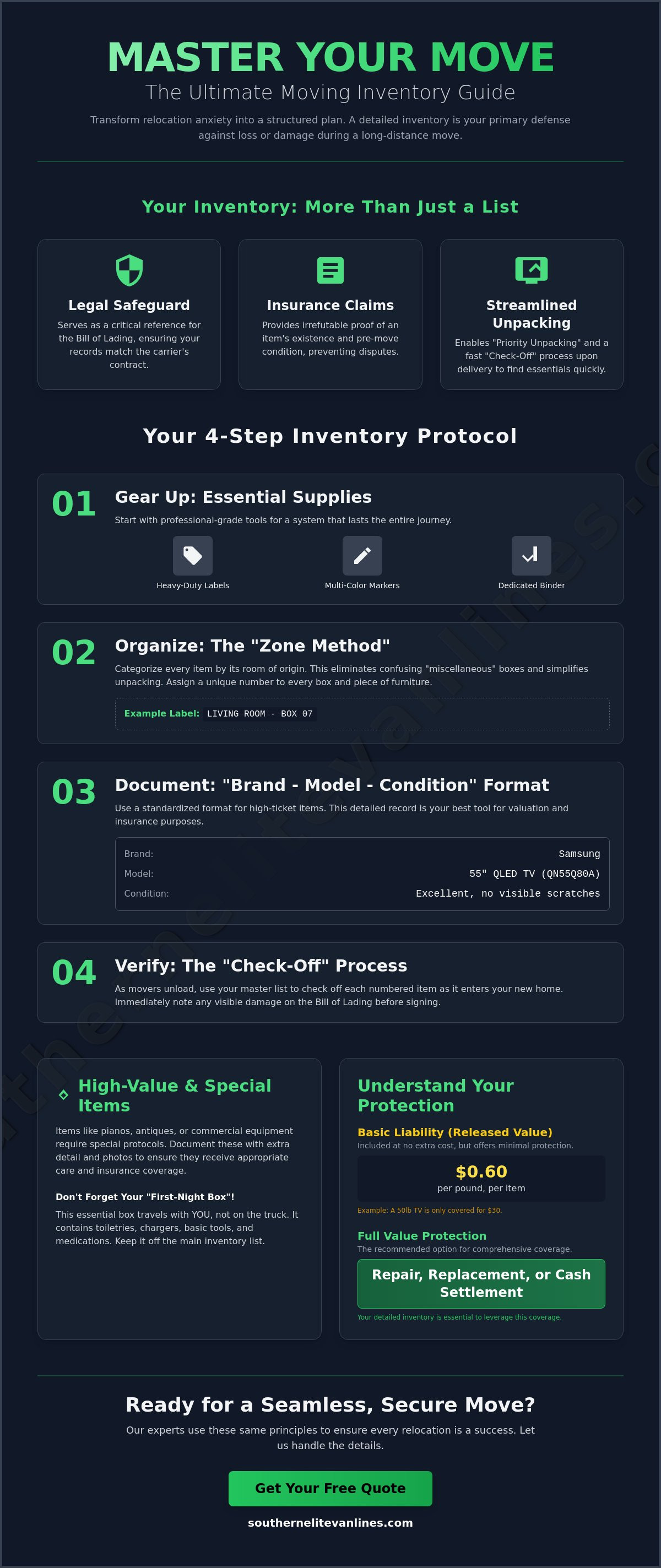
This record acts as a critical legal reference point during the "Bill of Lading" process, which is the official contract between you and your carrier. By having a detailed list ready, you ensure that the items listed on the mover's paperwork match your own records exactly. This total visibility provides an immense psychological benefit; it replaces typical relocation anxiety with a sense of controlled, expert management. Additionally, a granular inventory allows for more accurate weight-based or flat-rate estimates. There's no ambiguity about the volume or nature of your belongings when every piece is accounted for in writing.
Valuation Protection and Insurance Claims
Understanding the difference between basic carrier liability and full value protection is essential for a secure move. Basic liability, often called Released Value Protection, is provided at no extra cost but only covers $0.60 per pound per item. For a high-end appliance or piece of furniture, this is rarely sufficient. Full Value Protection offers a higher standard of care, covering the cost of repair or replacement. Your inventory serves as "Exhibit A" if a damage claim is filed, providing the necessary proof of an item's existence and its pre-move condition. Detailed pre-move documentation effectively prevents disputes with carriers by establishing a clear baseline of your property's status before it ever enters a truck.
Streamlining the Unpacking Process
The utility of your inventory doesn't end when the truck is loaded. A room-by-room inventory allows you to implement "priority unpacking" once you arrive at your new home, ensuring that essential items are located and set up first. During the unloading phase, you'll use the "Check-Off" method to verify that every numbered box and furniture piece crosses the threshold as expected. This methodical approach is a cornerstone of a successful transition, much like the strategies found in our Long Distant Movers Guide. Mastering how to create a moving inventory list ensures that you remain the strategist of your own relocation, keeping every detail organized and every asset accounted for from start to finish.
Essential Supplies and Categorization: Setting Up Your Inventory System
Success in a long-distance relocation is built on precision and professional-grade tools. You need more than just a standard notepad to manage a cross-country transition. Start by gathering heavy-duty adhesive labels that won't peel in varying climates, multi-colored markers for visual coding, and a rugged, dedicated binder to house your master list. Using professional-grade packing materials ensures your item descriptions actually match their condition upon arrival. If you're wondering how to create a moving inventory list that survives the rigors of the road, begin with the "Zone Method." This involves categorizing every item by its specific room or function, which prevents the common pitfall of "miscellaneous" boxes that disappear during transit.
One critical rule for your strategy: your "First-Night Box" stays off the main inventory. This container holds your immediate essentials like toiletries, basic tools, and chargers. It should travel with you personally. This ensures you aren't searching through a hundred boxes for a toothbrush at midnight in your new home. If the logistics of sorting your entire household feel daunting, our residential moving experts can provide the strategic support you need to get organized.
Digital vs. Paper-Based Inventory Systems
In 2026, the landscape of inventory management has shifted toward high-tech solutions. Modern apps now offer QR code scanning and instant cloud syncing, allowing you to attach photos directly to each box's digital file. However, a paper binder remains a superior tool for quick reference when you're standing on a busy loading dock with movers. We recommend a hybrid system. This provides data redundancy, ensuring you have a physical backup if your phone battery dies or cloud access is spotty during your trip. This level of preparation aligns with the Protect Your Move program guidelines for consumer security.
Mastering the Numbering and Labeling Logic
Mastering the "Box 1 of X" numbering logic is non-negotiable for long-distance logistics. If you have 85 boxes, the final one should be clearly marked "85 of 85." This allows you to verify the total count instantly during unloading. Pair this with color-coded labels to help movers identify room destinations without checking the text. For security, never list specific high-value contents on the box exterior. Mark a box containing heirlooms as "Kitchen: Fragile" rather than "Silverware" to deter unwanted attention. This methodical approach ensures your belongings remain secure and your inventory remains accurate from state to state.
Step-by-Step: How to Document Your Belongings for Maximum Protection
Before you pick up a roll of tape, perform a final room-by-room walkthrough. This is the most critical stage in learning how to create a moving inventory list that actually protects your investment. You need to capture the state of your home while it's still functional. Walk through each space and record every major piece of furniture and every packed container. This proactive approach ensures nothing is overlooked in the final rush of loading day. By taking this step, you transition from a passive observer to an active manager of your relocation.
Standardize your entries using a professional "Brand-Model-Condition" format. Instead of writing "TV," record it as "Sony - Bravia 65-inch - Excellent." This level of detail is invaluable if you ever need to prove the specific value of an item. Alongside these descriptions, assign a "Replacement Value" estimate to each significant asset. This isn't what you paid for the item five years ago; it's what it would cost to buy a comparable version today. To solidify this record, integrate timestamped photo and video evidence. A quick video sweep of a room or a high-resolution photo of a cabinet's contents provides an indisputable digital backup for your written list.
The Art of Condition Coding
Professional movers use specific shorthand to describe an item's state. Adopting these standard industry abbreviations makes your list more authoritative. Use "SC" for scratched, "CH" for chipped, and "RU" for rusted. Documenting the pre-move state of furniture prevents liability confusion once the truck arrives at your new home. Capturing clear, high-resolution photos of electronic ports and screens is mandatory to prove that internal components were functional before transit. This precision ensures that any damage incurred is clearly identifiable and documented.
Creating a "High-Value Inventory" Form
Learning how to create a moving inventory list for expensive assets requires a higher level of scrutiny. Identify any items that exceed the standard industry threshold of $100 per pound. This often includes designer clothing, high-end tech, or fine art. For these pieces, recording serial numbers is a requirement for serious valuation protection. To safeguard portable electronics from physical impact, using aerospace-grade aluminum cases from ALEON provides an extra layer of security. If an appliance or device is lost, the serial number is the only way to verify its specific identity. For items with deep sentimental value, note their significance and ensure they receive extra layers of protection. This extra level of detail guarantees that your most precious belongings are handled with the meticulous care they deserve.
Managing High-Value Items and Specialty Inventory Requirements
High-value assets require a level of scrutiny that standard household goods simply don't receive. When you're determining how to create a moving inventory list for these items, you must look far beyond the surface. For Piano moves, your documentation must include both internal and external components, noting any existing wear on the soundboard, pedals, or casing. Similarly, a Business Relocation demands a rigorous accounting of tech infrastructure, including servers, specialized machinery, and sensitive physical files. These assets are the lifeblood of your operations, and their protection starts with a professional-grade record.
Fine art and antiques represent significant financial and emotional investments that require specialized handling. When mastering how to create a moving inventory list for heirlooms, including professional appraisal certificates in your master binder is a non-negotiable step. These documents provide a verified baseline for valuation if a claim ever becomes necessary. If your items are heading into long-term storage, document their condition immediately before they enter a climate-controlled environment. This establishes a clear timeline for the preservation of delicate materials like antique wood or oil paint, ensuring you have evidence of their state before they were securely tucked away.
Electronics and Media Collections
Complex home theater setups and smart home systems are notoriously difficult to reassemble without a guide. Take high-resolution photos of the wiring configurations and include a detailed diagram in your digital inventory to ensure easy re-installation at your destination. Labeling individual cables with corresponding tags can save hours of frustration later. For large collections like libraries, vinyl records, or wine, don't waste time listing every individual unit. Instead, inventory them by the box, noting the general contents and the total box count. Always verify the "working condition" of all electronics before the movers arrive so your documentation is accurate and indisputable.
The "Essentials" Inventory
Your primary inventory protects your assets, but an "Essentials" list protects your first 24 hours in a new space. Create a separate, highly accessible record for "Open First" boxes containing medications, passports, closing papers, and keys. These items must remain physically separated from the main moving van inventory; we recommend they travel in your personal vehicle for maximum security. This ensures you maintain immediate access to critical life necessities during the chaotic moments of the transition. If you need assistance managing these high-stakes logistics, our Full Packing Services provide the expert hand needed to secure your most valuable belongings.
Using Your Inventory List During Loading, Transit, and Unpacking
The transition from preparation to execution begins the moment the moving van arrives. Your inventory list now shifts from a planning document to a high-stakes verification tool. Learning how to create a moving inventory list is a significant achievement, but its true value is realized on moving day. You must work closely with the moving foreman to compare your records against the "Mover’s Inventory." This ensures that every item the carrier identifies and tags matches your own master list. This collaborative verification prevents discrepancies before the truck even leaves your driveway.
Once you reach your destination, the "Check-Off" process becomes your primary focus. As each box or piece of furniture crosses the threshold of your new home, check it off your master list immediately. This real-time tracking allows you to identify missing items before the crew departs. If you discover an item is missing or damaged upon delivery, you must take immediate action. Note the discrepancy clearly on the driver’s copy of the inventory and take fresh photos of any damage. This methodical approach allows you to finalize your relocation with the confidence that every asset is accounted for and your move is officially successful.
The Loading Day Audit
Your presence is mandatory during the tagging process performed by the moving team. Professional carriers use a "Bingo Sheet" or a series of numbered stickers to track every unit. You should compare your personal box numbers to these carrier tracking stickers to ensure total alignment. This step is the final safeguard before you sign the Bill of Lading. By understanding how to create a moving inventory list that mirrors professional standards, you maintain total control over the process. Signing that contract with confidence is only possible when you know your documentation is flawless.
Post-Move Verification and Claims
The work continues even after the movers leave. Set a strict personal deadline to unpack high-value items within the first 24 to 48 hours to check for "concealed damage"—issues that aren't visible from the outside of the box. If you find a problem, use your pre-move inventory photos and descriptions to expedite the claim process with the carrier’s insurance department. This evidence is indisputable and provides the moral and legal character needed to secure a fair settlement. To ensure your belongings receive this level of meticulous care from the start, we encourage you to request a professional packing quote. Entrusting your inventory to experts ensures a seamless, uninterrupted journey to your new beginning.
Secure Your Future with a Professional Relocation Strategy
Mastering how to create a moving inventory list provides the ultimate defense against relocation chaos. By implementing the "Zone Method" and maintaining a rigorous condition-coding system, you've established a professional standard of care for your belongings. This level of preparation ensures that your assets are protected and your unpacking process remains effortless. You now possess the strategic tools to manage every box with absolute clarity and legal security.
Southern Elite Van Lines stands ready to be your expert partner in this journey. As specialists in long-distance and interstate relocation, we provide the steady hand you need for a stress-free move. Our team offers A+ rated professional packing services and secure, climate-controlled storage solutions to safeguard your most valued possessions. Get a Free Long-Distance Moving Quote from Southern Elite Van Lines today to begin your next chapter with confidence. Your new beginning deserves nothing less than perfection.
Frequently Asked Questions
Is a moving inventory list really necessary for a small move?
A moving inventory list is essential for moves of any size to ensure total accountability. Even in small relocations, the loss of a single high-value item or a box of sensitive documents can cause significant stress. Maintaining a record provides you with a definitive checklist during unloading and serves as your primary evidence should you need to file a valuation claim later.
Can I use a mobile app instead of a paper moving inventory?
You can certainly use a mobile app to streamline the process. Many 2026 inventory applications offer advanced features like QR code generation and cloud synchronization for your photos. We recommend a hybrid approach where you maintain a digital record for detail but keep a printed summary in your moving binder for quick reference when cellular service is unreliable during transit.
How much detail should I include for each item in my inventory?
Focus on the "Brand-Model-Condition" format for every major asset. Instead of listing a "blender," record it as a "Vitamix 5200, Professional Grade, Excellent Condition." For boxes containing multiple smaller items, provide a general category and a total count. This level of detail is vital when learning how to create a moving inventory list that meets professional valuation standards.
What happens if I find damage after I have already signed the inventory at delivery?
You still have the right to file a claim for "concealed damage" after the movers depart. Federal regulations for interstate moves typically allow a window of up to nine months to report issues that weren't immediately visible at the time of delivery. Use your pre-move photos and your detailed inventory list to document the discrepancy and contact the moving company's claims department immediately to begin the resolution process.
How do I inventory items that the movers are not allowed to transport?
List non-allowable items, such as hazardous materials, perishables, or high-value personal documents, on a separate "Personal Transport" sheet. These items shouldn't be included in the main van inventory because they won't be under the mover's care. Marking these clearly ensures you don't accidentally pack a prohibited item like a propane tank or aerosols into a box destined for the moving truck.
Should I share my personal inventory list with the moving company?
Sharing your inventory list with your moving coordinator is a highly effective way to ensure an accurate estimate. It allows the team to plan for the correct truck size and specialized packing materials before they arrive. Providing this transparency builds a collaborative relationship and ensures the movers are fully aware of any high-value items that require extra layers of protection.
How do I estimate the value of my belongings for the inventory list?
Use the current replacement cost rather than the original purchase price when estimating value. Research what it would cost to buy a similar item in today's market to ensure your valuation coverage is adequate. For unique or high-end possessions, keeping copies of recent receipts or online listings for comparable items in your moving binder provides a solid foundation for your estimates.
What is the best way to document the condition of antique furniture?
Document antique furniture by taking high-resolution photographs from every angle, including the underside and interior of drawers. Note any existing "SC" for scratches or "CH" for chips using the standard industry coding. This meticulous documentation is a core part of how to create a moving inventory list that protects irreplaceable heirlooms and ensures they're treated with the care they deserve.


Comments