
Can Movers Transport Alcohol? Your 2026 Guide to Moving Your Collection
Updated: Jul 17
A single broken bottle of vintage Cabernet can do more than ruin a dinner; it can saturate your heirloom upholstery and create a permanent, costly mess. You've spent years curating a collection that reflects your taste and history—perhaps even sourcing rare bottles during bespoke global journeys with Simply Elite Travel & Tours—so it's natural to feel protective of every cork and label. When planning a relocation, the most pressing question is often: can movers transport alcohol safely and legally? This isn't just about logistics. It involves a complex intersection of federal safety mandates and a shifting patchwork of state-specific liquor laws that vary significantly from California to Virginia.
We understand that your peace of mind is just as valuable as the contents of your cellar. Moving a high-end collection requires a level of exactness that goes beyond standard packing. This guide provides the professional clarity you need to manage your spirits with absolute confidence. You'll discover the specific legal requirements for 2026, the safety protocols that prevent leaks, and the meticulous strategies professionals use to ensure your rare finds arrive at your new home in pristine condition.
Table of Contents
Can Movers Transport Alcohol? The Essential Legal and Safety Guidelines
Flammability and Proof: Why Some Spirits Face Transportation Restrictions
Interstate Relocation Challenges: Navigating Alcohol Laws Across State Lines
How to Pack Alcohol for a Long-Distance Move: A Professional Checklist
Ensuring a Seamless Transition with Southern Elite Van Lines
Can Movers Transport Alcohol? The Essential Legal and Safety Guidelines
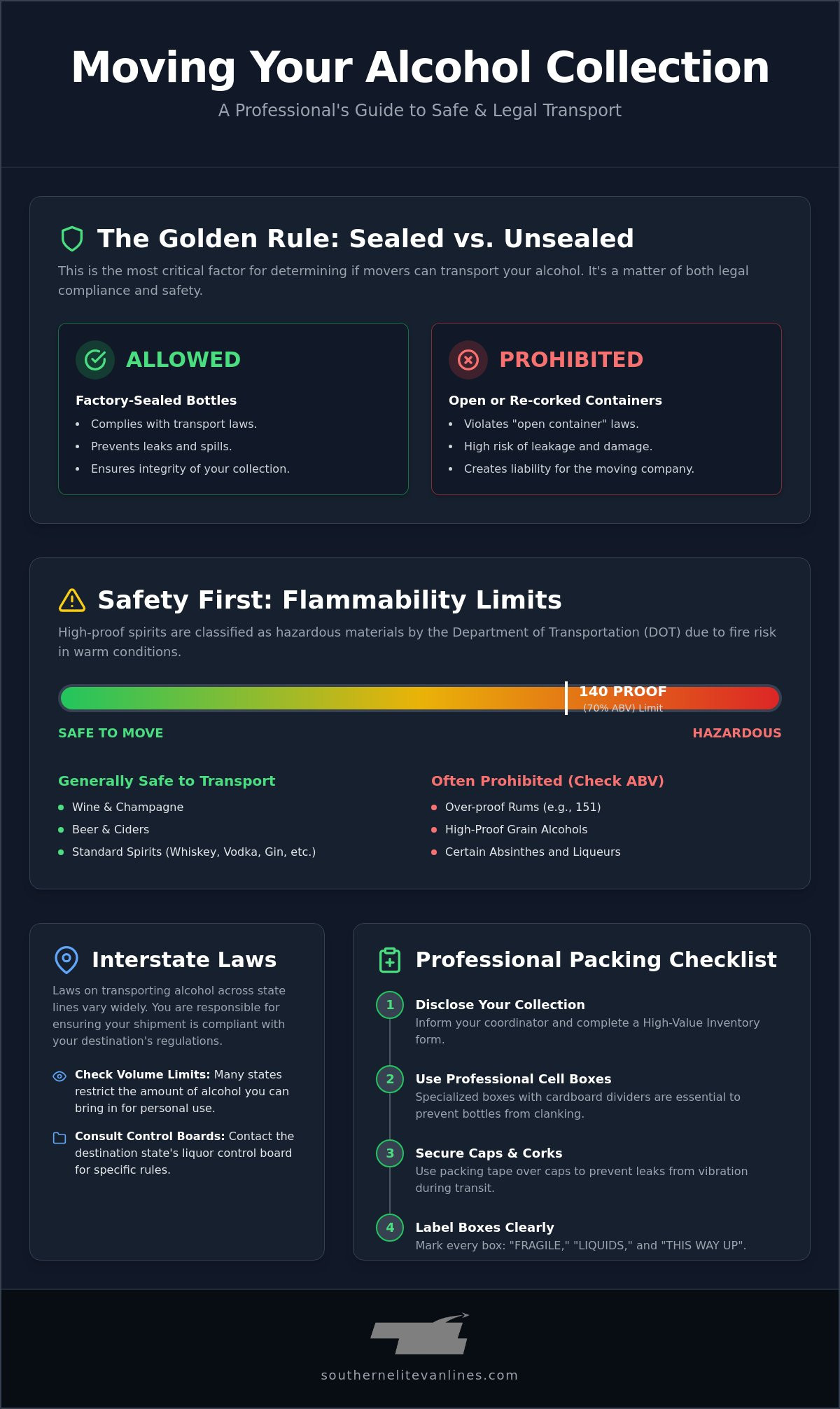
The short answer is yes, but this permission comes with specific, non-negotiable conditions. Most full-service moving companies will gladly include your wine cellar or spirits collection in their manifest, provided the items are sealed and fall within safe flammability limits. This isn't just a company policy; it's a matter of regulatory compliance. Professional movers distinguish between standard household goods and hazardous materials. While a bottle of vintage Merlot is considered a household possession, a high-proof grain alcohol might be classified as a flammable liquid under certain transportation safety standards.
Transparency is the foundation of a successful relocation. You should disclose the full extent of your collection during the initial inventory process. This allows your moving team to prepare the necessary specialized packing materials and ensure the trailer environment is suitable for your bottles. Failing to mention a large collection can lead to significant delays on moving day if the crew isn't equipped with the proper dividers or climate-control considerations. By being upfront, you allow your moving coordinator to act as a skilled strategist for your inventory's safety.
Sealed vs. Unsealed: The Non-Negotiable Line
The distinction between a sealed bottle and an open one is the most critical factor in determining if your can movers transport alcohol request is approved. Professional drivers cannot legally transport "open containers" of alcohol in the cargo area of a commercial vehicle. This restriction is rooted in the complex alcohol laws of the United States, which vary by jurisdiction but generally prohibit unsealed liquor in transit to prevent liability. Beyond the legal risks, unsealed bottles are prone to leakage. A single loose cap can result in a spill that saturates packing boxes, ruins heirloom furniture, and creates a persistent odor that is nearly impossible to remove from upholstery.
Disclosing Your Collection to Your Moving Coordinator
Early communication ensures that your long distant movers have the resources required to protect your investment. For rare vintages or high-value spirits, you'll likely need to complete a High-Value Inventory form. This document provides a clear record of your collection's worth and ensures that the level of care matches the value of the items. It also clarifies the limits of liability, giving you a sense of security before the first box is even taped. Your coordinator will use this information to determine if specialized crates or climate-controlled transport are necessary for your specific journey, ensuring an effortless and uninterrupted experience from your old cellar to your new home.
Flammability and Proof: Why Some Spirits Face Transportation Restrictions
Safety is the primary driver behind most transit restrictions. While wine and standard beer are generally stable, high-proof spirits present a genuine chemical risk in a transit environment. The Department of Transportation (DOT) classifies liquids with a low flash point as hazardous materials. This classification directly dictates whether can movers transport alcohol for your specific collection. If a spirit has a high enough alcohol by volume (ABV), it effectively becomes a flammable liquid that requires specialized handling beyond the scope of traditional residential moving.
Heat is the catalyst for these risks. During a long-distance relocation, the interior of a moving trailer can easily exceed 140 degrees Fahrenheit. At these temperatures, high-ABV liquids expand rapidly. This expansion puts immense pressure on corks and caps, leading to leaks or, in extreme cases, combustion. Most professional carriers cap the proof level at 140 (70% ABV) to maintain a safe environment for your entire shipment. This meticulous approach to safety ensures that your other household goods remain protected from chemical damage or fire hazards, drawing on the same principles of pressure control and reliability utilized by industrial specialists like OG VALVES LTD..
Identifying High-Risk Spirits in Your Bar
You should identify over-proof rums, certain absinthes, and grain alcohols before your packers arrive. These items often fall into the prohibited category due to their volatility. The chemical reality of alcohol expansion in non-climate-controlled trailers is a serious consideration for any long-distance haul. If you are unsure about a specific bottle, our team at Southern Elite Van Lines can provide expert guidance during your initial consultation to help you categorize your inventory with exactness.
Alternative Solutions for Prohibited Items
When items are prohibited, you have several dependable options. You may choose to transport these specific bottles in your personal vehicle, where climate control is more consistent. For massive collections of rare, high-proof spirits, specialized hazardous material couriers offer a dedicated, though often more expensive, solution. Alternatively, many collectors choose a consumable disposal strategy. This involves hosting a farewell gathering to enjoy open or high-proof bottles with friends. Gifting unmovable spirits to neighbors is another responsible way to clear your bar while ensuring your move remains a shared journey toward your new beginning.
Interstate Relocation Challenges: Navigating Alcohol Laws Across State Lines
Crossing state lines adds a layer of complexity to the logistical question: can movers transport alcohol? The United States operates under a Three-Tier System for alcohol distribution, which creates a patchwork of regulations that change the moment you cross a border. While the Federal Alcohol Administration Act generally exempts personal collections from the strict permits required for commercial importers, individual state liquor control boards have the final authority. We prioritize staying compliant with these nationwide commerce regulations to ensure your shipment isn't delayed by legal technicalities at a weigh station or state line.
Volume limits are the most common hurdle for private collectors. Many states have specific thresholds for how much alcohol an individual can bring in tax-free. For instance, California allows you to transport up to 60 liters for personal or household use. Colorado is more precise; they permit 9 liters of wine and 6 liters of spirits. Virginia offers more flexibility, allowing a "reasonable quantity" as part of your household effects. Staying within these limits helps prove your collection is for personal enjoyment rather than an "intent to sell," which carries much stricter legal consequences. Our team acts as your steady, expert hand, helping you verify these limits before the truck is loaded.
Wine Collections and Temperature Sensitivity
Fine wine is a delicate, living product that doesn't respond well to the rigors of a 1,000-mile journey. Standard moving trailers aren't climate-controlled and can reach internal temperatures that cause "thermal shock." This heat can cook the wine, push the cork out, or ruin the flavor profile of a rare vintage. Strategic timing is your best defense against these risks. We often suggest planning your move during the milder temperatures of spring or autumn. If you must move during a summer heatwave, your most valuable bottles might require specialized climate-controlled transit rather than a standard dry van to ensure they arrive in peak condition.
Inventory Documentation for Cross-State Transit
A detailed manifest is essential for a seamless transition. You should create a list that includes the quantity, type, and approximate value of every bottle in your collection. This documentation is vital if your shipment is ever inspected by state authorities. For business owners or those managing larger inventories, our commercial relocation services offer the advanced logistical support needed for high-volume transfers. Professional-grade wine cell boxes, which cost approximately $12 each as of June 2026, provide the structural integrity needed for inspection and safety. These specialized containers ensure your bottles are organized, secure, and ready for the journey ahead.
How to Pack Alcohol for a Long-Distance Move: A Professional Checklist
Once you've confirmed that your collection meets the criteria for can movers transport alcohol, the focus shifts to physical protection. Standard grocery store boxes aren't designed for the weight or fragility of glass bottles; they lack the structural integrity to withstand the stacking pressures of a long-haul trailer. To ensure your collection survives the journey, you must adopt a methodical, industrial-grade approach to packing. This process transforms your bottles from vulnerable glass into a secure, unitized cargo shipment.
Step 1: Procure professional-grade materials. Invest in double-walled 'Dish Pack' or specialized 'Wine Cell' boxes. These containers feature reinforced sides that prevent crushing when other boxes are stacked on top.
Step 2: Secure every closure. Use parafilm or electrical tape to wrap around the cork or cap of every bottle. This prevents the vibration of the road from loosening seals and protects against minor leaks caused by pressure changes.
Step 3: Install corrugated cell dividers. These inserts are essential. They eliminate bottle-to-bottle contact, which is the primary cause of breakage during transit.
Step 4: Create a cushion zone. Place at least 3 inches of crumpled packing paper at the bottom of the box before inserting bottles, and add another 3 inches on top before sealing. This creates a shock-absorption buffer.
Step 5: Execute precise labeling. Mark every carton as 'Fragile - Glass' and 'This Side Up' on all four sides. Clearly list the contents so your crew knows exactly how to prioritize these boxes in the load.
The Anatomy of a Properly Packed Bottle
Individual bottle preparation is your first line of defense. Wrap each bottle in clean newsprint or acid-free paper to protect the labels from scuffing. While many DIY movers rely on bubble wrap, professionals view it as a secondary defense. The real security comes from the box's structural integrity and the tightness of the fit. After the box is taped, perform a gentle 'shake test.' If you feel or hear any movement inside, you need more padding. A perfectly packed box feels like a solid, immovable block.
Professional Packing Services vs. DIY
The decision to utilize our Full Packing Services often comes down to liability and precision. When our experts pack your collection, we assume the responsibility for its safe arrival, providing a level of security that DIY efforts can't match. We offer custom crating for oversized magnums or exceptionally rare vintages that don't fit standard dividers. This meticulous care ensures your collection remains an investment rather than a liability, allowing you to focus on the excitement of your new home while we handle the technical complexities of the task.
Ensuring a Seamless Transition with Southern Elite Van Lines
Relocating a curated collection is about more than just moving boxes; it's about preserving a legacy of taste and investment. We treat your high-value household goods with the same meticulous care you've used to curate them over the years. When you're finalizing the details of your relocation, the question of can movers transport alcohol becomes a matter of choosing a partner that values your peace of mind as much as the physical safety of the shipment. Our team approaches every inventory with a commitment to moral character and exactness, ensuring your rare vintages and spirits are handled with the respect they deserve.
We pride ourselves on providing a sophisticated balance between high-end service expectations and down-to-earth reliability. Our communication is transparent, proactive, and designed to eliminate the inherent stress of a long-distance move. By positioning ourselves as the steady, expert hand in your relocation journey, we turn a complex operation into an effortless, uninterrupted experience. We don't just move items; we manage a shared journey toward your new beginning, answering the technical question of can movers transport alcohol with a resounding "yes" through professional action and rigorous safety standards.
The Southern Elite Process for Specialty Items
Our personalized moving coordinators act as your skilled strategist, guiding you through every inventory restriction and legal requirement. They ensure that your collection is documented with perfection, preventing delays and providing clarity before the truck even arrives. We utilize modern vehicles specifically designed for the efficient and safe transportation of household goods, maintaining the integrity of your shipment across every mile. To see how we apply these rigorous safety standards to complex projects, read our Southern Elite Van Lines case study to see our standards in action.
Request Your Comprehensive Moving Quote
Financial transparency is a hallmark of our premium service. We provide weight-based or flat-rate interstate moving fees that are clear, logical, and devoid of hidden costs. This methodical approach to pricing builds immediate trust and allows you to plan your relocation with absolute confidence. Securing your peace of mind is our highest priority, from the moment you make your initial inquiry to the final delivery at your new residence. Contact our expert team today to discuss your specific relocation requirements and discover how we can provide the personalized assistance you need for a flawless transition.
Secure Your Collection for the Journey Ahead
Moving a refined collection requires more than just heavy lifting; it demands a strategic understanding of safety and law. Your collection deserves precision. You now know that the answer to can movers transport alcohol depends on maintaining sealed inventory and respecting proof limits. By utilizing professional-grade materials like double-walled wine cell boxes and securing every seal with protective tape, you mitigate the risks of leaks and breakage during a cross-country haul.
Southern Elite Van Lines provides the steady, expert hand needed for such a delicate task. We offer specialized high-value item handling and full-service packing with premium materials to ensure your investment arrives in pristine condition. If your timeline requires a delay, our climate-controlled storage solutions provide a secure environment for your most sensitive vintages. Request a Professional Long-Distance Moving Quote from Southern Elite Van Lines today. We look forward to making your next chapter an effortless and rewarding experience.
Frequently Asked Questions
Can movers transport open bottles of alcohol?
No, professional moving companies cannot transport open or unsealed bottles of alcohol. This restriction is primarily due to state "open container" laws that prohibit unsealed liquor in a vehicle's cargo area, creating a legal liability for the driver. Beyond the legal risks, open bottles present a high risk of leakage that can saturate packing boxes and cause permanent damage to your furniture and upholstery.
Is there a limit to how much wine I can move across state lines?
Yes, individual states set specific volume limits for personal alcohol importation. For example, California permits up to 60 liters for personal use, while Colorado limits wine to 9 liters and spirits to 6 liters. Researching the laws of your destination state ensures your relocation remains compliant and avoids the appearance of "intent to sell," which carries much stricter regulatory consequences.
Will movers pack my wine and spirits for me?
Yes, our team can pack your collection if you opt for our Full Packing Services. We utilize professional-grade, double-walled boxes and specialized cell dividers to ensure each bottle is isolated and secure. This service provides the meticulous care required to answer the question of can movers transport alcohol with total confidence in the physical safety of your inventory.
What happens if a bottle of alcohol leaks in the moving truck?
A leak can cause extensive damage to surrounding furniture, upholstery, and heirloom items. Because liquids are often excluded from standard liability coverage, the owner usually bears the financial responsibility for damage to other items in the shipment. This is why we emphasize the use of professional-grade tape and specialized packing materials to create a secure, shock-absorbent seal for every bottle.
Do I need special insurance for a valuable wine collection?
Yes, high-value collections typically require specialized insurance or a "High-Value Inventory" declaration. Standard valuation coverage may not fully account for the market value of rare vintages or provide protection against spoilage caused by temperature fluctuations. We recommend discussing your collection's specific value with your moving coordinator to ensure a customized protection plan is in place before transit begins.
Are there certain types of alcohol that are completely prohibited?
Spirits exceeding 140 proof, such as certain grain alcohols or high-proof rums, are generally prohibited due to their classification as flammable hazardous materials. Most carriers will not can movers transport alcohol that presents a combustion risk in non-climate-controlled trailers where temperatures can exceed 140 degrees. Open containers and home-brewed beverages with inconsistent seals are also frequently restricted.
Can I put alcohol in a moving container or storage unit?
Most storage facilities and moving container companies prohibit the storage of alcohol due to flammability and temperature sensitivity. Extreme heat in a non-climate-controlled container can cause corks to fail or spirits to expand, creating a potential safety hazard. If your relocation requires a delay, our climate-controlled long-term storage is the only dependable way to preserve your collection's chemical integrity and value.


Comments