
How Are Long Distance Moves Calculated? A 2026 Guide to Moving Costs
- nadineharoon
- Jun 15
- 13 min read
Updated: 3 days ago
Your local mover's hourly rate is a useless metric when you are crossing state lines. While a cross-town relocation depends on the clock, interstate moving is a precise science of weight, logistics, and liability. It's completely natural to feel a sense of dread when reviewing a quote, especially with the fear of hidden fees appearing on delivery day or confusion over how weight estimates actually work. You want to know that your high-value items are safe and that your budget won't vanish into unexpected surcharges.
We believe that clarity is the foundation of a stress-free transition. Understanding exactly how are long distance moves calculated is the only way to transform that moving day anxiety into a strategic, well-managed plan. As diesel prices continue to fluctuate in 2026, knowing the math behind fuel surcharges and federal regulations is essential for any savvy homeowner. This guide unlocks the professional formulas used for interstate quotes, promising you a predictable final bill and the confidence that comes from a transparent partnership. We will walk you through weight-based pricing, the impact of current fuel trends, and the legal ways you can lower your total cost for a seamless relocation journey.
Table of Contents
The Core Distinction: Why Long Distance Moves Aren't Billed Hourly
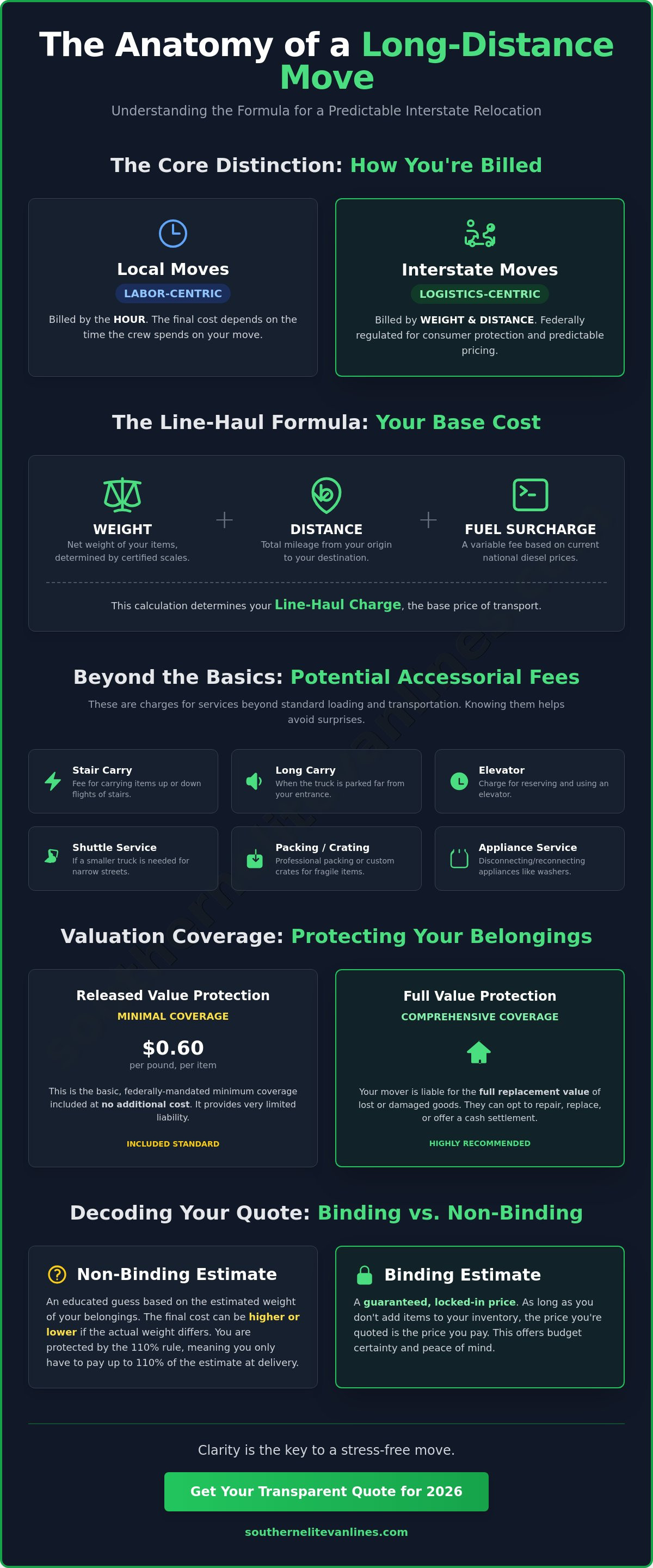
Most people are accustomed to local movers who charge by the hour. You pay for the time the crew spends loading, driving, and unloading. However, as soon as your shipment crosses a state line, the entire financial structure shifts. Understanding how are long distance moves calculated requires moving away from the clock and toward the scale. Interstate relocations are logistics-centric rather than labor-centric. This means your primary cost isn't determined by how fast the crew works, but by the physical weight of your belongings and the distance they travel. This base price is known as the line-haul charge. It represents the fundamental cost of transporting goods across the country, covering the specialized equipment and professional coordination required for such a journey.
Federal law actually prohibits hourly billing for most interstate moves. This regulation exists to protect you. If movers charged by the hour for a trip from New York to Florida, a single traffic jam or a slow-walking crew could inflate your bill by thousands of dollars. When you ask how are long distance moves calculated, you're really asking about a transition from labor-based fees to a structured logistics model. By using weight and distance, the price remains tied to objective data rather than variable labor speeds, ensuring your budget stays intact despite the complexities of the road.
Local vs. Interstate: A Regulatory Divide
The Department of Transportation (DOT) and the Federal Motor Carrier Safety Administration (FMCSA) oversee the interstate moving industry. These agencies require any professional moving company to provide a published tariff. This document is a comprehensive list of every possible charge, from the cost per pound to the price of a fuel surcharge. Your final bill must align with this tariff and the details outlined in your Bill of Lading. This document acts as your contract and receipt, ensuring the calculation remains transparent and legally binding throughout the entire process.
The Concept of the Minimum Weight
You might notice a minimum weight on your estimate, usually set at 2,000 pounds. This is a standard industry practice. Operating a massive tractor-trailer involves significant fixed costs, including fuel, insurance, and driver wages. Carriers set a minimum to ensure these expenses are covered even for smaller shipments. If you're only moving a single room, you might find that the cost per pound feels higher than expected. It's a strategic reality of long-distance logistics; the truck is designed for volume, and the pricing reflects the commitment of that space and the driver's time.
Decoding the Primary Variables: Weight, Volume, and Mileage
The answer to how are long distance moves calculated lies in three specific metrics: weight, distance, and the current fuel market. While local moves focus on time, interstate logistics prioritize the physical mass of your shipment. Weight is the industry's gold standard for consumer protection because it's verifiable through third-party certified scales. Some carriers may offer quotes based on cubic feet, but volume can be subjective. How a crew stacks your boxes can change the perceived space used, whereas a scale ticket provides an objective, unalterable fact. Relying on weight ensures that your final bill is based on reality rather than a mover's estimation of truck space.
Accuracy begins long before the truck arrives. A professional visual survey, whether performed in person or via a virtual walkthrough, allows a strategist to inventory every item. This survey is the primary tool used to predict your final weight calculation. In the 2026 market, where precision is paramount for budgeting, these surveys help eliminate the "delivery day surprises" that many families fear. Partnering with experts for long distance moving ensures your visual survey is performed by a strategist who understands these complex variables.
How Movers Determine Net Weight
Professional movers use a two-step process at certified truck scales to ensure accuracy. First, the driver obtains a "Tare Weight," which is the weight of the empty vehicle with a full fuel tank and all necessary moving equipment. After loading your belongings, the driver returns to the scale to get the "Gross Weight." Net weight is the difference between the fully loaded truck and the empty vehicle. Under federal law, you have specific protections during this process, including the right to witness the weighing of your shipment. You can find more about these protections in the official FMCSA document, Your Rights and Responsibilities When You Move, which outlines the standards for interstate carriers.
Distance and the 'Zone' System
Mileage isn't just a number on a dashboard; it's a strategic calculation. Most carriers use standardized industry software, such as Rand McNally, to determine the official distance between your origin and destination. This ensures the mileage used for how are long distance moves calculated is consistent across the industry. In 2026, fuel costs have become a significant variable. With diesel prices climbing over $5.00 per gallon, movers apply fuel surcharges that often fluctuate weekly. Current data shows these surcharges can range from 32% for household goods to even higher for specialized freight. Additionally, moving to a remote rural area often costs more than a major metro-to-metro route. This is because carriers can easily find "backhauls," or return shipments, in big cities, whereas rural deliveries require the truck to travel empty for longer periods, increasing the overall logistical cost.
Beyond the Basics: Accessorial Fees and Service Add-ons
While weight and distance form the baseline of your quote, the specific logistics of your origin and destination homes introduce another layer to the math. These are known as accessorial fees. When homeowners ask how are long distance moves calculated, they often overlook the "last mile" details that can influence the final invoice. These fees cover the additional labor, specialized equipment, and time required for non-standard situations. Transparency is our priority. By identifying these challenges during your initial survey, you ensure your quote remains a reliable roadmap rather than a vague estimate.
Every home is unique, and the price of your move should reflect the actual work performed. Whether you are moving from a high-rise apartment or a rural estate, these service add-ons allow for a customized approach. This precision prevents delivery day surprises and ensures that the crew arrives with the correct tools to handle your specific environment with care and moral character.
Professional Packing and Material Costs
Packing is often the most significant variable outside of the line-haul cost. Carriers typically calculate packing labor based on the number of boxes or the total hours required to secure your household. For families with high-value items or busy schedules, opting for full packing services provides both physical security and financial clarity. While standard boxing is efficient for most items, high-value art or delicate antiques may require custom wooden crating. This specialized service involves building a crate tailored to the item's exact dimensions, ensuring perfection in transit. This isn't just about labor; it's about the meticulous care and premium materials used to safeguard your investment during a thousand-mile journey.
Environmental and Access Challenges
Your home’s layout plays a massive role in the final tally. If a mover must carry items more than 75 feet from the truck to your door, a "long carry" fee applies. In 2026, industry standards for these fees typically range between $50 and $150. Similarly, "stair carry" fees apply for each flight of stairs, often costing between $50 and $100 per flight. Even the presence of an elevator in a high-rise can trigger a fee, usually between $50 and $100, to account for the extra time spent waiting for and loading communal lifts.
Sometimes, a standard 53-foot trailer simply cannot navigate a narrow cul-de-sac or a street with low-hanging tree canopies. In these cases, a shuttle service is required. A smaller truck transfers your goods from the main trailer to your doorstep, a process that typically adds between $200 and $500 to the total. If your new home isn't quite ready for move-in, Storage-in-Transit (SIT) provides a secure, short-term solution. This is calculated based on the weight of the shipment and the duration of the stay. Understanding these variables is key to mastering how are long distance moves calculated and maintaining total control over your 2026 relocation budget.
If your transition involves more than just household items—such as a sailboat or powerboat that needs to reach a new harbor—you can discover Capable Captain for professional yacht delivery services that align with your high standards for safety and logistics.
Valuation Coverage: Calculating the Cost of Protection
Your relocation budget isn't complete until you address the safety of your assets. While the weight and distance determine the baseline of your quote, the level of protection you choose acts as a critical financial safety net. When families ask how are long distance moves calculated, they often focus solely on the truck and labor, but valuation is the final piece of the puzzle. This isn't traditional insurance; valuation is a contractual limit of liability that defines how much a carrier must pay if an item is damaged or lost during transit. In 2026, where high-end electronics and designer furniture are common in modern homes, choosing the right coverage level is essential for your peace of mind.
Carriers offer two primary levels of protection. Released Value Protection is the minimum coverage required by federal law and is included at no additional cost. It provides coverage of $0.60 per pound per item. For more comprehensive security, Full Value Protection (FVP) is the industry standard. The premium for FVP is typically calculated as 1% to 5% of the total declared value of your household goods. For example, if you value your belongings at $60,000, the cost for Full Value Protection would be approximately $600. You can also adjust your immediate moving costs by selecting a higher deductible, which lowers the initial premium while maintaining a higher standard of care for your journey.
Released Value vs. Full Value Protection
The difference between these two options becomes clear when you look at the math for a single high-value item. Consider a modern 100-pound television. Under Released Value Protection, if that TV is damaged, the carrier’s liability is limited to just $60. This often falls far short of the replacement cost. Full Value Protection, however, ensures the carrier is responsible for the current replacement value of the item, or its repair. This coverage acts as a peace of mind surcharge in the overall move calculation. We recommend a comprehensive inventory before your move to ensure your declared value accurately reflects your lifestyle and assets.
The 'Hidden' Cost of Liability
Carriers calculate risk differently for long-haul transit than they do for local moves. The longer the distance, the more handling is involved, especially if your goods are transferred between warehouses or vehicles. This increased risk is why professional packing is so vital. If you pack your own boxes, it can limit your ability to claim Full Value Protection, as the carrier cannot verify the condition of the items before they were sealed. Valuation is a contractual limit of liability, not traditional insurance. By opting for professional residential moving services, you ensure that every item is inventoried and packed to meet the highest standards of liability protection. Additionally, any items worth more than $100 per pound, such as jewelry or fine art, must be specifically listed on a High-Value Inventory form to be covered at their full worth, ensuring no detail is left to chance during your 2026 relocation.
Navigating the Quote Process: Ensuring Your Calculation is Accurate
Securing a quote is the moment where logistical theory meets financial reality. While previous sections detailed the variables of weight and distance, the type of estimate you sign determines how those numbers are legally enforced. Understanding how are long distance moves calculated is only half the battle; you must also ensure your mover is legally bound to those numbers. A professional estimate should be the result of a meticulous inventory process, providing a clear roadmap for your 2026 relocation budget. This stage requires a steady, expert hand to ensure that every possible variable is accounted for before the truck arrives at your door.
The final calculation is solidified on your Bill of Lading. This document is the heart of your move, acting as both your contract and your receipt. When the truck reaches its destination, you should compare the final weight tickets to your initial estimate. Federal regulations, specifically the "110% rule" for non-binding estimates, protect you by ensuring a mover cannot demand more than 110% of the written estimate at the time of delivery. This legal ceiling provides a sense of security, ensuring that your move remains a shared journey of transparency rather than a source of financial stress.
Binding vs. Non-Binding Math
A binding estimate is the gold standard for a guaranteed price. It functions as a legal promise: as long as your inventory doesn't change, your price won't either. This is ideal for families who want total predictability. Alternatively, a "Binding-Not-to-Exceed" estimate offers a different kind of protection. If your shipment weighs less than the original calculation, you pay the lower amount; however, if it weighs more, you are still protected by the original "ceiling" price. We prioritize detailed virtual or in-home surveys because they are the only way to achieve this level of accuracy. A strategist who sees your home can account for every piano, antique, and heavy appliance, ensuring the math is perfect from the start. This meticulous approach to inventory is shared by professional teams like Domikysgroup Moving & Delivery, which focuses on providing transparent and precise estimates for both residential and commercial moves.
Red Flags in Moving Calculations
Transparency is a hallmark of a premium carrier. You should be wary of any quote based solely on "cubic feet" for an interstate move. Because volume is subjective and can be manipulated by how a truck is loaded, weight remains the only objective metric for a fair calculation. Always verify the moving company's USDOT number and carrier authority on the FMCSA’s SAFER database. An unusually low "lowball" quote is often a red flag for a broker who may not have the equipment or moral character to handle your shipment with care. You can see how a premium carrier handles these complexities by reviewing the standards at Southern Elite Van Lines. By choosing a partner that values exactness and personalized assistance, you ensure that how are long distance moves calculated results in an effortless, uninterrupted experience for your family.
Securing a Transparent Path to Your New Destination
Mastering the shift from hourly local rates to weight-based logistics is the first step toward a successful move. You now understand that certified scale tickets, 2026 fuel surcharges, and specific accessorial fees define your final invoice. This knowledge transforms a complex operation into a manageable, strategic plan. Understanding how are long distance moves calculated allows you to approach your relocation with the precision of a seasoned strategist. It's about ensuring your budget is as secure as your belongings throughout the entire process.
As a licensed and insured national carrier, we provide the steady, expert hand you need for a seamless transition. We prioritize perfection through detailed inventory-based binding estimates and offer climate-controlled secure storage options for total flexibility. Your peace of mind is our highest priority during this shared journey. We are committed to maintaining a higher standard of quality for every family we serve.
Request Your Transparent Long-Distance Moving Quote from Southern Elite Van Lines
Your new beginning deserves a foundation of trust and meticulous care. We look forward to supporting your next chapter with down-to-earth reliability and professional excellence. Your effortless relocation starts with a single, clear step today.
Frequently Asked Questions
How much does a 2,000-mile move typically cost in 2026?
The cost for a 2,000-mile relocation depends on the total weight of your shipment and the current fuel surcharges at the time of transport. While industry data provides broad averages for long-distance moves, your specific quote is a unique calculation based on your inventory and the logistical needs of your route. A professional survey is the only way to secure a precise figure that accounts for the distance and specialized equipment required for such a significant journey.
What is the difference between a moving broker and a moving carrier in terms of pricing?
A moving carrier owns the trucks and employs the professional crews, providing direct pricing based on their own published tariffs. A broker acts as a sales agent that sells your move to a third-party company. Carriers offer more pricing transparency because you are dealing directly with the entity performing the work. Brokers may add a service fee to the quote, which can sometimes lead to discrepancies between the initial estimate and what the actual carrier charges on moving day.
Are moving quotes binding if I add more items later?
No, a binding estimate is a legal agreement based strictly on the inventory list created during your initial survey. If you decide to add more furniture or boxes after the quote is finalized, the carrier must provide a revised estimate to reflect the additional weight. Keeping your inventory accurate is the best way to ensure your final bill aligns with your original budget expectations without any delivery day adjustments.
How do movers calculate the weight of my furniture without a scale at my house?
Movers use industry-standard weight cubes to estimate the mass of your belongings during the visual survey. However, the official answer to how are long distance moves calculated involves certified truck scales. The driver weighs the vehicle empty to find the "tare weight" and then weighs it again after loading your goods to find the "gross weight." The difference between these two numbers is the exact net weight used for your final billing.
What are 'accessorial charges' on a moving estimate?
Accessorial charges are fees for additional services that fall outside of standard loading, transport, and unloading. These include professional packing, crating for high-value art, and handling physical obstacles like multiple flights of stairs or long carries. By identifying these needs during the survey, your strategist ensures the crew arrives with the correct tools and that your quote remains transparent and accurate from the start.
Is fuel included in the initial moving quote calculation?
Fuel is typically applied as a separate surcharge rather than being bundled into the base line-haul rate. In 2026, these surcharges are adjusted frequently to reflect the national average price of diesel fuel, which has seen significant fluctuations. Your estimate will include a projected fuel percentage, but the final cost is calculated based on the rates effective during the actual dates of your transport journey.
Can I lower my moving cost by packing my own boxes?
Yes, packing your own belongings can reduce the labor and material portions of your estimate. It's a practical way to manage your budget if you have the time and energy to secure your goods. You should be aware that carriers generally provide limited liability for items they didn't pack themselves. For fragile or high-value items, professional packing remains the most secure choice for long-distance transit.
Why is my long-distance move quote so much higher than a local one?
Long-distance moves are priced using a logistics-centric model rather than an hourly labor rate. This is how are long distance moves calculated to account for federal tariffs, specialized long-haul equipment, and the coordination of crossing state lines. The quote reflects the weight of your goods, the total mileage, and the complex scheduling required to move a shipment across the country safely and efficiently.


Comments