
Changing Your Address When You Move States: The Ultimate 2026 Checklist
- nadineharoon
- Jun 13
- 12 min read
Updated: Jun 27
Changing your address is no longer just a mail-forwarding task; it's a strategic exercise in establishing your legal residency. When you're managing the logistics of changing your address when you move states, it's natural to feel overwhelmed by the sheer volume of administrative requirements. You likely feel the pressure of looming DMV deadlines, such as the ten day notification windows required in Washington or California, and the anxiety of potentially losing sensitive documents in the mail. We recognize that this transition is about more than just boxes; it's about ensuring your life continues without a hitch in a brand new location.
This guide provides the expert clarity you need to master this complex transition with absolute confidence. We promise to help you maintain legal compliance and protect your identity while securing uninterrupted utility and financial services. You'll find a methodical, step-by-step breakdown of every essential update, from voter registration deadlines like North Carolina's October 9, 2026, cutoff to the specific $1.25 identity verification fees at the USPS. By following this strategic checklist, you can transform a chaotic interstate move into a perfectly executed relocation that protects your peace of mind.
Table of Contents
The Strategic Timeline for Changing Your Address When You Move States
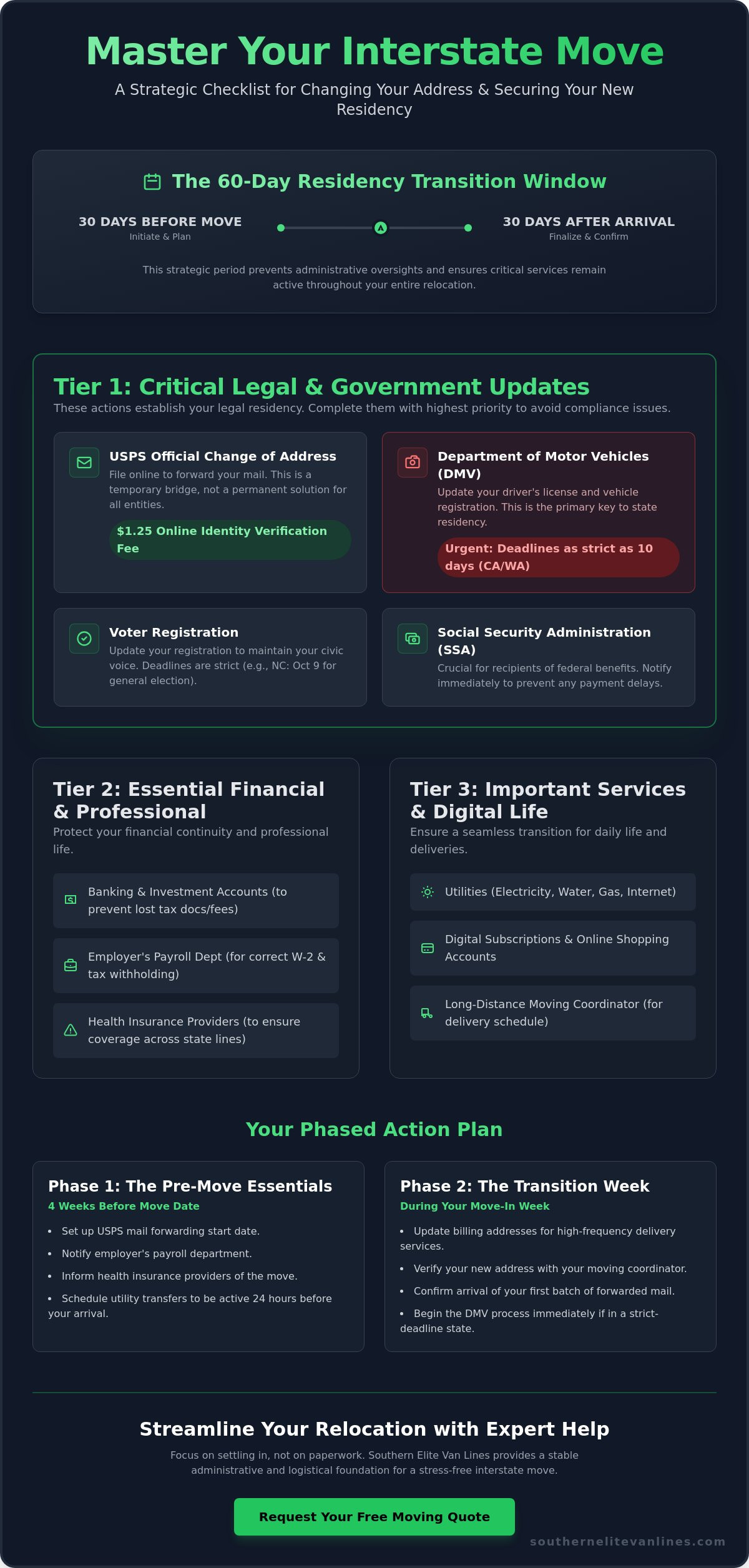
Successfully changing your address when you move states requires more than a single afternoon of filling out forms. We recommend viewing this process through the lens of a "Residency Transition Window." This is a strategic 60-day period that begins 30 days before your departure and extends 30 days after your arrival. By adopting a tiered approach, you prevent administrative oversight and ensure that critical services remain active throughout the journey. It's a common mistake to treat all notifications with the same level of urgency, but prioritizing legal and financial records first protects your standing in your new home.
There is a fundamental difference between temporary mail forwarding and permanent residency updates. While the USPS redirects your mail for a set period, it doesn't notify government agencies, banks, or insurers of your new status. You must initiate these changes individually to establish legal residency. Starting this process at least four weeks before the moving truck arrives is essential for a seamless transition. Professional long-distance movers often emphasize that administrative preparation is just as vital as the physical packing of your belongings. A well-timed plan ensures you aren't scrambling to prove your residency when you need it most.
Phase 1: The Pre-Move Essentials (4 Weeks Out)
Four weeks before your move date, focus on the foundations of your new life. Your first priority is setting up your official USPS mail forwarding start date. You can do this online for a $1.25 identity verification fee, which ensures your first-class mail follows you to your new doorstep. Next, notify your employer's payroll department and your health insurance providers. These entities require lead time to adjust tax withholdings and ensure your coverage remains valid across state lines. Finally, schedule your utility transfers. Aim to have electricity, water, and internet active at your new destination at least 24 hours before you arrive to avoid a dark house on move-in night.
Phase 2: The Transition Week (Move-In Day)
During the week of your move, the focus shifts to immediate needs and verification. Update your billing address for high-frequency delivery services and digital accounts to prevent packages from being sent to your old home. It's also the time to verify your new address with your long-distance moving coordinator. They'll need the exact details to finalize your delivery schedule and inventory records. Once you've settled in, confirm the arrival of your first forwarded mail batch. This serves as a practical test of the USPS system and gives you the peace of mind that your "Residency Transition Window" is progressing exactly as planned.
Updating Legal Residency and Government Records
Managing the legal shift between jurisdictions is the most critical component of changing your address when you move states. Your first step should always be the Official USPS Change of Address form. While you can visit a local post office to submit a paper form, the online portal is the standard for 2026. It requires a $1.25 identity verification fee to protect against fraud, but it offers the most reliable way to ensure your first-class mail follows you. Don't forget that this is a temporary bridge; you must still update each individual agency to ensure your records are accurate and secure.
For those receiving federal benefits, the Social Security Administration (SSA) requires immediate notification to prevent payment delays. Similarly, voter registration is a time-sensitive task that requires your attention to maintain your civic voice. For example, if you're moving to North Carolina in 2026, you must register by 5 p.m. on October 9 to participate in the general election. These steps solidify your status as a resident and ensure your voice is heard in your new community.
Establishing State Residency via the DMV
The Department of Motor Vehicles serves as the primary gatekeeper for state residency. While some jurisdictions provide a 30-to-90 day window for transferring an out-of-state license, others are far more strict. In states like Washington and California, you must notify the DMV of your new address within 10 days. To complete this transition, you generally need to provide:
Two forms of proof of physical residency, such as a utility bill or lease agreement.
Your Social Security card or official proof of your number.
A valid identity document, such as a passport or your current out-of-state license.
Updating your vehicle registration and obtaining new state license plates typically happens during the same visit. This process can be daunting, but coordinating these tasks early helps you avoid late fees or registration lapses. If you need assistance managing the physical side of your move while you handle these legalities, consider how professional residential moving services can provide the support you need.
Federal and State Tax Agency Notifications
Waiting until you file your next tax return to update the IRS is a mistake that can lead to identity theft or lost refund checks. You should notify the tax department of your previous state as well to finalize your tax liability and prevent them from attempting to tax income earned after you've left. IRS Form 8822 serves as your official declaration of a new mailing address to ensure all federal tax correspondence and sensitive documents reach you securely. Taking this proactive step protects your financial identity and ensures that your 2026 tax season remains stress-free.
Ensuring Continuity for Financial Services and Utilities
Establishing your new life in a different state involves more than just updating your driver's license. You must also secure the financial and logistical infrastructure that supports your daily routine. When you are changing your address when you move states, your permanent address becomes the anchor for essential tax documents like 1099s and interest statements. If these documents are sent to an old residence, you risk identity theft and significant delays during tax season. Beyond security, timely updates with credit card companies and retail accounts prevent the frustration of lost statements and the subsequent late fees that can damage your credit score.
Insurance providers also require immediate notification because your geographic location directly impacts your risk profile and premiums. Auto insurance rates vary significantly by state and even by zip code. Similarly, you must ensure that your renters or homeowners policy is active at your new residence the moment you arrive. While you can find comprehensive lists of government services for moving to handle federal records, managing your private financial and insurance portfolio requires a personalized, methodical approach to ensure no coverage gaps occur during the transition.
Banking and Credit Card Updates
Your billing address is a primary security feature for your financial accounts. Most modern point-of-sale systems require zip code verification; if your card's registered address doesn't match your new location, you might face declined transactions at the most inconvenient times. We recommend updating your billing info for all major accounts at least one week before you depart. This update should extend to all loan issuers, including student loans, personal loans, and mortgages. If you still use physical checks, remember to request a new checkbook reflecting your updated address to maintain professional consistency in your financial dealings.
Beyond financial documents, consider the impact of your new address on your professional identity. Using a full-service communications provider like Linemark can help you quickly update your business cards, stationery, and other printed assets to reflect your new location.
The Utility Transfer Protocol
Maintaining a comfortable environment in your new home depends on a perfectly timed utility transfer. We suggest scheduling the "stop-service" date for your current residence for the day after you leave. This ensures you have water and electricity during the final cleaning and loading process. Simultaneously, set the "start-service" date for your new state residence for at least 24 hours before your scheduled arrival. This protocol covers essential services like gas, electric, water, and waste management. Don't overlook the digital side of your move; coordinating the transfer of internet, cable, and home security systems early helps you avoid the stress of downtime in a new, unfamiliar environment.
Managing Personal, Digital, and Professional Notifications
While legal and financial updates form the backbone of your relocation, your digital and professional footprint requires equal precision. Changing your address when you move states involves notifying a vast network of service providers that operate behind the scenes. For professionals such as doctors, lawyers, or teachers, this transition often requires coordinating with state licensing boards to maintain your credentials. We recommend starting these professional inquiries early, as reciprocity rules vary significantly between jurisdictions. Additionally, ensure your employer's HR department has your new details. This ensures your W-2 forms for the 2026 tax year reach you without delay, preventing complications with your future filings.
Digital subscriptions also demand a proactive approach. While it's easy to remember high-profile services like Amazon or Netflix, don't overlook delivery apps like DoorDash or Chewy. Sending a week's worth of groceries or pet supplies to your old home is a common and costly mistake. Updating these platforms during your transition week ensures your essential supplies arrive exactly where you need them. If you're feeling overwhelmed by the logistical weight of your move, our long-distance moving experts can handle the physical heavy lifting while you focus on these essential administrative tasks.
Digital Identity and Security Updates
In 2026, your digital wallet is a primary point of contact for your financial life. You must update the billing address in Apple Pay or Google Pay to prevent transaction declines at local retailers. This is a security measure that many travelers overlook. Verify your two-factor authentication (2FA) settings as well. If your move involves a change in phone number, update your recovery addresses immediately to avoid being locked out of critical accounts. Finally, notify your cell phone provider of your new residency. This ensures you're paying the correct local taxes and receiving the best available service in your new area.
Professional and Educational Records
Your professional life extends beyond your daily office tasks. If you contribute to a Health Savings Account (HSA), your HR department needs your current address to manage your contributions and distributions legally. Similarly, notify your university alumni associations and any schools your children attend to ensure transcripts or diplomas are sent to the correct location. Professional memberships and local chapter affiliations also need your attention. Transferring these memberships ensures you stay connected to your industry network and continue receiving relevant trade publications at your new doorstep. Maintaining these connections provides a sense of continuity as you build your new community.
How Professional Long-Distance Movers Streamline the Transition
The physical aspect of relocating often feels divorced from the paperwork, but the two are deeply intertwined. When you are changing your address when you move states, the documentation provided by your moving team becomes a vital administrative asset. A professional inventory list serves as the foundation for your new household records, offering a meticulous account of your possessions as they cross state lines. This level of organization reduces the mental load of administrative tasks, allowing you to focus on residency requirements while your strategist handles the logistics. Hiring long distant movers ensures that your physical transition is as methodical as your digital one.
A clear communication channel with your moving coordinator is essential for a stress-free experience. This partner acts as the steady, expert hand guiding you through the complexities of a nationwide move. They ensure that every box is accounted for and that your delivery schedule aligns perfectly with your Residency Transition Window. By outsourcing the heavy lifting and packing, you reclaim the time needed to visit the DMV or finalize your voter registration before critical deadlines pass.
Inventory Management and Address Verification
Your moving contract is more than just a service agreement; it can often serve as secondary proof of residency. Some local services, such as school districts or community centers, may accept a signed long-distance moving contract to establish your intent to reside in the area before your first utility bill arrives. It's also vital to ensure your moving team has your Day 1 contact information, including your new cell number and local address. Utilizing full packing services further protects your peace of mind by ensuring that sensitive documents, like those needed for your DMV appointment, are packed securely and labeled for immediate access upon arrival.
Storage Solutions for Transitional Periods
Sometimes, the timing of a move doesn't align perfectly with your new home's availability. In these instances, utilizing secure, climate-controlled storage is a strategic choice. Short-term storage allows you to stage your new home gradually while you finalize your permanent address records and settle into your professional role. This flexibility prevents the chaos of living among boxes while you're trying to navigate new state laws and residency protocols. Ready for a seamless state-to-state move? Get a free quote from Southern Elite Van Lines today and experience a relocation defined by precision and care.
Step Into Your New State with Confidence
Mastering the administrative shift of your relocation requires a methodical approach that balances legal compliance with personal continuity. By adhering to a strategic 60-day transition window and prioritizing high-stakes updates like the DMV and IRS, you protect your identity and your legal standing. Success depends on treating changing your address when you move states as a shared journey between your own preparation and the professional support you choose to employ. You now possess the strategic framework needed to navigate this evolution with precision and calm confidence.
Our team stands ready to serve as your steady partner throughout this complex process. As licensed and insured interstate movers, we offer transparent flat-rate or weight-based pricing to ensure your budget remains as secure as your belongings. We provide professional packing services to safeguard your essential documents and secure storage solutions for any transitional periods. Get Your Free Long-Distance Moving Estimate today and let us handle the logistics while you focus on your new beginning. You've worked hard for this next chapter; we're here to ensure it starts with total peace of mind.
Frequently Asked Questions
How early should I file my change of address with the USPS?
You should file your request at least two weeks before your move date to ensure a seamless transition. While the USPS can process requests in as little as five business days, giving them a 14-day lead time prevents any gaps in your mail delivery. You can schedule the forwarding to begin on a specific date, allowing you to focus on the physical aspects of your relocation without worrying about missed correspondence.
Does the USPS forward all types of mail to my new state?
The USPS primarily forwards First-Class Mail, Priority Mail, and Priority Mail Express for free during the first 12 months. Marketing mail and packages shipped via Ground Advantage or Media Mail are typically not forwarded unless you pay additional postage. For those who need more time, the 2026 fee for extending forwarding to 18 months is $48.50, ensuring your transition remains uninterrupted and your sensitive documents stay secure.
Is there a fee for changing my address with the DMV in a new state?
Most states do not charge a fee to simply update your address in their system, but you will usually pay for a replacement license that reflects your new residence. For instance, in Washington, a new card with the updated address costs $20 as of June 2026. Changing your address when you move states requires checking the specific fee schedule of your new jurisdiction to ensure you remain legally compliant and carry valid identification.
How do I update my voter registration after moving states?
You must re-register in your new state because voter registration does not automatically transfer across state lines. Most states allow you to register online, by mail, or in person at the DMV when you update your driver's license. Be mindful of state-specific deadlines; for the 2026 general election, North Carolina requires registration by October 9, while other states may allow for same-day registration at your local polling station.
Do I need to notify the IRS immediately when I move?
Yes, you should notify the IRS as soon as possible by filing Form 8822 to ensure you receive all official tax correspondence. Relying on the USPS to forward tax documents is risky, as sensitive financial information can be lost or delayed. Updating the IRS directly is a crucial step in changing your address when you move states, as it helps prevent identity theft and ensures your tax refunds reach the correct destination.
What happens to my car insurance when I move to a different state?
Your current policy will likely need to be replaced with a new one that meets the minimum coverage requirements of your new state. Insurance companies calculate premiums based on your specific zip code, so your rates will change once you relocate. You should contact your agent before you move to ensure your coverage remains continuous and to avoid any legal lapses in protection during the drive to your new home.
Can I change my address online for all government agencies?
While many federal and state agencies offer online portals, not all government entities are fully digitized in 2026. You can typically update the USPS, IRS, and Social Security Administration online, but some state DMV offices still require an in-person visit for identity verification and new photographs. We recommend checking the official website of each agency early in your transition window to determine their specific requirements and avoid unnecessary trips.
What is the most common mistake people make when changing their address?
The most frequent error is assuming that a USPS mail forwarding request updates every other organization automatically. In reality, you must individually notify banks, insurance providers, and government agencies to establish your new legal residency. Failing to update these entities directly can lead to missed bills, service cancellations, and complications when proving your residency for local schools or professional licensing boards.


Comments