
Best Way to Pack Fragile Items for Moving: The 2026 Professional Guide
Most people think that piling on bubble wrap is the secret to a safe move, but excessive padding often provides a false sense of security while leaving your heirlooms at risk. Finding the best way to pack fragile items for moving isn't about how much soft material you use; it's about mastering the science of immobility engineering. You've likely felt that knot in your stomach while wrapping a family heirloom, wondering if a single pothole on a long-distance journey will turn your memories into shards. It's exhausting to stare at a mountain of glass and china, worrying that even a successful insurance claim can't replace the sentimental value of a broken treasure.
We understand that your belongings are more than just objects. They're the foundation of your home. This guide teaches you the exact professional techniques elite movers use to ensure every delicate item survives a long-distance journey without a scratch. You'll discover how to create a systematic packing plan that eliminates internal movement, handles the nuances of modern electronics, and provides the absolute peace of mind you deserve during your transition to a new beginning.
Key Takeaways
Learn why professional-grade dish barrel boxes and specialized packing paper are essential to protect fine china from ink damage and structural failure.
Discover the "immobility engineering" method to create three-inch shock zones that neutralize road vibrations during long-distance transit.
Master the best way to pack fragile items for moving by applying the "Individual Armor" technique to secure oddly shaped kitchenware and high-value electronics.
Understand how stacking pressure and long-distance road hum affect your boxes so you can prevent crushing and shifting before the truck even leaves.
Identify when to transition from a DIY approach to professional packing services to ensure your items are fully covered by comprehensive valuation protection.
Table of Contents
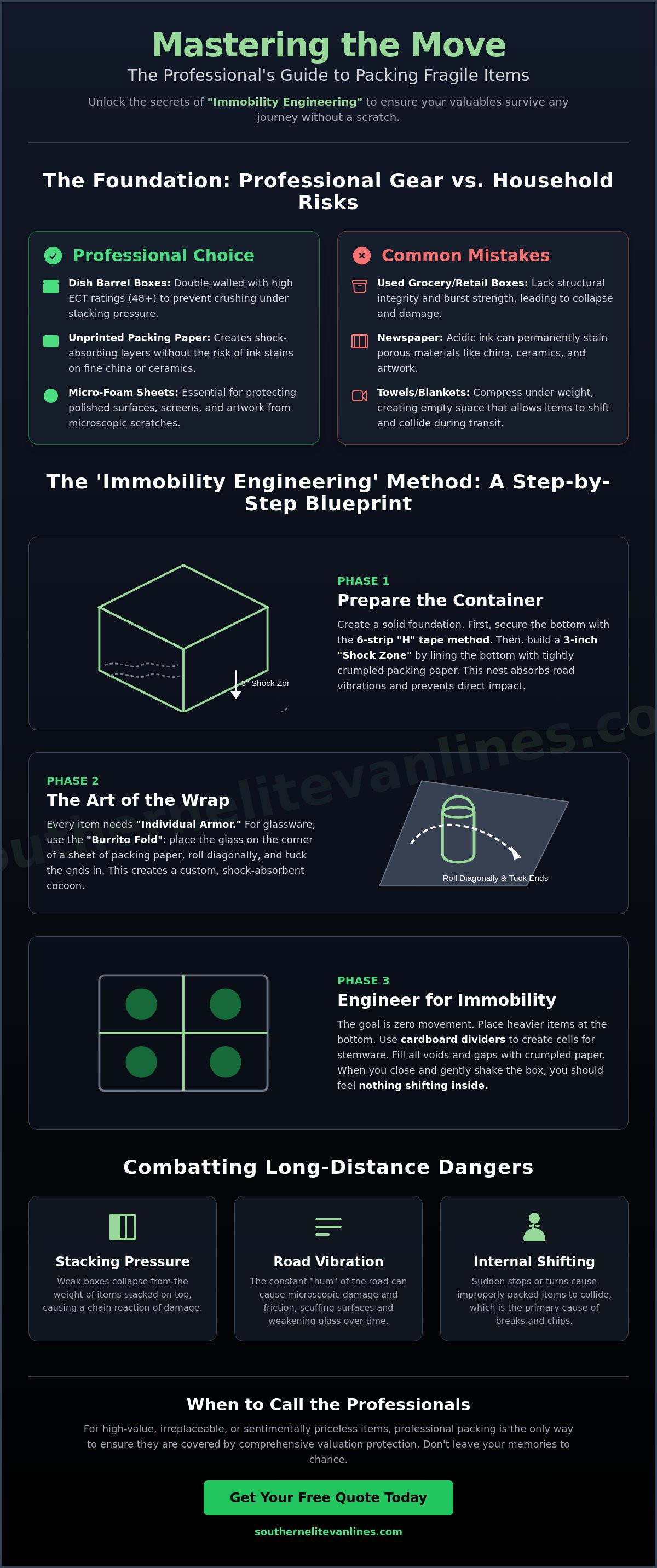
The Foundation: Professional Materials vs. Household Substitutes
Success in a residential or long distance move depends on structural integrity. The best way to pack fragile items for moving starts with professional-grade materials rather than leftovers from the local grocery store. While it is tempting to save money by collecting free boxes, these containers are usually designed for a single trip from a warehouse to a shelf. They lack the burst strength required to survive the stacking pressure inside a 26-foot moving truck. Professional "Dish Barrel" boxes are non-negotiable for breakables because they feature double-walled corrugated cardboard. This extra layer provides a rigid skeleton that prevents the box from collapsing when several other containers are stacked on top of it.
Choosing the right medium for shock absorption is equally critical. While bubble wrap provides excellent protection for heavy glass, foam peanuts are often better for filling voids in boxes containing lightweight, intricate items. However, the true hero of the packing process is clean, unprinted packing paper. Many homeowners make the mistake of using old newspapers, but the high acidity and wet ink can permanently stain porous ceramics or fine china. When you are packing fragile items, professional techniques involve layering this paper to create a shock zone that absorbs the hum of the road.
Essential Supplies for a Fragile-First Move
Look for boxes with a high Edge Crush Test (ECT) rating. This number indicates how much pressure the side of the box can withstand before buckling. For your most delicate valuables, aim for double-walled containers with an ECT of at least 48. Pair these with micro-foam sheets to protect polished surfaces from microscopic scratches. Finally, secure every seam with heavy-duty 2-inch acrylic packing tape. This adhesive maintains its grip in varying temperatures, ensuring your boxes don't pop open during a climate-controlled long distance move.
Why Household Substitutes Often Lead to Damage
Relying on towels or blankets to cushion your valuables is a common mistake that leads to heartbreak. Fabrics are soft, but they compress under weight. This creates internal gaps that allow items to shift and collide. Similarly, thin "Amazon boxes" are engineered for lightweight parcel shipping, not the rigors of a professional moving truck. The best way to pack fragile items for moving requires avoiding these thin-walled containers that lack structural reinforcement. Investing in the right materials is a small price to pay for the peace of mind that comes with knowing your history is well-protected.
The 'Immobility Engineering' Method: A Step-by-Step Guide
Professional packing is a disciplined craft that moves beyond mere wrapping. The best way to pack fragile items for moving is through a process we call immobility engineering. This technique focuses on neutralizing the kinetic energy that occurs when a moving truck shifts, brakes, or encounters uneven road surfaces. By treating the interior of a box as a high-performance suspension system, you can protect even the most delicate heirlooms from the rigors of transit. Success depends on three distinct phases of preparation and execution.
Phase 1: Preparing the Container
Structural integrity begins with the 6-strip tape method. Apply three strips of heavy-duty tape across the bottom seams in an H-pattern, ensuring the tape extends at least three inches up the sides of the box. Immobility engineering is the total elimination of internal movement. Once the base is secure, create a "Shock Zone" by layering the bottom three inches of the box with tightly crumpled packing paper. This nest acts as a localized shock absorber, preventing the weight of the items from making direct contact with the hard floor of the truck.
Phase 2: The Art of the Wrap
Each item requires "Individual Armor" tailored to its specific geometry. For glassware, use the "Burrito Fold" by placing the item in the corner of a paper sheet and rolling it diagonally, tucking the edges into the globe or opening as you go. For those handling high-value documents or art, following museum standards for packing and shipping paper artifacts ensures that even the most delicate fibers remain intact. Use cardboard dividers to create internal cells for stemware, as these prevent items from knocking against one another. If the process feels overwhelming, exploring full packing services can provide the professional security your items require.
Phase 3: Density and Stacking
Placement within the box is a matter of physics. Always place the heaviest, sturdiest items at the base to maintain a low center of gravity. Crucially, items like plates and vinyl records must be packed on their edges in a vertical orientation. Flat-packed plates are prone to cracking under the pressure of the items above them, whereas vertical edges can support significant weight. Fill every remaining "void space" with small bundles of crushed paper until the contents cannot move. Before sealing the top with another H-pattern tape job, perform the "Shake Test." Gently lift the box and give it a slight move; if you hear even the slightest rattle, you need more padding. A perfectly packed box is silent, signifying that you've achieved the best way to pack fragile items for moving through exactness and care.
Room-by-Room Fragile Strategies: Kitchen, Electronics, and Art
Every room in a home presents unique challenges that require a specialized approach to immobility engineering. While the foundational principles of padding remain constant, the best way to pack fragile items for moving varies significantly between the kitchen and the home office. Kitchen items often involve repetitive shapes like plates and bowls. When nesting bowls, place a double layer of packing paper between each piece to prevent friction. Never nest more than three or four items together. The cumulative weight can cause the bottom bowl to crack during a long distance move. For stemware, ensure the delicate stems are wrapped individually before the entire glass is encased in a protective layer.
Securing High-Tech Gear and Screens
Modern electronics require protection that goes beyond physical cushioning. Static electricity can damage sensitive internal components even if the device never suffers a direct impact. Always use anti-static bubble wrap, which is typically pink, for computer towers and circuit boards. If you no longer have the original packaging, you must replicate its support by using custom-fit foam inserts or tightly packed micro-foam. Before disconnecting your setup, take a photo of the ports and label every cable with masking tape. This methodical step ensures an effortless transition when you begin the unpacking process in your new residence.
Packing Mirrors and Large Glass Panels
Large glass surfaces are vulnerable to vibration and structural flexing. Start by applying a large "X" across the glass using blue painter's tape. This provides structural tension and keeps shards contained if an impact occurs. For oversized pieces, utilize the "Telescoping Box" method. This involves sliding two mirror cartons together from opposite ends to create a custom-fit, reinforced sleeve. Always use plastic corner protectors to shield the weakest points of the frame. Remember that mirrors must always be moved and stored on their long edge, never flat. Stacking mirrors horizontally creates immense pressure on the center of the glass, making breakage almost certain.
Heirlooms and antiques require an even higher standard of exactness. These pieces often feature aged wood or delicate joints that have become brittle over decades. Avoid applying adhesive tape directly to any finished surface. This can strip away historical patinas or gold leaf. Instead, wrap the item in a soft micro-foam sheet and secure the padding to itself. For heavy furniture with fragile legs, such as a piano or a vintage sideboard, consider the benefits of professional residential moving services. These experts possess the specialized equipment to handle your most significant investments with meticulous care and safety.
Long-Distance Specific Risks: Vibration, Shifting, and Climate
While a local move might forgive a loosely packed box, a cross-country journey is a relentless test of endurance. The best way to pack fragile items for moving across state lines involves accounting for the "Vibration Factor." Over a 1,000-mile journey, the constant road hum acts like a slow-motion earthquake. This vibration causes items to settle and microscopic gaps to expand. If you haven't achieved total immobility, those gaps allow pieces to strike one another repeatedly, leading to hairline fractures or total failure. Achieving the best way to pack fragile items for moving means looking beyond the box to the environment of the truck itself.
Stacking pressure is another critical variable that homeowners often overlook. In a long-distance trailer, boxes are loaded in tiers that can reach seven or eight feet high. The bottom box in a tier must support the cumulative weight of every container above it for several days. This is why professional long distant movers emphasize the use of high-ECT rated, double-walled boxes. Without that structural integrity, the bottom box will eventually compress. This compression causes the entire tier to shift, creating a domino effect that puts your most delicate valuables at risk.
Surviving the Long Haul
Interstate relocations require significantly tighter packing than a trip across town. Every void must be filled with dense materials to prevent the contents from reacting to the truck's momentum during braking or turns. Professional teams use logistical tracks and heavy-duty tie-downs to secure these tiers into "bulkheads," which are vertical walls of cargo that prevent forward and backward shifting. Many elite fleets also utilize air-ride suspension systems. These systems use compressed air bags to absorb road shock, providing a much smoother ride for your cargo than traditional leaf-spring suspensions found in standard rental trucks.
Temperature and Humidity Control
Climate changes can be just as damaging as a physical impact. If your move takes you through regions with extreme heat or high humidity, standard adhesives can soften and lose their grip. Conversely, extreme cold can make certain plastics and old adhesives brittle, causing them to snap under pressure. Musical instruments and fine wood furniture are particularly susceptible to warping if they aren't protected from rapid humidity shifts. For these sensitive items, we recommend utilizing professional long distance moving services to maintain a stable environment throughout the journey. This level of care ensures your belongings arrive in the same condition they left, regardless of the weather outside.
The Professional Advantage: When to Delegate Fragile Packing
While mastering the science of immobility engineering is possible for a dedicated homeowner, executing these steps perfectly across an entire household requires significant time and physical stamina. The best way to pack fragile items for moving often involves recognizing when a task requires a professional hand. Professional teams do more than just supply materials; they assume the logistical risk of the entire operation. When you choose full packing services, you shift the burden of exactness from your shoulders to a team of trained strategists who specialize in high-stakes transit. This choice is often the most efficient path to achieving zero breakage during a complex residential move.
Understanding Liability and Valuation
There is a critical legal distinction between boxes you pack and those packed by experts. Most carriers cannot take liability for the contents of "PBO" (Packed By Owner) boxes because they cannot verify the internal packing quality. If an item breaks inside a box you packed, the carrier is typically only responsible for the legally mandated "Released Value Protection." As of May 2026, this basic coverage only provides $0.60 per pound per item. In contrast, professionally packed items are eligible for Full Value Protection. This premium coverage ensures that if an heirloom is damaged, the carrier is responsible for the actual replacement value or repair, providing a level of financial security that DIY packing cannot match.
A professional inventory list further protects your assets by documenting the condition of every high-value item before it enters the truck. This methodical approach is a hallmark of the service provided by southern elite van lines. For items that are simply "un-boxable," such as large chandeliers or heavy marble statues, professionals utilize custom crating. These wooden enclosures are built to the exact dimensions of the object, providing a rigid external skeleton that standard cardboard cannot offer. This is the ultimate solution for ensuring your most significant investments survive the rigors of long distance moving.
Making the Final Decision
Deciding whether to delegate requires a realistic assessment of your move's complexity. If you are managing a large volume of breakables or moving a piano, the risk of a single mistake often outweighs the cost of the service. Use this checklist to determine if you need professional intervention:
Your move involves more than 15 boxes of high-value kitchenware or collectibles.
You are coordinating a long distance move where road vibration is a major factor.
You require an official, carrier-verified inventory for insurance claims.
Your schedule does not allow for the 40 to 60 hours required to pack a typical three-bedroom home.
Choosing to delegate the most stressful aspects of your relocation provides a sense of calm confidence. It allows you to focus on the new beginnings ahead while experts handle the technical demands of safety and precision. To ensure your transition is handled with meticulous care, Get a professional packing quote from Southern Elite Van Lines today and secure the peace of mind you deserve.
Secure Your Legacy for the Journey Ahead
Relocating is a complex operation that requires more than just boxes and tape. By applying the principles of immobility engineering and selecting professional-grade materials, you've built a solid foundation for a damage-free move. You now recognize that the best way to pack fragile items for moving is to eliminate internal shifting while accounting for the unique physics of long-distance transit. Whether you're protecting a vintage piano or delicate heirlooms, a methodical approach ensures your history arrives intact at your destination.
If the volume of your breakables feels overwhelming, you don't have to manage this journey alone. Our team provides the expert hand you need to navigate this transition with total confidence. We include professional-grade packing materials and offer climate-controlled storage options for your most sensitive valuables. With deep expertise in handling high-value and specialty items, we treat your belongings with the meticulous care they deserve. Secure Your Valuables with Southern Elite Van Lines today. Your new beginning is waiting. Let's make sure everything you love is there to welcome you.
Frequently Asked Questions
Is it better to use bubble wrap or packing paper for fragile items?
You should use a combination of both materials to achieve the highest level of protection. Packing paper is the best way to pack fragile items for moving when you need to prevent surface scratches and fill small internal voids. Bubble wrap provides superior shock absorption for heavier glass or porcelain items that may experience impact during transit. Use paper as the first layer against the item and bubble wrap as an outer secondary shield for maximum safety.
How do I pack glasses so they don't break during a move?
Always pack glasses in a vertical orientation within a specialized dish barrel box. Wrap each piece individually in packing paper and use cardboard cell dividers to prevent items from knocking against one another. You must fill the hollow center of each glass with crumpled paper to provide internal structural support. This method ensures that the strongest part of the glass, the rim and base, supports the weight of the stack.
Can I use newspaper to pack my dishes?
You should avoid using newspaper because the ink is highly acidic and prone to transferring onto your belongings. This ink can permanently stain porous ceramics, fine china, and unsealed stoneware. Professional teams always use clean, unprinted packing paper to ensure your kitchenware arrives in pristine condition. Using unprinted paper also eliminates the need to wash every dish immediately upon arrival at your new home.
What is the best way to pack a flat-screen TV without the original box?
Use a heavy-duty telescope-style TV box designed specifically for modern electronics. Wrap the screen in a non-abrasive micro-foam sheet to prevent scratches, followed by several layers of heavy-duty bubble wrap. Secure the TV inside the box using foam corner protectors to ensure it remains suspended and does not touch the outer cardboard walls. You must keep the TV in an upright position throughout the entire journey to prevent the screen from cracking under its own weight.
How do I label boxes containing fragile items for a long-distance move?
Label your boxes clearly on at least two sides using bold, permanent markers. Include the destination room, a brief list of the contents, and the word "Fragile" in large letters. Adding "This Side Up" arrows is the best way to pack fragile items for moving over long distances, as it guides the movers on how to orient the box within the truck's cargo tiers. This prevents your delicate items from being loaded upside down or beneath heavier containers.
Should I buy moving insurance for my fragile items?
You should seriously consider Full Value Protection if your inventory includes high-value electronics, antiques, or heirlooms. The legally mandated Released Value Protection only covers $0.60 per pound per item, which is insufficient for a ten-pound television or a delicate vase. Full Value Protection ensures the carrier is responsible for the actual replacement cost or repair of the item. This investment provides essential peace of mind during a complex relocation process.
How do you pack heavy but fragile items like stone sculptures?
Heavy stone or marble sculptures require custom wooden crating rather than standard cardboard boxes. These crates feature a reinforced base and internal bracing designed to prevent any internal shifting during transit. Because stone can be brittle, any movement within a box can lead to structural snapping or chipping. Professional crating ensures the weight is distributed evenly and the item remains completely immobile regardless of road vibrations.
What happens if a moving company breaks a fragile item?
You must document any damage on the bill of lading at the time of delivery to begin the claims process. Most professional companies require you to file a formal written claim within a specific window, often nine months for interstate moves. The resolution will depend on the level of valuation coverage you selected before the move began. If you opted for Full Value Protection, the company will either repair the item, replace it with a similar one, or offer a cash settlement for its current market value.
Comments