
Best Time of Year to Move Cross Country in 2026: The Strategic Guide
- nadineharoon
- 1 day ago
- 12 min read
Choosing the warmest months for your relocation might seem like the most convenient option, but it's often the most logistically complex and expensive decision you can make. You already know that a nationwide move is more than just a change of address; it's a massive operation that demands precision. It's natural to worry about your belongings sitting in a truck during a summer heatwave or getting caught in a winter storm delay while seasonal prices climb. You want the security of knowing your mover is available and your timeline is protected.
This guide will help you identify the best time of year to move cross country by weighing seasonal demand against regional weather patterns and the latest 2026 digital compliance regulations. We'll provide a clear framework to help you secure a reliable booking window and ensure your household goods arrive safely at your new front door. We'll explore how to balance the 20 to 30 percent savings typically found in the off-peak season against the predictability of spring and autumn windows. By the end of this article, you'll have a strategic plan to move with total confidence.
Table of Contents
Understanding the Moving Industry Seasonality and Market Cycles
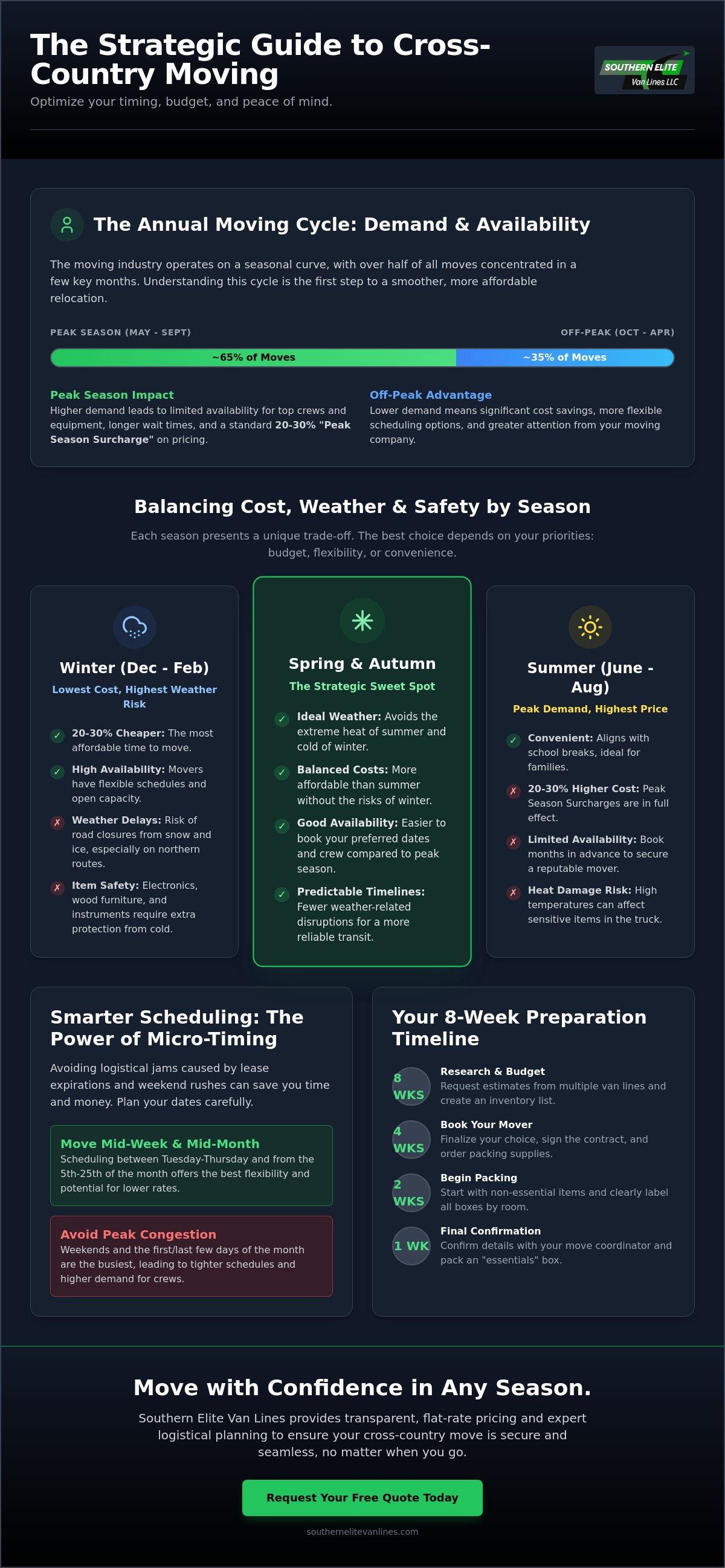
The moving business operates as a seasonal industry, where demand follows a predictable but intense curve. Most relocations occur between May and September, a window that accounts for a vast majority of annual moves. This peak period aligns with the school calendar and the most active months in the residential real estate market. When you are searching for the best time of year to move cross country, understanding this cycle is your first step toward a successful outcome. High demand during these months often leads to limited availability for premium equipment and experienced crews.
Carrier capacity is a finite resource. Long-haul trucks must navigate strict Federal Motor Carrier Safety Administration (FMCSA) regulations, specifically Hours of Service (HOS) mandates that limit how long a driver can remain behind the wheel. These safety rules, combined with the 2026 focus on digital compliance and electronic Driver Vehicle Inspection Reports (DVIR), mean that timelines are more rigid than ever. While the industry is seeing a shift toward year-round relocation patterns due to the rise of remote work, the summer months remain the most congested. Choosing a window outside of this rush can often lead to a more seamless experience.
The Supply and Demand of Nationwide Logistics
The availability of long-haul trucks fluctuates significantly throughout the year. During the summer peak, every available asset is typically deployed, which can lead to tighter scheduling windows. Logistics planners must also account for "deadhead" miles, which are the distances a truck travels empty to reach its next pickup. If you're moving from a region with low outbound volume, your quote might reflect the cost of positioning a truck in your area. Additionally, corporate relocation cycles often peak in January and June, further squeezing the availability of professional crews for residential customers.
Economic Factors Influencing 2026 Moving Costs
Interstate transportation costs are sensitive to external economic shifts. Fuel price volatility remains a primary driver for transportation surcharges, as long-distance routes require substantial energy resources. Labor availability also plays a critical role in the quality of your experience. High-quality professional packing and loading services require skilled teams; during the busiest months, these experts are in high demand. A Peak Season Surcharge is a standard industry adjustment applied during summer months to account for the heightened demand for equipment and personnel. Identifying the best time of year to move cross country involves balancing these economic factors against your personal timeline to find the most efficient window.
Seasonal Breakdown: Balancing Cost, Weather, and Safety
Identifying the best time of year to move cross country requires a careful evaluation of your priorities. While budget is often the primary driver, weather conditions and safety must never be secondary concerns. Each season presents a unique set of logistical variables that can either streamline your transition or introduce unexpected delays. According to U.S. Census Bureau migration data, millions of Americans relocate annually, but the timing of these moves significantly dictates the level of service and equipment availability you will encounter.
Winter Moving: Risks and Rewards of the Off-Peak
The months of December through February represent the traditional off-peak window. January and February are typically the cheapest months to move because van lines often have idle equipment and more flexible scheduling. However, these financial rewards come with logistical hurdles. Crossing mountain passes or northern routes during the winter requires specialized expertise to manage potential road closures or ice. You must also take extra care to protect your inventory from extreme temperature shifts during transit. Items like electronics, musical instruments, and delicate wood furniture require meticulous packing to prevent damage from sub-zero temperatures inside the trailer.
The Summer Rush: Navigating the Most Popular Window
June, July, and August are the busiest months for nationwide relocation. Demand is at its highest, and moving costs during this peak season are often 20 to 30 percent higher than in the winter. High heat in the Southwest and humidity in the East create a physical toll on loading crews and can impact the safety of heat-sensitive belongings. Because long distant movers face their highest volume during these months, you must secure your booking well in advance to guarantee your preferred dates. If your schedule requires a summer move, we recommend loading as early in the morning as possible to mitigate the risks of extreme afternoon heat. For a truly seamless transition, securing your professional moving team early is the most effective way to ensure a predictable timeline.
Spring and Autumn: The Moderate Alternatives
If your timeline allows for flexibility, the transitional seasons offer a balanced alternative. Spring (March through May) is frequently considered the "sweet spot" for nationwide moves. The weather is generally moderate across most regions, and the intense summer demand hasn't yet peaked. Autumn (September through November) also provides cooling temperatures and stabilizing market rates as the summer rush subsides. It's important to remember that hurricane season in the Southeast runs from June through November, so coastal routes may still require weather-related contingency planning during the fall months. Choosing these windows allows you to benefit from more consistent transit times and a wider selection of available service dates.
Micro-Timing: Why the Week and Day Matter More Than You Think
Selecting the best time of year to move cross country provides the strategic foundation for your relocation, but the specific dates on your calendar dictate the daily logistics. While seasonal trends influence the overall price and availability, micro-timing determines the quality of the crew you receive and the predictability of your delivery window. A well-timed move reduces the friction often caused by industry-wide congestion. By looking beyond the month and focusing on the specific week and day, you position your household for a more controlled, professional experience.
Avoiding the End-of-Month Logjam
Nearly 80% of residential moves cluster around the first and last days of the month. This congestion happens because most apartment leases expire on the 30th or 31st, and real estate closings typically target month-end dates. When demand spikes during these narrow windows, equipment becomes scarce and crews often work extended hours to keep up with the volume. Booking your move between the 10th and 20th of the month offers a significant advantage. During this mid-month window, administrative staff and loading crews have more bandwidth to focus on the meticulous details of your inventory. This period also mitigates the risk of "closing day" delays, where a late wire transfer or paperwork snag can throw your entire moving schedule into chaos.
The Mid-Week Strategy for Professional Relocation
Choosing a Tuesday or Wednesday for your load day is a hallmark of a sophisticated moving strategy. Most people attempt to move on Fridays or weekends to minimize time away from work, which creates a secondary surge in demand. Mid-week moves often result in more predictable delivery windows. Starting your move on a Tuesday also allows you to handle any administrative needs while banks and utility companies are open during standard business hours. This timing provides a natural "buffer day" before the weekend, giving you uninterrupted time to begin unpacking and settling into your new environment. To ensure every detail is accounted for, consult an official moving checklist to align your micro-timing with necessary regulatory and logistical steps.
Holiday weekends present another layer of complexity for long-distance transit. While an extra day off work seems appealing, these periods often involve heavy highway traffic, potential labor shortages, and seasonal surcharges. For a cross-country route, holiday congestion can add hours or even days to a driver's transit time, potentially impacting your arrival date. Planning your move during a standard work week ensures that the logistics network is operating at full capacity, providing the steady, expert hand required for a successful nationwide transition. When you combine the best time of year to move cross country with a mid-month, mid-week start date, you create the most efficient path for your belongings.
Logistical Planning and Preparation Timelines
While choosing the best time of year to move cross country provides the logistical framework, your preparation timeline ensures the operation remains on track. A successful nationwide relocation requires a methodical 8-week countdown. This window allows you to secure your preferred dates before the seasonal rush begins. Starting early also provides the necessary time to manage your inventory. Reducing the weight of your shipment by purging unnecessary items before the season changes directly impacts your final cost, as interstate moves are largely calculated by weight and distance.
The 60-Day Strategic Countdown
The journey begins approximately two months before your move date. During weeks 8 through 6, focus on researching southern elite van lines and securing binding estimates. This early start is critical if you are targeting a high-demand window like early summer. By week 4, you should finalize your inventory and confirm the Bill of Lading with your move coordinator. This document serves as your official contract and receipt for your belongings. In the final 48 hours, shift your focus to high-value items and essential "open-first" boxes. This organized progression prevents the last-minute stress that often accompanies long-distance transitions.
Maximizing Efficiency with Professional Packing
Professional packing services offer a strategic advantage that DIY efforts cannot match. A typical four-bedroom home can take a family four or more days to pack correctly for a cross-country haul. Expert teams often condense this process into a single day of focused activity. Beyond speed, professional crating provides essential protection against the vibrations and shifts inherent in a 2,000-mile journey. Specialized materials and techniques ensure fragile items remain secure, significantly reducing transit anxiety. Detailed inventory labeling further streamlines the process, allowing for an effortless unpacking experience at your destination.
If your new residence is not yet ready, coordinating short-term or long-term storage solutions is a standard part of a well-planned move. These transitional services provide a secure environment for your belongings while you finalize your housing arrangements. To begin your journey with a precise strategy, request your personalized moving estimate today. This step ensures you have the expert guidance needed to choose the best time of year to move cross country while maintaining a realistic, manageable timeline.
Why Southern Elite Van Lines is the Right Choice in Any Season
Choosing the best time of year to move cross country is a strategic decision that sets the stage for your future. However, the success of your relocation ultimately rests on the competence and moral character of your moving partner. At Southern Elite Van Lines, we provide a level of exactness that transforms a complex logistical operation into a predictable, effortless experience. Our commitment to flat-rate transparency means you can plan your budget with total confidence, knowing that seasonal demand won't lead to unexpected pricing shifts. We believe that your peace of mind is just as important as the physical safety of your belongings.
Our teams possess the expertise required to navigate the diverse challenges of nationwide routes. Whether you face the high heat of a summer crossing or the unpredictable conditions of a winter mountain pass, our drivers and coordinators maintain a steady, expert hand throughout the journey. We specialize in minimizing downtime for every client, whether we are executing a sensitive residential move or a large-scale commercial relocation. This focus on efficiency ensures that your life or business remains uninterrupted during the transition.
A Premium Experience from Coast to Coast
We maintain a modern, meticulously serviced fleet designed specifically for long-haul reliability. Every vehicle in our inventory undergoes rigorous inspections to ensure your belongings travel in a secure, climate-protected environment. Our moving professionals are not just laborers; they are dedicated specialists trained in the art of meticulous care and safety. This high standard of professionalism ensures that your high-value items and sentimental possessions receive the exactness they deserve. We frame every service as a shared journey, providing personalized assistance from the first box packed to the final item placed in your new home.
Securing Your 2026 Move Date
Once you have identified the best time of year to move cross country for your needs, securing your date early is essential. An early consultation allows us to lock in your preferred window and begin the 8-week strategic countdown discussed earlier. If your timeline involves transitional periods, our secure, climate-controlled storage solutions offer the flexibility you need to manage your move on your own terms. We are here to guide you through every milestone with clarity and transparency. Start your journey with a steady, expert hand by contacting our team to finalize your 2026 relocation strategy.
As you look forward to your new home and the adventures ahead in 2026, you can visit Ares Elite Journeys to discover premium travel options and curated cruise selections for the coming year.
Secure Your Seamless Nationwide Transition
Mastering the logistics of a cross-country relocation requires a strategic blend of market awareness and precise timing. By choosing a mid-month, mid-week window and aligning your schedule with off-peak seasonal trends, you can significantly reduce both costs and transit stress. You've learned that identifying the best time of year to move cross country is only the first step; the quality of your moving partner and the exactness of your preparation timeline are what guarantee a successful outcome. Whether you're moving for a new career or a fresh start, a well-timed strategy protects your peace of mind and your household budget.
Southern Elite Van Lines provides the steady, expert hand you need for this complex journey. With our A-rated nationwide coverage, specialized packing for high-value items, and climate-controlled secure storage solutions, we ensure your belongings are protected every mile of the way. Our team handles the logistical heavy lifting so you can focus on the excitement of your destination. Don't leave your 2026 relocation to chance. Request your tailored long-distance moving estimate today and take the first step toward your new beginning with absolute confidence. We look forward to making your move an effortless and uninterrupted experience.
Frequently Asked Questions
Is it cheaper to move cross country in the winter?
Winter is the most budget-friendly time for a nationwide relocation because demand for equipment and labor drops significantly. January and February are the most cost-effective months for those seeking the best time of year to move cross country on a tight budget. While you save on seasonal surcharges, you must prepare for potential weather delays. Our teams utilize specialized equipment to ensure your belongings remain safe despite freezing temperatures or snowy routes.
How far in advance should I book movers for a cross-country trip?
We recommend securing your booking at least 8 to 10 weeks before your target date. If you plan to move during the summer peak, extending this window to 12 weeks provides the highest level of security. Early consultation allows our strategists to reserve the necessary long-haul equipment and professional crews. This lead time is essential for coordinating full packing services and any required storage solutions for your nationwide transition.
What is the most expensive month to move across the United States?
July stands as the most expensive month for nationwide relocation due to extreme market demand. This period aligns with the height of the real estate cycle and the summer school break, leading to peak season surcharges. When demand for interstate trucks exceeds supply, prices naturally climb. Planning your move for late spring or early autumn can provide a more balanced cost structure while still offering favorable weather conditions for your belongings.
Can I move cross country during the holidays?
Relocating during major holidays is possible but requires careful logistical planning and higher budget considerations. You should expect increased labor costs and potential delays due to heavy highway traffic and driver rest requirements. Moving companies often face limited crew availability during Thanksgiving and the late December holidays. If your timeline is flexible, scheduling your load day just before or after a holiday week ensures a more predictable and cost-effective delivery window.
How does weather affect the delivery window for long-distance moves?
Extreme weather events directly impact the safety and speed of long-haul transit. Heavy snow, ice, or tropical storms can lead to road closures that extend your delivery window. Our drivers prioritize safety and comply with all FMCSA regulations regarding hazardous conditions. We maintain constant communication throughout the journey, providing real-time updates to ensure you feel supported and informed even when environmental factors necessitate a temporary schedule adjustment.
What happens if my closing date changes after I book my movers?
If your real estate closing is delayed, we provide secure, climate-controlled storage solutions to bridge the gap. This flexibility is a standard part of our professional service, allowing your belongings to remain safe while you finalize your housing paperwork. Your move coordinator will manage the transition from transit to storage and then to your final destination. This methodical approach ensures your relocation remains uninterrupted despite common real estate fluctuations.
Is mid-month really better for booking a moving company?
Scheduling your move between the 10th and 20th of the month is a highly effective strategy for a smoother experience. Most residential moves occur at the very beginning or end of the month to align with lease expirations. By targeting the mid-month window, you bypass this congestion and gain access to our most experienced crews. This timing often leads to more flexible scheduling options and a more relaxed, meticulous loading process for your household goods.
How do I handle moving high-value items during peak season?
Protecting high-value items during the busy summer months requires specialized packing and extreme exactness. We recommend utilizing our full packing services, which include custom crating for fragile or expensive possessions. Peak season volume means trucks are at full capacity, making professional-grade protection essential for a 2,000-mile haul. Always ensure your high-value inventory is documented with precision on your Bill of Lading to maintain clear accountability throughout the shared journey.


Comments