
Common Moving Scams and How to Spot Them: A 2026 Protection Guide
- nadineharoon
- 2 days ago
- 13 min read
The lowest quote you receive for your 2026 move is likely the most expensive mistake you'll ever make. When you're preparing for a new beginning, the last thing you need is the paralyzing anxiety of your life's possessions being held for ransom in an unmarked truck. You already know that if a deal seems too good to be true, it probably is. Understanding common moving scams and how to spot them is no longer just a precaution; it's a vital necessity for protecting your belongings and your budget.
This guide provides the expert-led security framework you need to navigate the industry with total confidence. We'll show you how to identify sophisticated fraud tactics like weight bumping and broker ghosting, which currently accounts for over 78% of reported moving complaints. You'll gain a clear checklist to vet movers, a deep dive into the latest FMCSA digital compliance regulations, and a breakdown of the 110% rule that prevents hidden fees from doubling your costs at delivery. We're here to ensure your transition is methodical, transparent, and entirely within your control.
Table of Contents
Understanding the Landscape of Moving Fraud in 2026
Moving fraud is a calculated deception designed to exploit the logistical complexity of relocation. It isn't a simple misunderstanding about a bill; it's the intentional misrepresentation of services, costs, or safety protocols to extract unearned profit. Fraudulent operators often target long-distance moves because the hundreds of miles between your old home and your new one provide the perfect cover to disappear or demand more money. Understanding common moving scams and how to spot them requires looking past the polished surface of a website to the operational reality beneath. A foundational starting point for any homeowner is Wikipedia's overview of moving scams, which outlines the historical patterns these criminals follow to deceive unsuspecting customers.
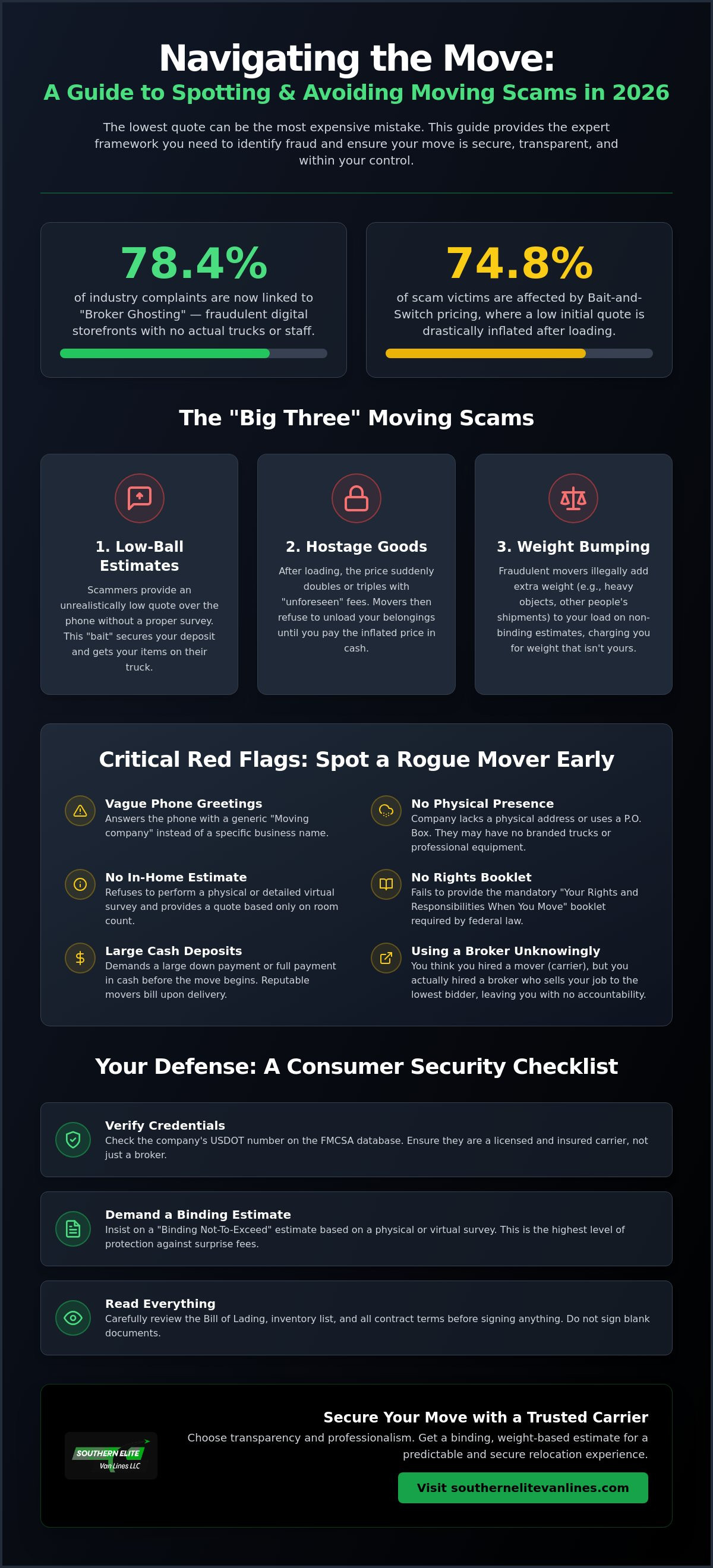
Scams have evolved significantly by 2026. We've moved past simple "hidden fees" into a world of complex digital identity theft. Fraud isn't just a mistake; it's a business model for rogue operators. Proactive vigilance is your only real defense. Once your belongings are on a truck and the driver has left your driveway, you've lost your primary leverage. Recent data suggests that bait-and-switch pricing affects 74.8% of people who fall victim to these schemes, making it clear that early detection is the only way to ensure a secure transition.
The Cost of Moving Fraud Beyond the Invoice
The true price of a scam rarely appears on the final invoice. When a rogue mover holds your goods hostage, it creates a cascade of logistical failures. You might miss a real estate closing or be forced to live in an empty house for weeks while negotiating for your own furniture. There's also a deep emotional toll when sentimental items are lost or damaged by unvetted day laborers. Perhaps most dangerously, moving involves transporting your most sensitive documents. In 2026, a moving scam is often a gateway to long-term identity theft if your tax records, birth certificates, or passports fall into the wrong hands during the journey.
Why 2026 Requires a New Level of Vigilance
Vigilance looks different this year because the tools of deception have become more sophisticated. We've seen a rise in "ghost movers"—entities that exist only as professional digital storefronts with no actual trucks, staff, or physical presence. These organizations use AI-generated reviews to inflate their reputation, making star ratings less reliable than they were just a few years ago. Analysis shows that broker ghosting now accounts for 78.4% of industry complaints. Adopting a "Consumer Security Mindset" means you must verify every claim. You shouldn't just read a review; you should check the company's physical equipment, verify their USDOT number, and examine their digital compliance records before signing any contract.
The "Big Three" Scams: Low-Ball Estimates, Hostage Goods, and Weight Bumping
The most frequent methods rogue operators use to exploit families during a transition are categorized as the "Big Three" scams. A "Low-Ball" estimate serves as the initial hook. By providing an unrealistically low quote over the phone without a physical or virtual survey, scammers secure your deposit and gain access to your home. Once your possessions are loaded onto the truck, the price suddenly doubles or triples. This bait and switch tactic works because many consumers prioritize the lowest price over contract transparency. In reality, the cheapest quote often becomes the most expensive mistake you can make.
Understanding the legal distinction between estimates is your first line of defense. A non-binding estimate is merely an educated guess; your final cost depends entirely on the actual weight of your shipment. Rogue movers use these as a trap to inflate costs after the fact. Conversely, a binding estimate guarantees the total cost based on the inventory provided. For the highest level of protection, you should seek a "Binding Not-To-Exceed" agreement. This ensures you won't pay more than the quoted price even if the actual weight is lower than the initial estimate, providing much needed financial security.
The Mechanics of the Hostage Scam
The U.S. Department of Transportation tracks common types of moving fraud, with hostage situations being the most severe. In this scenario, movers demand immediate payment for "unforeseen" labor, such as long carry fees or stair charges, before they'll open the truck doors. Legally, for moves based on a non-binding estimate, the FMCSA 110% rule states a mover cannot require you to pay more than 110% of the original estimate at the time of delivery. Any overages must be billed at least 30 days after the move is complete. A hostage situation occurs when a mover unlawfully refuses to relinquish a customer's property until additional, unquoted fees are paid; this is a federal criminal offense.
Weight Bumping and Volume Fraud
Weight bumping is a deceptive practice where a driver adds weight to the truck, such as extra fuel or heavy equipment, before the official weigh in at a certified scale. They then present a falsified ticket to justify a higher price. To prevent this, you should always request a "tare weight" ticket showing the empty truck weight and a "gross weight" ticket showing the loaded truck weight from the same scale. You have the legal right to witness the weighing of your shipment if you suspect foul play.
Be particularly wary of quotes based on cubic feet rather than weight. Federal law requires interstate moves to be priced by weight. Rogue operators prefer cubic foot pricing because it's easier to manipulate by "loose loading" the truck to take up more space. If a company refuses to provide a weight based estimate, it's a major red flag for common moving scams and how to spot them. Selecting a reputable moving carrier that utilizes transparent, weight based calculations is the best way to safeguard your investment and ensure an effortless relocation.
Red Flags: How to Spot a Rogue Mover Before the Truck Arrives
Identifying a rogue operator requires you to look beyond a professional website and pay close attention to behavioral cues. The first test is often the simplest: the phone greeting. When you call a legitimate carrier, they identify themselves by their full, registered business name. If the person on the other end answers with a generic phrase like "Movers" or "Moving Company," you're likely dealing with a broker or a fly-by-night operation that uses multiple names to dodge bad reviews. Professionalism starts with a clear identity, and a lack of one is a primary indicator of common moving scams and how to spot them before you ever sign a contract.
Financial pressure is another immediate warning sign. Reputable movers typically don't demand large cash deposits or "upfront insurance fees" before the move begins. If a company insists on payment via untraceable methods like cash, Zelle, or Venmo to "secure your date," walk away. Similarly, pay attention to the equipment they use. While some legitimate companies occasionally use rentals during peak seasons, a company that arrives in an unmarked truck with no USDOT number displayed is a major risk. Your belongings deserve the security of a dedicated fleet maintained by a verified carrier.
Digital and Behavioral Red Flags
In 2026, scammers have turned to technology to mask their lack of infrastructure. You must be wary of AI-generated reviews that appear "too perfect." These reviews often lack specific details about the move, such as the crew's names or the specific items handled, and instead use repetitive, glowing language. Another behavioral red flag is the refusal to perform a detailed survey. A mover who gives you an "instant quote" without seeing your home or conducting a thorough virtual inventory is guessing at your expense. Real logistics require exact data; anything else is just a trap designed to be inflated later.
Credential and Insurance Discrepancies
Verifying credentials is the only way to confirm a mover's legal standing. Use the FMCSA "Protect Your Move" portal to check the company's safety records and complaint history. Be particularly careful with companies using "DBAs" (Doing Business As). Scammers often cycle through these names to hide a trail of federal violations or "hostage goods" complaints. Finally, ask for specific cargo insurance details. A legitimate company will provide a Certificate of Insurance (COI) that names their provider and coverage limits. If they are vague about how your items are protected or claim that "standard 60 cents per pound" is all you need without explaining full-value protection options, they aren't prioritizing your peace of mind.
The Professional Standard: Verifying Credentials and Contracts
A legitimate move is built on a foundation of federal compliance and clear documentation. By law, every interstate mover must provide you with the "Your Rights and Responsibilities When You Move" booklet before you sign a contract. This document isn't just a courtesy; it's a mandatory disclosure that outlines your legal protections. If a company fails to provide this or seems unfamiliar with it, you've encountered one of the most visible common moving scams and how to spot them before your inventory is loaded. A professional carrier treats these regulations as the bare minimum for service quality.
Verification begins with the company's USDOT and MC numbers. These identifiers are your gateway to the FMCSA’s safety data. You should confirm that the carrier has the required $750,000 in bodily injury and property damage liability insurance, along with the mandatory cargo insurance of $5,000 per vehicle. Don't simply take their word for it. Cross-reference these numbers on the federal portal to ensure their operating authority is "Active." A company with "Pending" or "Revoked" authority is a significant liability that puts your entire household at risk.
Broker vs. Carrier: Know Who is Actually Moving You
It’s essential to distinguish between a moving broker and a moving carrier. A broker is a sales entity that books your move but doesn't own trucks or employ the staff who will handle your furniture. While some brokers are legitimate, many operate as middlemen who sell your contract to the lowest bidder. This "double brokering" often leads to the price hikes and service failures discussed earlier. To maintain control over your relocation, ensure you are working with long distant movers who operate as a direct carrier. This ensures the company you hire is the same one that arrives at your door.
The Anatomy of a Legitimate Moving Contract
Your Bill of Lading is the most important document in your move. It serves as your formal contract and your receipt for your goods. A valid Bill of Lading must include the mover’s name and address, the agreed-upon payment terms, the minimum liability for loss or damage, and the specific pickup and delivery dates. You must also understand the difference between "Valuation Coverage" and "Insurance." Valuation is the amount of liability a mover assumes; standard released value is 60 cents per pound, but you are legally entitled to choose Full Value Protection. A blank or incomplete contract is a legal death trap that leaves you with no recourse if something goes wrong.
In addition to the Bill of Lading, a professional contract includes a detailed Inventory Cube Sheet. This document lists every item being moved and assigns it a standard volume or weight. It's a critical tool for identifying common moving scams and how to spot them, specifically preventing the weight bumping tactics mentioned previously. If your mover doesn't provide a line-by-line inventory before you sign, they haven't performed a legitimate estimate. For a transparent experience that prioritizes your security, contact Southern Elite Van Lines today to review your inventory and secure a binding agreement.
Securing Your Move with Southern Elite Van Lines
Choosing a moving partner is the most critical decision you'll make during your relocation. While understanding common moving scams and how to spot them provides you with a necessary shield, working with a carrier that prioritizes absolute transparency is your best defense. We build every client relationship on a foundation of trust and precision. Unlike rogue operators who use non-binding traps to inflate costs, we utilize binding, weight-based fees. This methodical approach ensures that the price we quote is the price you pay, eliminating the financial anxiety that often accompanies long-distance transitions.
We operate as a direct carrier, meaning we manage every aspect of your journey from the initial inventory to the final delivery. This eliminates the risks associated with brokers who might sell your contract to unvetted third parties. Whether you're coordinating a complex commercial relocation for your business or moving your family to a new home, you receive the same high standard of meticulous care. Every client is provided with the mandatory "Rights and Responsibilities" guide immediately, ensuring you're fully informed and legally protected from day one. Our history of excellence has established southern elite van lines as a dependable leader in the premium relocation sector.
Our Process: From Accurate Inventory to Final Delivery
Our operational flow is designed to be effortless and uninterrupted. We maintain a modern fleet of vehicles and employ highly trained specialists who adhere to the industry's most rigorous packing standards. Your belongings aren't just cargo; they're the physical history of your life, and we treat them with the exactness they deserve. Our "No Hidden Fees" promise applies to all long-distance relocations, covering everything from fuel to labor. For those in transition, we offer climate-controlled, secure storage solutions for both short-term and long-term needs, providing a steady hand during complex timelines.
Your Next Steps for a Scam-Free Relocation
Securing a stress-free move begins with accurate information. We invite you to request a comprehensive, transparent moving estimate that reflects the true scope of your needs. Our team performs thorough surveys to ensure our binding quotes are grounded in reality, not guesswork. If you have high-value items or delicate equipment, our professional packing services provide the specialized protection necessary for a safe journey. Experience a relocation defined by calm confidence and professional integrity. Contact our expert team today to begin your shared journey toward a successful, secure new beginning.
Secure Your New Beginning with Confidence
Navigating a relocation in 2026 demands more than just organization; it requires a commitment to security and transparency. By mastering the nuances of common moving scams and how to spot them, you've taken the first step toward protecting your household from predatory tactics. Remember that a legitimate carrier always prioritizes federal compliance, providing binding estimates and clear documentation long before the first box is loaded. Vigilance against red flags like generic greetings or cash deposits ensures that your possessions remain in safe, professional hands throughout the entire journey.
Southern Elite Van Lines stands as your steady partner in this process. As an FMCSA Licensed and Bonded Carrier with specialized long-distance expertise, we replace uncertainty with meticulous care. We offer comprehensive valuation coverage options to provide the peace of mind you deserve during a major life transition. Don't leave your belongings to chance when you can choose a verified standard of excellence.
Take the final step toward an effortless move. Request Your Transparent, Scam-Free Moving Quote Today and experience the security of a premium relocation service. Your new chapter deserves a start defined by integrity and professional support.
Frequently Asked Questions
How can I tell if a moving company is a broker or a carrier?
You can identify the difference by checking the company's registration on the FMCSA "Protect Your Move" website under the "Entity Type" field. A carrier owns the trucks and employs the movers, while a broker is a sales agent that hires a third-party company to perform the work. Legitimate brokers must disclose their status in their advertisements and contracts. If a company is vague about their fleet or equipment, they're likely a broker.
What should I do if a mover refuses to give me an in-person estimate?
You should consider a refusal to provide an in-person or virtual survey as a major warning sign and seek a different company. Federal regulations require movers to perform a physical survey of your household goods for any move originating within 50 miles of their location. An estimate based solely on a phone conversation is often inaccurate and is a primary tactic used in common moving scams and how to spot them to justify later price hikes.
Is it normal for a moving company to ask for a large deposit upfront?
No, reputable movers typically don't require large upfront deposits or cash payments before the move begins. While some carriers may ask for a small credit card deposit to secure a specific date, a demand for a significant percentage of the total cost is a red flag. You should only pay for the majority of your moving services at the time of delivery, ensuring you maintain leverage throughout the relocation process.
What federal agency regulates interstate moving companies?
The Federal Motor Carrier Safety Administration (FMCSA), an agency within the U.S. Department of Transportation, regulates all interstate moving companies. They're responsible for issuing USDOT numbers and enforcing safety and consumer protection regulations. You can use their online portal to verify a mover's registration, insurance status, and safety record. This oversight ensures that carriers adhere to professional standards and provides a path for consumer recourse if disputes arise.
What is weight bumping and how can I prevent it during my move?
Weight bumping occurs when a mover adds weight to the truck before the official weighing to artificially increase your final bill. You can prevent this by requesting "tare" and "gross" weight tickets from a certified scale for both the empty and loaded truck. Legitimate carriers will allow you to witness the weighing process. Always ensure both tickets come from the same scale and show the same vehicle identification to maintain accuracy and prevent fraud.
What happens if a mover holds my belongings hostage for more money?
If a mover refuses to unload your goods until you pay more than 110% of a non-binding estimate, they're committing a federal crime. You should immediately contact local law enforcement and file a complaint with the FMCSA. This situation is a severe form of common moving scams and how to spot them. Reputable carriers avoid these disputes by providing binding estimates that clearly outline all costs before the move starts.
How do I check a moving company’s complaint history?
You can check a company’s history by visiting the FMCSA National Consumer Complaint Database and entering their USDOT number. This portal provides a detailed breakdown of complaints regarding lost items, damaged goods, and deceptive pricing. Reviewing these records allows you to see if a company has a pattern of "hostage goods" incidents or broker ghosting, which helps you make a more informed and secure choice for your family.
What is the "Your Rights and Responsibilities When You Move" booklet?
The "Your Rights and Responsibilities When You Move" booklet is a mandatory federal document that interstate movers must provide to you during the planning stage. It explains your legal protections, the types of estimates available, and the procedures for filing claims if your belongings are damaged. Receiving this booklet is a sign that you're working with a professional carrier that respects federal law and values your informed participation in the moving process.