
Moving Insurance Options Explained: A 2026 Guide to Protecting Your Relocation
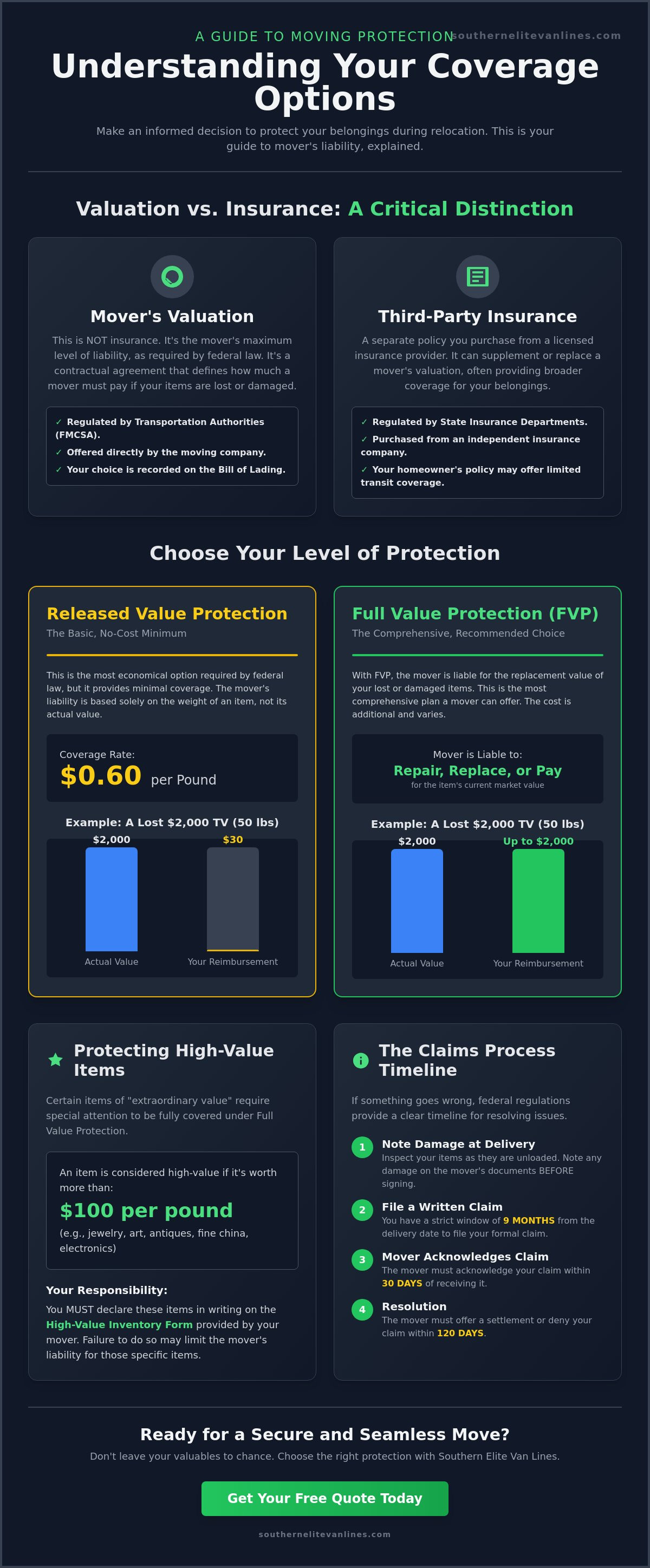
If you lose a $2,000 television during a cross-country relocation, the standard protection required by federal law might only reimburse you $30. This reality often surprises families who assume their belongings are automatically covered for their full replacement value. Having moving insurance options explained is the most effective way to protect your investment and maintain your peace of mind. While the industry average claims rate sits at a low 2.5%, the financial impact of a single mishandled item can be significant if you haven't selected the right level of liability.
You've worked hard to curate your home, and the fear of hidden costs or fine print shouldn't overshadow your new beginning. We understand that "valuation" and "insurance" are often used interchangeably, leading to unnecessary confusion. This guide will provide a clear, authoritative path through the complexities of relocation protection. We'll explore the specifics of Full Value Protection, explain how to document items of extraordinary value, and detail the exact 2026 timelines for filing a successful claim if the unexpected occurs.
Key Takeaways
Understand the vital legal distinction between mover valuation and third-party policies with our moving insurance options explained to ensure your assets are truly covered.
Compare the "no-cost" Released Value Protection against comprehensive Full Value Protection to determine which liability level fits your budget and risk tolerance.
Uncover why standard homeowners insurance often fails to protect belongings while they're in transit, leaving a gap that only professional valuation can fill.
Learn how to properly document items worth more than $100 per pound using a High-Value Inventory Form to guarantee they receive the highest level of care.
Gain clarity on the federal timelines for filing claims, including the strict nine-month window you have to report any loss or damage after your delivery.
Table of Contents
Valuation vs. Moving Insurance: Understanding the Legal Distinction
When you prepare for a major relocation, the paperwork can feel overwhelming. You'll likely see the term "valuation" used repeatedly in your contract. It's the single most important word regarding the safety of your belongings. Many people use "valuation" and "insurance" interchangeably, but they represent two different legal concepts. Having moving insurance options explained correctly helps you avoid a costly mistake before the truck even arrives at your door.
Valuation is the maximum dollar amount a mover is liable for if your goods are lost or damaged while in their care. It's a contractual limit of liability, not a third-party insurance policy. Under state and federal law, moving companies aren't licensed insurance agents. They can't sell you a policy in the traditional sense. Instead, they offer different levels of liability that dictate how much they must pay you if an accident occurs. If you want actual insurance, you must purchase it through a specialized third-party provider or check your existing homeowners policy for transit coverage.
Why the Terminology Matters for Your Move
The distinction between these terms is rooted in how different entities are regulated. State insurance departments oversee insurance companies and their agents. Moving companies, however, follow regulations for moving companies set by transportation authorities. Professional long distant movers are legally obligated to present these liability levels to you in writing before any work begins. This transparency ensures you aren't left guessing about the financial protection of your household goods.
Your choice of protection is officially recorded on the Bill of Lading. This document acts as your primary contract and receipt. It establishes the specific liability level you've selected for your shipment. Once you sign this document, the mover's financial responsibility is locked in. It's vital to review this section carefully to ensure it matches your expectations for the journey ahead.
The Role of Federal Oversight
The Federal Motor Carrier Safety Administration (FMCSA) provides a safety net for consumers through mandatory disclosure requirements. Every interstate mover must provide you with a copy of the "Your Rights and Responsibilities When You Move" booklet. This guide is a tool designed to empower you during a complex process. It outlines exactly what you should expect regarding claims, estimates, and liability. Federal mandates require carriers to offer two distinct types of valuation. This ensures that every customer has access to at least a baseline level of security. Understanding these moving insurance options explained in your contract allows you to make an informed decision for your family's future.
Comparing Protection Levels: Released Value vs. Full Value Protection
Choosing between liability levels is the most critical decision in your moving contract. Federal law requires movers to offer two distinct paths for protecting your property. While one is provided at no additional cost, the other offers a comprehensive safety net that reflects the true value of your belongings. Having these moving insurance options explained clearly helps you weigh the risk against the cost of protection before the first box is loaded.
The primary difference lies in how a carrier calculates the payout for a lost or damaged item. Released Value Protection uses weight as the sole metric for reimbursement. In contrast, Full Value Protection (FVP) treats your shipment as a collection of valuable assets. To make an informed choice, you should visit the federal Protect Your Move website to understand the minimum standards every interstate carrier must uphold. This knowledge empowers you to select a plan that aligns with your specific needs.
The Reality of Released Value Protection
Released Value Protection is the most economical option because it's included in your base moving rate. However, its limitations are significant. This plan covers your items at a rate of $0.60 per pound per article. This means the mover's liability is tied strictly to how much an object weighs, regardless of its actual market value. Consider the "math of loss" for common household items:
A 10lb high-end laptop: You would receive only $6.00 in compensation.
A 100lb designer sofa: Your reimbursement would be capped at $60.00.
A 50lb 4K Television: A total loss would result in a $30.00 check.
This level of protection might suffice for low-value bulk items or robust plastic bins. For most families, however, the gap between $30 and the cost of a new television is a risk too large to ignore. It's a basic safeguard, not a replacement strategy.
The Benefits of Full Value Protection
Full Value Protection is the gold standard for anyone seeking total peace of mind. Under this plan, the mover is liable for the replacement value of lost or damaged goods in your entire shipment. If an item is damaged, the mover has the option to repair it to its original condition, replace it with a similar item, or offer a cash settlement for the current market replacement value. This comprehensive approach is a hallmark of the southern elite van lines experience, where the focus remains on the integrity of your home.
Most FVP plans involve a premium that is typically calculated at about 1% of the total declared value of your shipment. You can often choose a deductible, ranging from $0 to $500, to adjust the upfront cost. This investment ensures that an accidental drop doesn't become a financial burden. If you are planning a high-stakes move, choosing a partner like Southern Elite Van Lines ensures your assets receive the meticulous care they deserve from start to finish.
The Gap in Coverage: Why Homeowners Insurance Often Falls Short
Don't assume your current homeowners policy provides a safety net for your relocation. While your policy protects your belongings while they sit in your living room, the rules change the moment they cross the threshold of your front door. Many people realize too late that their coverage doesn't follow them onto the moving truck. This gap is why having moving insurance options explained by a professional is so important for a secure transition.
Most homeowners insurance operates on a "named peril" basis. This means you're only covered for specific events explicitly listed in your policy, such as fire, lightning, or theft. If a mover accidentally drops your marble coffee table or a box of fine china, it likely won't qualify as a covered event. These "accidents of handling" are the most common risks during a move, yet they're the ones standard insurance is least likely to cover. Relying solely on your home policy can leave you exposed to significant financial loss.
Another hurdle is the "off-premises" limit found in many standard contracts. This clause typically caps coverage at 10% of your total personal property limit for items located away from your primary residence. If you have $100,000 in personal property coverage, only $10,000 might apply to your entire shipment while it's on the road. When you consider the total value of a full household, this limit is often woefully inadequate. Standard insurance deductibles also present a problem. If your deductible is $1,000 and a $600 appliance is damaged, your insurance provides no benefit at all.
Common Exclusions in Standard Policies
Improper packing is the primary reason insurance companies deny moving-related claims. If you pack your own boxes and the contents break, insurers almost always attribute the damage to your preparation rather than a covered peril. Mechanical derangement is another common exclusion; this refers to internal components of electronics or appliances failing during transit without any signs of external impact. Finally, most policies exclude "Acts of God," such as floods or earthquakes, unless you have specifically purchased additional riders for those events.
Questions to Ask Your Insurance Agent
Before you sign your moving contract, call your agent to clarify your current level of protection. Ask specifically if your policy covers "perils of transit" and if there are any exclusions for professional handling. You should also confirm if your coverage remains active while your goods are held in secure storage during your transition. Understanding these details allows you to coordinate your private insurance with your mover's valuation for a seamless, uninterrupted experience. Having these moving insurance options explained by both your agent and your mover ensures you don't discover a coverage gap when it's too late to fix it.
Protecting High-Value Inventory and Extraordinary Items
Protecting your most prized possessions requires more than just selecting a standard liability level. In the moving industry, items of "extraordinary value" are defined as any article worth more than $100 per pound. This category includes everything from antique silverware and fine art to high-end electronics and jewelry. To ensure these items receive the protection they deserve, the High-Value Inventory Form is a non-negotiable requirement. If you fail to declare an extraordinary item on this form, the mover's liability is limited to $100 per pound per article, even if you have purchased Full Value Protection. Having these moving insurance options explained in the context of your specific inventory is the only way to prevent a catastrophic financial loss.
Precision is the hallmark of a successful relocation. When you identify high-value assets early, your moving team can implement specialized handling protocols that go beyond standard procedures. This proactive approach ensures that your most delicate items are tracked and protected from the moment they are inventoried until they are placed in your new home. Clear communication about your inventory's worth allows the carrier to assign the appropriate resources and expertise to your shipment.
The Importance of Professional Packing
Professional packing acts as the first line of defense for your assets. Most carriers use the designation "Packed by Owner" (PBO) for boxes you seal yourself. If a PBO box shows no external damage but the contents are broken, most claims are denied because the carrier cannot verify the original packing quality. Choosing full packing services creates a digital paper trail of the item's condition and shifts the responsibility for safe transit to the experts. For fragile, high-value assets, custom crating provides a rigid outer shell that absorbs the stresses of a long-distance journey, offering a level of security that standard cardboard cannot match.
Specialty Moving: Pianos and Fine Art
Specialty items like pianos or fine art require more than just a sturdy box. These assets often demand custom crating and climate-controlled transit to prevent damage from temperature fluctuations or structural stress. This is particularly true for commercial relocation projects where sensitive server equipment or laboratory instruments are at stake. We recommend taking high-resolution photographs of every high-value item before it is packed to establish a clear baseline of its pre-move condition. This visual documentation is invaluable if you ever need to have moving insurance options explained during a claims process. Secure your high-value assets by choosing a partner that prioritizes precision; contact Southern Elite Van Lines to schedule your professional packing and inventory assessment.
The Claims Process: What to Do if Something Goes Wrong
Delivery day represents the final milestone of your journey, but your role as a vigilant homeowner continues until the last box is unpacked. Even with the most meticulous care, the physical demands of a long-distance relocation can occasionally lead to the unexpected. Understanding the claims process is the final piece of having moving insurance options explained fully. Federal regulations provide a structured timeline for resolution, ensuring that both the customer and the carrier operate within a transparent, professional framework.
For interstate moves, you have a strict nine-month window from the date of delivery to file a written claim for loss or damage. While this window seems generous, immediate action is always the superior strategy. Your first opportunity to protect your interests occurs the moment the truck arrives. You must inspect each item as it enters your home and note any visible damage directly on the delivery receipt before the crew departs. If you discover damage later, retain the item and all original packing materials. Discarding the box or bubble wrap can inadvertently destroy the evidence needed to prove the damage occurred during transit.
Step-by-Step Filing Guide
A successful claim relies on exactness and clear documentation. Begin by taking high-resolution, well-lit photographs of the damage from multiple angles, including the packing materials used. Most premium carriers provide a dedicated digital portal for submitting your formal claim form, which streamlines the process and creates a permanent record of your submission. Once you file, the mover has 30 days to acknowledge receipt of your claim and 120 days to either deny the claim or provide a formal settlement offer. This methodical progression ensures that your case is reviewed with the professional attention it deserves.
Avoiding Claim Denials
The most common pitfall for customers is signing a "clean" delivery receipt without a thorough inspection. A signature on a blank receipt suggests that all goods arrived in perfect condition; this can make it significantly more difficult to pursue a claim for visible damage later. If you encounter "unseen damage," which refers to items that appear fine externally but are broken inside the box, report it to the carrier as soon as it is discovered. Prompt reporting reinforces the validity of your claim and shows you've been attentive. At Southern Elite, our commitment to moral character and exactness means we treat every claim with the same level of integrity we apply to the move itself. We believe a fair resolution is the only acceptable conclusion to our shared journey, providing you with the final sense of security you deserve. Having these moving insurance options explained ensures you remain in control of your relocation from the first box to the final claim resolution.
Securing Your Future with Confidence
A successful relocation is built on transparency and meticulous planning. By distinguishing between basic valuation and comprehensive protection, you ensure that your household assets remain secure from the first box to the final delivery. You now understand the necessity of declaring extraordinary items and the importance of adhering to federal claim timelines. With these moving insurance options explained, you possess the knowledge to make strategic decisions that prioritize your family's peace of mind during this significant transition.
Protecting your legacy requires a partner who values exactness and moral character. Southern Elite Van Lines provides nationwide coverage using modern, secure vehicles and specialized protocols for high-value inventory protection. As an FMCSA licensed and insured carrier, we manage the logistical complexities with a sense of calm competence. Request a Transparent Moving Quote with Full Protection Options today to experience a relocation defined by professional care and precision. Your journey deserves the steady hand of a dependable expert who views your satisfaction as the ultimate measure of success.
Common Questions About Moving Protection
Is moving insurance mandatory for a long-distance move?
No, you aren't legally required to purchase a third-party insurance policy, but choosing a liability level is a mandatory part of your moving contract. Federal law requires every interstate mover to offer you two choices: Released Value Protection and Full Value Protection. You must select one of these options and sign the Bill of Lading before your household goods are loaded onto the truck.
How much does Full Value Protection typically cost?
The cost for Full Value Protection is generally calculated as a percentage of the total declared value of your shipment. Most plans cost approximately 1% of the total value you assign to your belongings. For example, protecting a shipment valued at $60,000 would typically cost around $600. You can often adjust this premium by choosing different deductible amounts, which usually range from $0 to $500.
What does '60 cents per pound' actually mean in a real-world scenario?
This figure represents the minimum legal liability for interstate movers under Released Value Protection. It's a weight-based calculation that ignores the actual market value of your items. If a 100-pound dresser is destroyed during transit, the mover is only liable for $60. This applies whether the furniture is a basic model or a high-end designer piece, making it a risky choice for valuable households.
Does my homeowners insurance cover my belongings while they are in a moving truck?
Standard homeowners policies often provide very limited coverage for personal property while it's in transit. Most policies only cover "named perils" like fire or theft and specifically exclude damage caused by movers dropping or mishandling items. Additionally, "off-premises" coverage is frequently capped at 10% of your total personal property limit, which may not cover the full value of a large relocation.
What is an 'Extraordinary Value' item and how do I protect it?
An item is classified as having "extraordinary value" if it's worth more than $100 per pound. This category includes jewelry, fine art, antiques, and high-end electronics. To protect these items, you must list them on a High-Value Inventory Form before the move begins. If you fail to declare them, the mover's liability for those specific items is limited to $100 per pound, even under Full Value Protection.
Can I buy moving insurance from a third-party company?
Yes, you can purchase a separate moving insurance policy from a licensed insurance provider. This is distinct from the valuation coverage offered by your mover. Third-party insurance often provides "all-risk" coverage, which can include protection against natural disasters or mechanical failure. Having these moving insurance options explained by both your mover and an insurance agent ensures you have no gaps in your financial protection.
What happens if I pack my own boxes and something breaks?
Moving companies are generally not liable for the contents of "Packed by Owner" (PBO) boxes unless the exterior of the box shows clear signs of physical damage. If the box arrives in perfect condition but the items inside are broken, the carrier typically denies the claim based on improper packing. Professional packing services are the most effective way to ensure the mover accepts full liability for the safety of your items.
How long do I have to file a claim after my move is complete?
You have exactly nine months from the date of delivery to file a written claim for loss or damage with an interstate moving company. After you submit the claim, the mover has 30 days to acknowledge it and 120 days to provide a settlement offer or deny the claim. Having your moving insurance options explained early in the process helps you manage these federal timelines and maintain a clear path to resolution.



Comments