
Moving an Apartment Across the Country: The 2026 Logistics & Cost Guide
- nadineharoon
- 3 days ago
- 12 min read
What if the most challenging aspect of moving an apartment across the country isn't the thousands of miles on the road, but the final thirty feet through a narrow hallway? For many professionals, the logistics of a long-distance relocation are often complicated by strict building management rules and the physical constraints of urban living. You've likely already felt the stress of coordinating elevator times or worrying about hidden fees for stairs. It's a complex puzzle that requires more than just a truck; it requires a strategic partner who understands the precision needed for a damage-free transition.
We agree that your peace of mind is just as valuable as the items being moved. This guide promises to help you master the intricacies of apartment relocation by providing expert strategies for logistics and cost management. You'll learn how to navigate building requirements, secure predictable pricing, and ensure your move remains professional and efficient. We will explore the essential steps for coordinating timing with new leases and securing a seamless, low-stress experience from your current home to your next destination.
Key Takeaways
Learn how to navigate strict building management requirements and the COI process to ensure your move begins without logistical delays.
Understand the differences between flat-rate and weight-based pricing models to secure predictable costs and avoid common hidden fees.
Master the "Cost Per Square Foot" rule to effectively downsize your inventory before moving an apartment across the country.
Discover how to coordinate lease timing and professional transit schedules to eliminate stressful gaps between your old and new homes.
Gain insight into specialized apartment handling techniques that protect your belongings in shared hallways and restrictive urban spaces.
Table of Contents
Navigating the Unique Challenges of Moving an Apartment Across the Country
Essential Logistics: From Service Elevators to Certificates of Insurance
Evaluating Costs: Professional Long-Distance Movers vs. DIY Containers
Strategic Packing and Downsizing for Small-Space Relocations
The Southern Elite Advantage: Premium Care for Your Apartment Transition
Navigating the Unique Challenges of Moving an Apartment Across the Country
Moving an apartment across the country is a specialized operation that requires a high degree of precision. It's a logistical paradox where having less stuff actually increases the complexity of the journey. In 2026, the interstate moving industry is more regulated than ever. This means you must verify that your carrier holds a valid USDOT number and is registered with the Federal Motor Carrier Safety Administration. While a DIY approach might seem cheaper at first glance, the total cost of stress often makes professional residential moving the more strategic choice. This includes the risk of property damage, the physical exhaustion of long-distance driving, and the hidden fees associated with truck rentals that many people overlook.
Why Apartment Moves Differ from Residential House Moves
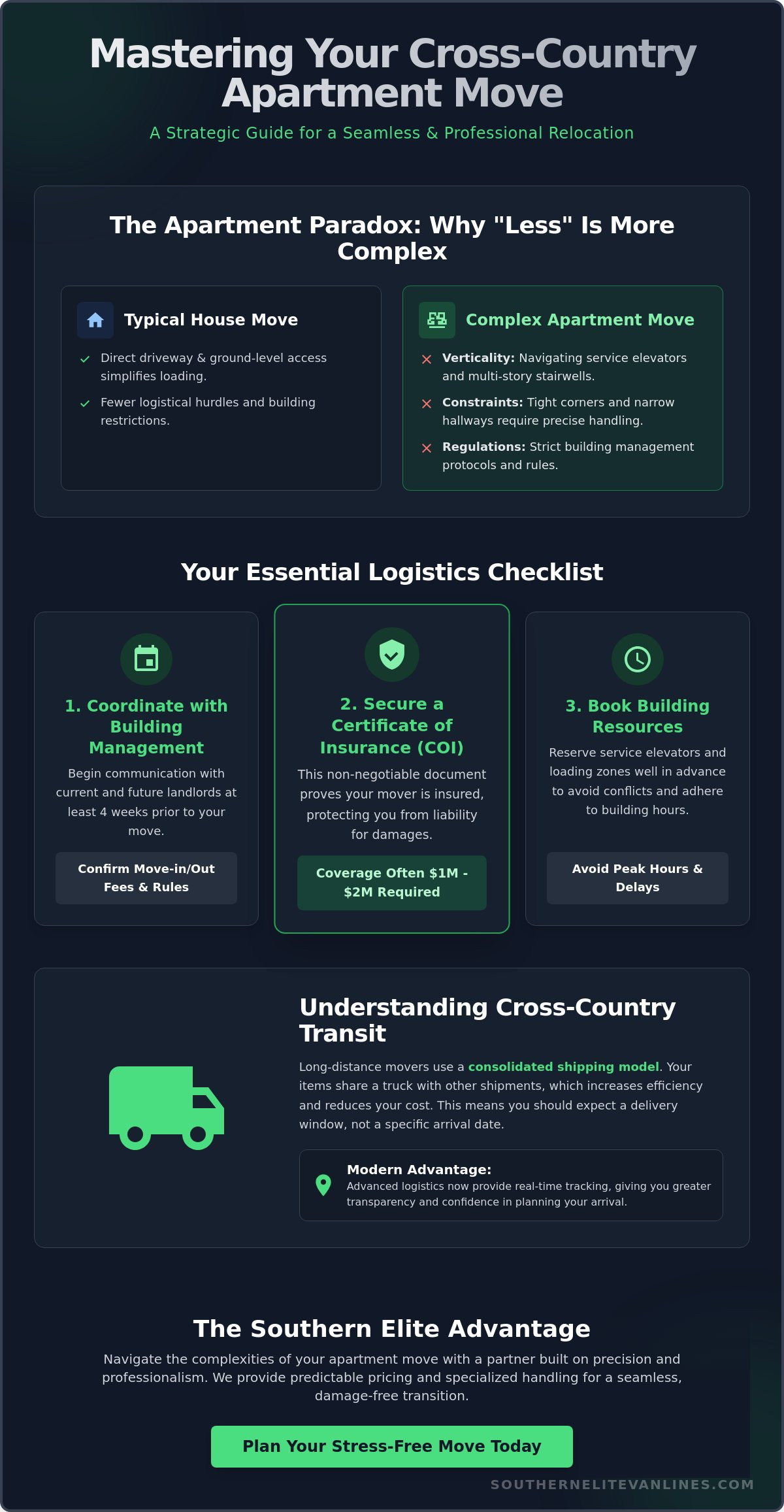
Apartment relocations are defined by verticality. Unlike a house with a driveway, an apartment requires navigating service elevators and multi-story stairwells. These factors significantly impact labor requirements and timing. Narrow hallways and tight corners are common in urban environments, demanding precise handling to avoid damage to furniture or walls. You also have the added responsibility of maintaining neighborly relations. A professional moving company ensures that shared spaces like lobbies and elevators remain clean and accessible, adhering to strict building management protocols during the transit process. This level of care prevents the friction often caused by blocking hallways or using elevators during peak hours.
The Reality of Cross-Country Transit Times
When moving an apartment across the country, most providers utilize a consolidated shipping model. This approach combines multiple small shipments into one large trailer to increase efficiency and reduce costs for you. Because the truck makes several stops to deliver other shipments, you should expect a delivery window rather than a specific arrival date. In 2026, logistics technology has advanced to provide real-time tracking and increased transparency. You can now monitor your shipment's progress across the United States with greater accuracy. This data allows you to plan your arrival at your new residence with confidence, ensuring you're ready to receive your items when the truck pulls up.
Essential Logistics: From Service Elevators to Certificates of Insurance
Moving an apartment across the country involves more than just packing boxes; it requires navigating a labyrinth of administrative requirements. Building managers often act as gatekeepers. They prioritize the safety and convenience of all residents, which means you must satisfy their "Red Tape" checklist long before the truck arrives. This includes securing formal permission for the move date and providing documentation that your chosen team meets the building's safety standards. Taking these steps early prevents last-minute delays that could disrupt your entire relocation schedule.
Understanding the Certificate of Insurance (COI)
A Certificate of Insurance is a non-negotiable document for high-rise or managed apartment complexes. It serves as proof that your residential moving partner carries adequate liability and workers' compensation insurance. Premium buildings typically demand coverage limits reaching $1 million or $2 million to protect against property damage. Using uninsured or underinsured labor puts you at significant financial risk. If a mover damages an elevator or a common area wall, the building management will hold you personally liable for the repairs if the moving company cannot cover the cost.
Coordinating with Building Management
Communication with your current and future landlords should begin at least four weeks before your departure. Ask specific questions about their move-in and move-out fee structures. In 2026, many luxury buildings have implemented standardized fees to cover the wear and tear on facilities during transitions. You should also confirm their policies regarding floor protection and wall padding. Most managers require Masonite boards for marble floors or specific padding for elevator cabs. Ensuring your movers have these materials ready is essential for a smooth exit and entry.
Strategic timing is the final piece of the logistical puzzle. You must book elevator banks and loading zones well in advance to avoid conflicts with other residents. Most buildings restrict moving hours to specific windows, often between 9:00 AM and 4:00 PM on weekdays. Failing to secure a dedicated elevator can result in your crew waiting for hours, which unnecessarily increases your labor costs. Additionally, investigate local parking permit requirements. In high-density urban areas, a truck parked without a permit can incur heavy fines or even be towed. Securing these permits early ensures the team can focus on the physical task of moving an apartment across the country rather than avoiding traffic enforcement.
Evaluating Costs: Professional Long-Distance Movers vs. DIY Containers
Choosing how to manage the financial aspect of moving an apartment across the country requires a clear-eyed look at the data. In 2026, the industry has largely shifted toward two primary pricing structures: flat-rate and weight-based models. A flat-rate quote provides a binding price based on a detailed inventory, offering the highest level of predictability for your budget. Weight-based models depend on the actual mass of your shipment as measured on certified scales. While weight-based pricing can be economical for minimalist studio dwellers, it introduces uncertainty until the truck is weighed. Federal regulations provide a safety net here; for non-binding estimates, movers can't charge more than 110% of the original estimate at the time of delivery.
Apartment residents should be particularly vigilant about "access fees" that don't always appear in a basic DIY rental quote. Because apartment buildings often involve long hallways or multiple flights of stairs, professional movers may apply "long carry" or "stair carry" charges. If a large tractor-trailer cannot physically reach your building entrance due to narrow city streets, a "shuttle service" using a smaller box truck will be necessary. Small load specialists provide better value for apartments because they optimize space in consolidated shipments, preventing you from paying for the empty "dead air" of a half-empty truck.
The Professional Full-Service Advantage
A premium long-distance move includes more than just transit. You're paying for professional inventory management, where every item is tagged and tracked. This is essential for small-batch apartment shipments that share space on a trailer. Beyond the transit itself, full-service quotes include essential valuation coverage. While federal law mandates a basic 60 cents per pound protection at no extra cost, professional teams offer Full Value Protection. This ensures your high-end electronics or designer furniture are covered for their actual replacement value across a 2,000-mile journey, providing a level of security that DIY insurance rarely matches.
When DIY Containers Make Sense (And When They Don't)
Portable containers are often marketed as the budget choice, but they present a significant "parking problem" for apartment dwellers. Most urban building managers won't permit a container to sit in a shared loading zone for days. You'll likely find yourself paying for city permits or risking heavy fines. Loading a container also places a massive physical toll on you. You're responsible for the heavy lifting, the strategic packing to prevent shifting, and the securing of your own goods. Once you account for the cost of truck fuel, multiple nights in hotels, and the value of your own time, the DIY gap shrinks. Professional movers become the more cost-effective choice once your inventory exceeds the capacity of a single small shipping container or requires more than two days of solo driving.
Strategic Packing and Downsizing for Small-Space Relocations
Moving an apartment across the country requires a ruthless assessment of your belongings. Every cubic foot of space in a moving truck represents a specific financial commitment. We call this the "Cost Per Square Foot" rule. If the expense of transporting an old sofa exceeds its replacement value at your destination, it's a financial error to keep it. This is especially true for modular furniture made of particle board, which often loses structural integrity during the vibrations of a 2,000-mile journey. By downsizing strategically, you reduce the weight of your shipment and lower your total transit costs.
The Art of the Apartment Purge
Effective auditing begins with digital inventory tools. Use your smartphone to document every item in each room; this list helps you decide what survives the trek and serves as a vital record for insurance purposes. When handling IKEA-style furniture, consider if it's worth the risk. These pieces aren't designed for multiple moves. Instead of paying to ship them, utilize sustainable disposal options common in urban centers. Local charities often provide pick-up services for gently used items, allowing you to downsize while supporting the community. This approach ensures you only pay to move items that hold genuine value or utility.
Packing for Fragile Urban Transit
Once you've narrowed down your inventory, focus on protection. High-density apartment living means your items will pass through tight elevators and shared hallways. Professional long distant movers utilize specialized crating for electronics and high-value decor to mitigate the risk of damage. This level of care is vital when moving an apartment across the country, as items face unique stresses during long-haul transit. Your labeling system should correspond directly to your new apartment's layout. Instead of just marking a box "Kitchen," specify "Kitchen, Upper Cabinets" to streamline the unpacking process and help movers place boxes exactly where they belong.
Don't forget the "First Night Box." This container should hold essentials like toiletries, basic tools, chargers, and bedding. It's the first thing you'll need after a long day of travel. If you're overwhelmed by the prospect of boxing up a lifetime of belongings, our team offers full packing services to handle the heavy lifting for you. This ensures your items are secured with professional-grade materials designed for the rigors of interstate transit, providing you with a seamless start in your new city.
The Southern Elite Advantage: Premium Care for Your Apartment Transition
Southern Elite Van Lines understands that moving an apartment across the country isn't just about hauling boxes. It's about navigating the intricate requirements of luxury high-rises and urban management. We bridge the gap between the logistical power of a national carrier and the meticulous, boutique attention of a specialist. Our team handles the specific red tape, from professional COI management to building compliance, so you don't have to. We operate a fleet of modern, reliable vehicles specifically maintained for coast-to-coast transport. This ensures your belongings are protected by the latest safety technology throughout the long-haul journey, providing you with a sense of security from the first mile to the last.
Nationwide Reach with Personal Precision
Our operations span the entire United States, but we maintain a small-team feel for every client. You'll work with a dedicated moving coordinator who serves as your single point of contact. This expert manages the complex timing of interstate logistics, ensuring that your arrival at the new building aligns perfectly with your reserved elevator bank. For a deeper look at our process, see Southern Elite Van Lines: A Case Study in Premium Nationwide Relocation. We treat every shipment with exactness, providing a level of moral character and reliability that is rare in the high-volume moving industry. Our coordinators handle the heavy lifting of scheduling, so you can focus on settling into your new city.
Seamless Transitions and Secure Storage
Lease start dates rarely align perfectly with move-out deadlines. To solve this, we offer short-term storage solutions designed to bridge the gap between your old and new homes. Your items remain in a secure, climate-controlled environment until your new residence is ready for occupancy. This flexibility is a cornerstone of our service, allowing for a transition that isn't rushed or compromised. We are committed to transparent pricing. You won't find hidden "apartment fees" or surprise surcharges for stairs in your final bill. Our goal is to provide an effortless, uninterrupted experience that values your peace of mind as much as your physical property. Moving an apartment across the country should be the start of an exciting new chapter, not a source of logistical dread.
Ready to experience a higher standard of service? Get your tailored apartment moving quote from Southern Elite Van Lines today and let us handle the complexities of your next journey with the steady, expert hand you deserve.
Secure a Seamless Start in Your New City
Mastering the complexities of moving an apartment across the country requires a blend of logistical precision and strategic planning. We've explored how navigating building management requirements, such as Certificates of Insurance and elevator bookings, ensures your move begins without unnecessary friction. By applying the "Cost Per Square Foot" rule to your inventory, you can significantly reduce the weight of your shipment and focus your budget on items that truly matter. Choosing professional expertise over the hidden burdens of DIY containers provides the security of predictable pricing and physical relief.
Southern Elite Van Lines stands ready as your dependable partner in this journey. As specialists in interstate logistics, we provide expert building compliance management and offer Full Value Protection options to safeguard your belongings across every mile. Our team is committed to delivering a polished, high-end experience that prioritizes your peace of mind. Request Your Comprehensive Nationwide Apartment Moving Quote today to begin your transition with confidence. Your new beginning is just a well-coordinated move away; we're here to ensure it is effortless and uninterrupted.
Frequently Asked Questions
How much does it typically cost to move a one-bedroom apartment across the country?
The total cost depends on the volume of your belongings and the total mileage of your journey. Industry pricing is typically calculated based on either a flat rate or the weight of the shipment. While smaller apartments naturally cost less than large homes, the logistical complexity of urban access can influence the final quote. We suggest obtaining a detailed inventory assessment to lock in a predictable price for your specific transition.
What is a Certificate of Insurance (COI) and why does my apartment manager need it?
A Certificate of Insurance is a document verifying that your movers carry active liability and workers' compensation coverage. Building managers require this to ensure the property is protected against accidental damage to elevators, lobbies, or hallways during the move. It shifts the financial responsibility from you to the moving company's insurance provider, ensuring the building's integrity is maintained without risk to your security deposit.
Can I leave a moving container on the street in a major city?
Leaving a container on a city street often requires a specific municipal permit and building manager approval. In high-density areas, many buildings prohibit containers entirely because they block loading zones or fire lanes. You should verify local parking ordinances and building rules at both your origin and destination. Failing to secure the proper permissions can result in heavy fines or your container being towed before you can unload it.
How long does it take for my furniture to arrive in a cross-country move?
Transit times for moving an apartment across the country typically range from 7 to 21 business days. This window exists because apartment shipments often utilize a consolidated model, where one truck carries several households to increase efficiency. Technology in 2026 allows for real-time tracking, giving you a clearer view of the delivery window as the driver progresses. Your moving coordinator will provide updates to ensure you are ready for the truck's arrival.
Should I take my furniture apart or let the professional movers do it?
You should generally let professional movers handle furniture disassembly to ensure the highest level of protection. They possess the tools and experience to take apart beds and desks without damaging the hardware or structural integrity. This is especially vital for modular furniture that requires delicate handling. Proper disassembly ensures that your items are packed efficiently and reassembled correctly at your new home, saving you time and physical effort.
Are there hidden fees for moving out of a third-floor apartment with no elevator?
Fees for stairs, often called "stair carries," are standard in the moving industry when an elevator is unavailable. Most companies charge a set rate for every flight of stairs beyond the first floor to account for the additional labor and time required. You should disclose the exact floor and access details during your initial quote. This transparency prevents unexpected surcharges on moving day and allows the team to arrive with the correct equipment.
What items are moving companies not allowed to transport across state lines?
Federal regulations prohibit moving companies from transporting hazardous materials such as gasoline, propane tanks, and fireworks. Perishable foods and living plants are also restricted on long-distance hauls to prevent spoilage or the transfer of pests between states. You should keep high-value personal items like jewelry, cash, and important documents with you during the transit. Your coordinator can provide a complete list of non-allowable items to help you pack safely.
How do I protect my security deposit during the move-out process?
Protect your security deposit by documenting the condition of your apartment with photos before the movers arrive. Use Masonite boards or heavy-duty felt pads to prevent floor scratches in high-traffic areas. Professional movers use wall padding in tight corners to avoid scuffs and dents. Repairing small nail holes and ensuring the apartment is clean after the truck is loaded will help you avoid common deductions from your landlord during the final inspection.


Comments