
Long Distance Moving Checklist: The 2026 Strategic Guide to Nationwide Relocation
- nadineharoon
- Jul 15
- 12 min read
Updated: Jul 16
What if the most daunting part of your cross-country relocation isn't the miles covered, but the uncertainty of who is actually handling your high-value possessions? Moving your life across state lines is a massive logistical operation that often feels like a high-stakes gamble; it requires a level of precision that goes beyond simple transport. We recognize that the fear of rogue movers or hidden delivery fees can overshadow the excitement of a new beginning. That's why we've created the definitive 2026 long distance moving checklist to help you maintain total control and ensure your belongings are treated with meticulous care.
You deserve a transition defined by transparency and expert coordination rather than logistical guesswork. This guide provides the strategic framework you need to navigate FMCSA regulations, understand the 110% rule for estimates, and secure a single point of contact for your entire journey. We'll walk you through the process of selecting a licensed, national-scale partner who prioritizes your peace of mind. By following this methodical approach, you can transform a complex interstate move into an effortless, well-planned success that protects your legacy and your future.
Table of Contents
Defining Long-Distance Moving: A Checklist for Regulatory Compliance
The Financial Checklist: Navigating Weight-Based vs. Flat-Rate Pricing
Vetting Your Moving Partner: A Credential and Security Checklist
The Strategic Packing Checklist: Transit-Ready Protection for Long-Haul Moves
Executing a Seamless Transition: The Full-Service Strategic Advantage
Defining Long-Distance Moving: A Checklist for Regulatory Compliance
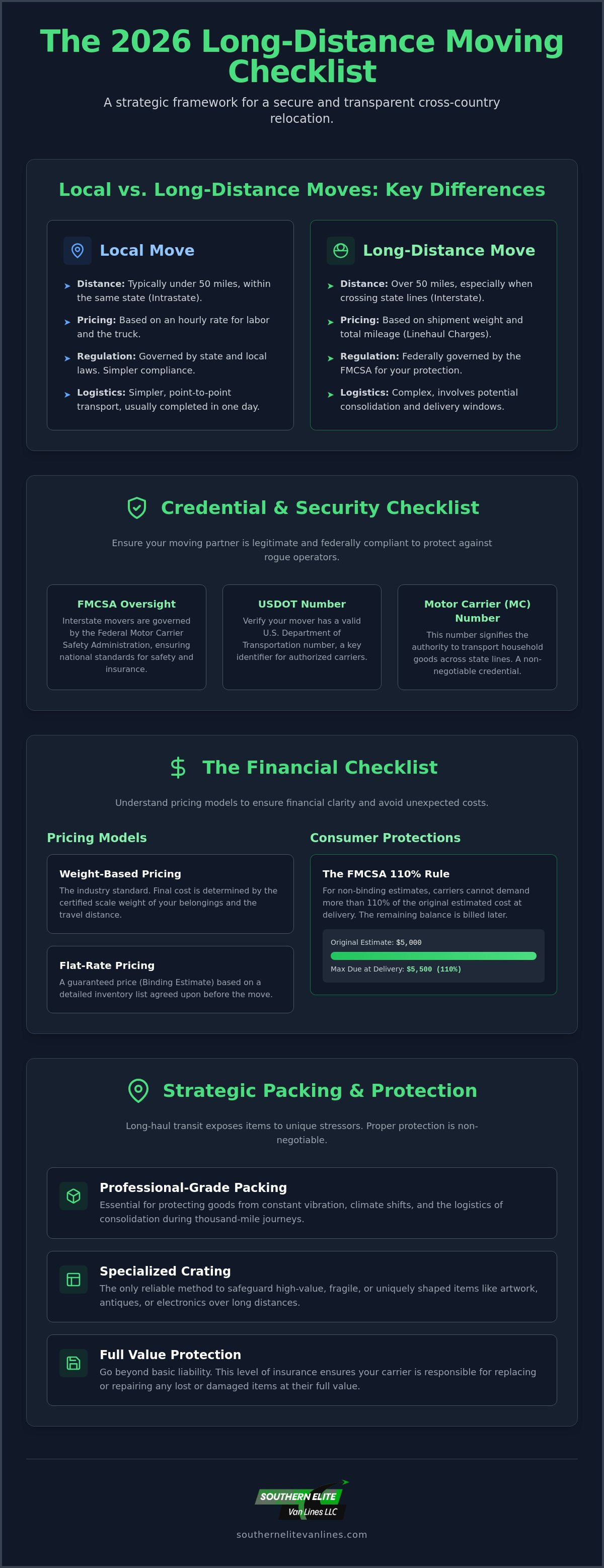
A move across town is a matter of hours; a move across the country is a matter of strategy. While a local relocation typically involves a simple hourly rate and a short drive, a nationwide journey introduces a complex web of federal oversight and logistical requirements. Most industry experts define a long-distance move as any relocation exceeding 50 miles, but the most critical distinction occurs when you cross a state line. At that precise moment, your move transforms from a local service into a federally regulated operation governed by the Federal Motor Carrier Safety Administration (FMCSA).
Understanding the legal nuances of Defining Long-Distance Moving is the first step in protecting your investment. When you transition from local to long-haul, the pricing structure shifts from hourly labor to linehaul charges. These charges are calculated based on the weight of your shipment and the total mileage. This shift requires a different approach to your long distance moving checklist, as precision in your initial inventory becomes the foundation for your entire moving quote. You aren't just paying for time; you're paying for the specialized space and fuel required to transport your life across the map.
Interstate vs. Intrastate: Why the Distinction Matters
The difference between moving within a state (intrastate) and crossing state lines (interstate) is a matter of legal protection. Interstate moving is a federally regulated logistics service that involves transporting household goods across state lines under the authority of the FMCSA. This federal oversight ensures that your carrier maintains specific insurance minimums and follows strict safety protocols. For a successful long distance moving checklist, you must verify that your mover possesses a valid USDOT number and a Motor Carrier (MC) number. These credentials act as your shield against rogue operators, ensuring that your moving partner is held to the highest national standards of moral character and operational exactness.
The Long-Haul Journey: What Happens During Transit
Long-distance transport subjects your belongings to unique stressors that a local move simply doesn't encounter. Over a 1,000-mile journey, household goods face constant vibration, varying climate conditions, and the logistical necessity of consolidation. Consolidation allows a carrier to combine multiple shipments into a single modern fleet trailer, which increases efficiency and reduces costs for the consumer. However, this process means your delivery will likely occur within a "delivery window" rather than at a specific hour. Professional-grade packing and a single point of contact become essential during this phase. They provide the steady, expert hand needed to guide your goods through transit and ensure they arrive in the same condition they left, regardless of the distance covered.
This level of care should also extend to your personal vehicles; if you need a professional to handle the logistics of automobile shipping, click here to learn about the specialized services offered by AutoPlex Transport Company.
The Financial Checklist: Navigating Weight-Based vs. Flat-Rate Pricing
Financial clarity is the cornerstone of a successful relocation. Your long distance moving checklist must prioritize a deep understanding of how your final cost is calculated. Most interstate quotes are built on linehaul charges. These charges represent the basic cost of transporting your goods from point A to point B. This figure depends on three primary variables: the total weight of your inventory, the distance of the transit, and the level of service required. Understanding these factors prevents the anxiety of unexpected costs on delivery day.
Transparency in 2026 relies heavily on the type of estimate you sign. A binding estimate guarantees the total cost based on the inventory listed. Conversely, a non-binding estimate provides a professional projection where the final price is determined by the actual weight after the truck is loaded. The FMCSA offers A Credential and Security Checklist to help you verify that your mover follows federal regulations, such as the 110% rule. This rule prevents carriers from demanding more than 10% above a non-binding estimate at the time of delivery, with any remaining balance billed within 30 days.
Weight-Based Fees: The Industry Standard
This method remains the standard for nationwide moves. Professional movers use certified scales to weigh the truck both before and after loading your items. The resulting difference is the official weight of your shipment. This model is often the most equitable choice for large homes with significant furniture volume. It ensures you pay only for the exact mass being transported. It eliminates the ambiguity of visual estimates and provides a clear, data-driven path to your final total.
Flat-Rate Options: Predictability for Your Budget
Flat-rate pricing offers a single, guaranteed price regardless of the final weight. This is contingent on your inventory remaining unchanged from the initial quote. This option is ideal for corporate relocations or families who require absolute budget certainty. Success with this model requires extreme inventory precision during the initial digital or in-person walkthrough. If you prefer a transparent, guaranteed price for your move, a flat-rate agreement provides the stability needed for a stress-free transition.
Vetting Your Moving Partner: A Credential and Security Checklist
Choosing a mover is more than a simple price comparison; it's a critical security decision. You're entrusting your entire household to a team that will traverse multiple state lines over several days. Your long distance moving checklist must include a rigorous verification process to separate established professionals from high-risk operators. Every legitimate interstate carrier must display their US DOT and MC (Motor Carrier) numbers prominently. These identifiers act as a federal license, allowing you to track a company's safety record and legal authority to operate across the country.
Liability coverage is another non-negotiable security layer that requires your attention. Federal law requires movers to offer Released Value Protection at no cost, but this covers only $0.60 per pound per item. For a premium experience, you should prioritize Full Value Protection. This comprehensive option ensures the mover is liable for the replacement value of lost or damaged goods. Review the Federal Motor Carrier Safety Administration's Moving Checklist to understand these rights in detail before you sign any contract. It's the best way to ensure your high-value items are handled with the financial protection they deserve.
Be wary of red flags that signal a "rogue" mover. A low-ball quote that significantly undercuts the industry average is often a lure for future "hostage load" scenarios where prices are hiked mid-transit. Always verify that a company has a physical headquarters rather than just a glossy website or a PO box. A national-scale expert will have a brick-and-mortar presence and a modern, identifiable fleet. These physical assets provide a level of accountability that independent "digital-only" brokers simply can't offer.
Verifying Credentials and Compliance
Use the FMCSA "Protect Your Move" portal to cross-reference a company's complaint history and insurance status. High-end providers like Southern Elite Van Lines maintain standards that exceed basic compliance, focusing on exactness and moral character. A robust long distance moving checklist ensures your partner is not just a transport service but a licensed strategist committed to federal safety protocols and transparent business practices.
The Role of Professionalism and Character
The quality of the crew inside your home defines the moving experience. Career movers bring a level of meticulous care that seasonal labor cannot match. They treat fragile heirlooms and high-value inventory with the respect they deserve, utilizing specialized techniques for long-haul protection. Look for a partner who provides a single point of contact. This ensures clear communication and a shared journey from the first box packed to the final delivery in your new home.
The Strategic Packing Checklist: Transit-Ready Protection for Long-Haul Moves
Standard corrugated boxes often fail during a 1,000-mile journey because they aren't designed for the sustained kinetic energy of a cross-country trailer. Your long distance moving checklist must prioritize "transit-ready" packing techniques that account for more than just lifting and carrying. In a long-haul scenario, your belongings face constant road vibrations and minor shifts for 20 to 40 hours of drive time. These repetitive micro-movements can loosen internal components in electronics or cause finish-rub on fine wood if you don't use high-density padding and double-walled containers.
Inventory management acts as the backbone of long-haul security. Every item requires a unique identifier that matches the official bill of lading. This level of exactness prevents loss during the consolidation process, where shipments are carefully organized within a modern fleet trailer for maximum efficiency. Specialized crating is a necessity for fragile heirlooms, stone tabletops, or delicate artwork. These custom wooden enclosures provide a rigid skeleton that protects against the multi-directional forces inherent in nationwide transport, ensuring your most prized possessions remain immobile and secure.
Full vs. Partial Packing Services
Deciding between full and partial packing services is a calculation of both time and liability. Full Packing Services involve professional crews who utilize high-quality materials to wrap every individual item, ensuring each box meets the carrier's strict safety standards for interstate transit. If you choose a partial approach to manage your budget, focus professional labor on your most vulnerable inventory. Professional-grade moving blankets and heavy-duty pads are essential tools. They act as a critical shock absorber between your furniture and the trailer walls, preventing the scuffs and scratches that often plague DIY packing efforts.
Secure Storage Solutions in 2026
Nationwide moves frequently involve a transitional gap between your move-out date and the moment you receive keys to your new residence. Secure storage becomes a strategic asset during this period. Short-term storage in a climate-controlled facility is vital for items sensitive to temperature and humidity fluctuations, such as antique furniture, musical instruments, and sophisticated electronics. In 2026, premium warehouse facilities utilize advanced environmental monitoring to ensure your goods remain in a stable state. This prevents the warping or internal damage that can occur in standard, non-regulated units.
Peace of mind comes from knowing your life's work is housed in a secure, monitored environment that mirrors the care taken during transport. Whether you require a few weeks of transitional space or long-term storage, ensure the facility is an integrated part of your mover's logistics chain to eliminate the risks of multiple hand-offs. If you're ready to secure a partner who handles every detail with perfection, explore our Full Packing Services to ensure your inventory is protected from the very first mile.
Executing a Seamless Transition: The Full-Service Strategic Advantage
Choosing to manage a cross-country move independently often results in a hidden "stress tax" that far outweighs the perceived savings of a DIY approach. When you factor in the costs of specialized equipment, fuel, lodging, and the high risk of transit damage, the logistical burden becomes overwhelming. A professional, single-source provider eliminates these variables by offering a streamlined operation that covers everything from packing to final delivery. This strategic approach is the final, most important entry on your long distance moving checklist because it shifts the responsibility from your shoulders to a team of licensed experts.
The Southern Elite philosophy centers on meticulous planning and moral character. We don't just transport boxes; we manage a complex life event with exactness and care. Our process is designed to be a supportive partnership, ensuring that every detail of your relocation is handled with professional-grade precision. By choosing a full-service partner, you gain the confidence that your move is in the hands of strategists who value your peace of mind as much as the physical safety of your goods. This commitment to perfection is what allows for an effortless, uninterrupted experience from start to finish.
The Strategic Advantage of Professional Logistics
Precision in timing is what separates a successful relocation from a chaotic one. Expert coordination by seasoned long distant movers ensures that your delivery window is respected and that every permit and regulatory requirement is handled in advance. By integrating high-level commercial relocation strategies into residential moves, we apply a corporate level of efficiency to your personal transition. A dedicated logistics partner views your inventory not as cargo, but as the physical foundation of your next chapter, treating every heirloom with the same vigilance they would their own.
Your New Beginning Starts with the Right Partner
Completing your long distance moving checklist involves more than just checking off tasks; it's about choosing a partner that provides calm confidence during the inherent chaos of moving. A seamless nationwide transition requires a steady hand and a clear, logical progression of services. From the initial inventory to the final unpacking at your new destination, the right partner ensures you feel both practically informed and emotionally supported. Your journey across the country doesn't have to be a source of anxiety. With a strategist by your side, it becomes an exciting gateway to your new life. Take the first step toward an effortless relocation and Contact Southern Elite Van Lines for your nationwide moving quote today to receive a transparent 2026 moving estimate.
Secure Your Future with Strategic Relocation Planning
A successful interstate move is built on a foundation of regulatory knowledge and financial transparency. By following this 2026 long distance moving checklist, you've gained the essential tools to verify federal compliance and navigate the nuances of weight-based pricing. You now understand that protecting your legacy requires more than just transport; it demands specialized handling and a partner who treats your high-value items with meticulous care. Whether you're relocating a single household or an entire corporation, the right strategy transforms a complex operation into an effortless journey.
Southern Elite Van Lines provides the steady, expert hand you need for a seamless transition across all 48 contiguous states. Our comprehensive service model integrates professional full-service packing and secure storage into a single, coordinated operation. We prioritize your peace of mind by utilizing a modern fleet and high-quality materials to safeguard every item. We focus on logistical perfection so you can focus entirely on the excitement of your new beginning. It's time to move with the confidence that only a national-scale expert can provide.
Get Your Transparent Nationwide Moving Quote from Southern Elite Van Lines today. We're ready to guide you home with the precision and support you deserve.
Frequently Asked Questions
What is considered a long-distance move in 2026?
Any move exceeding 50 miles is generally categorized as long-distance, though the most significant distinction involves crossing state lines. These interstate moves are governed by federal FMCSA regulations. Whether you're moving 100 miles or 3,000, your long distance moving checklist should account for the regulatory and logistical shifts that occur when leaving your current municipality or state.
How do national out-of-state movers calculate their prices?
Pricing for nationwide relocations is primarily based on the weight of your inventory and the total distance traveled, known as linehaul charges. Movers use certified scales to ensure accuracy. Additional factors include the level of packing service selected and any specialized crating requirements for fragile items. This data-driven approach provides a clear, transparent framework for your final quote.
How far in advance should I book my long-distance movers?
You should ideally book your moving partner 8 to 12 weeks before your desired move date. This is especially critical if you plan to relocate during the peak season between May and August. Early booking ensures you secure your preferred dates and allows for a more methodical, stress-free planning phase. It gives the carrier time to coordinate the logistics of your specific route.
What is the difference between a binding and non-binding estimate?
A binding estimate guarantees the total cost of your move based on the inventory listed at the time of the quote. A non-binding estimate is a professional projection where the final price is determined by the actual weight of the loaded truck. Under the federal 110% rule, movers cannot demand more than 10% above a non-binding estimate at the time of delivery.
Are my items insured during a nationwide move?
Yes, federal law requires movers to provide liability coverage, though the level of protection varies. Released Value Protection is the basic, no-cost option covering $0.60 per pound per item. For comprehensive security, most families select Full Value Protection. This ensures the mover is responsible for the replacement value of any lost or damaged possessions during the long-haul transit.
Can long-distance movers transport my car or piano?
Specialized carriers like Southern Elite Van Lines are equipped to handle high-value items, including piano moves and vehicle transport. These items require specific equipment and expert handling techniques to ensure their safety over hundreds of miles; if you are relocating a vintage vehicle, you can check out Elite Restomods for expert service and restoration. Including these specialty items in your initial inventory allows your strategist to prepare the necessary crating and transport logistics well in advance.
How long does a cross-country move typically take?
A cross-country relocation usually takes between 10 and 21 days from the initial pickup to final delivery. This timeline accounts for mandatory Department of Transportation Hours of Service (HOS) regulations, which limit driver hours for safety. The exact duration depends on the total distance and the logistical efficiency of the consolidation process within the modern fleet.
What items are prohibited from being moved long-distance?
Movers are legally prohibited from transporting hazardous materials, including explosives, flammable liquids, and pressurized gases. Perishable foods and living plants are also typically excluded due to the length of transit. Your long distance moving checklist should include a plan for safely disposing of or personally transporting these restricted items before the professional crew arrives to load the truck.


Comments