
How to Verify a Moving Company’s License: The 2026 Security Guide
Recent data from the USMPO shows that consumer complaints against moving companies have surged to over 8,000 annually, with loss, damage, and unexpected overcharges topping the list. It's understandable if you feel overwhelmed by conflicting reviews or the fear of a "rogue mover" holding your items hostage. You're looking for more than just a truck; you're seeking a professional partner who values your peace of mind as much as the physical task of relocation.
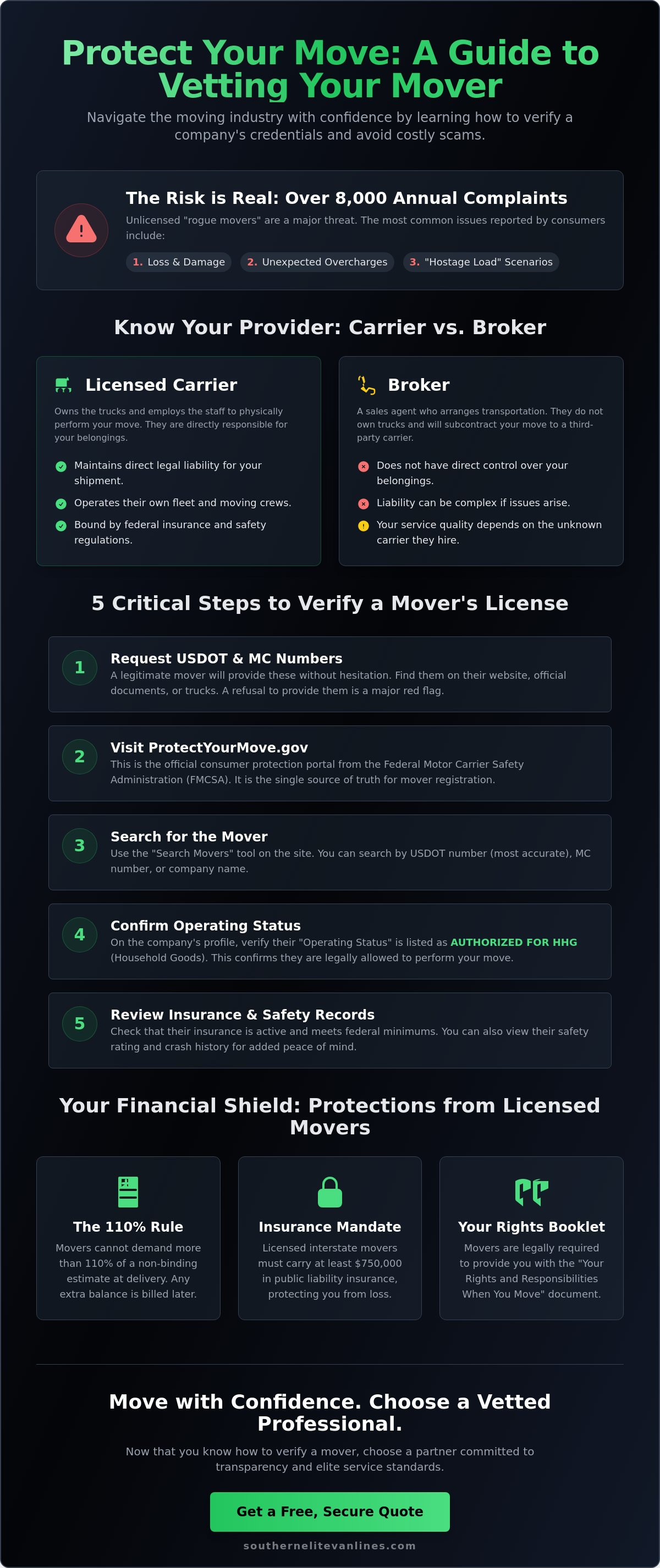
The strategic ritual of verifying a moving company's license is the only way to ensure your chosen provider is legally authorized to handle your belongings. This 2026 security guide simplifies the process, teaching you exactly how to validate credentials using the FMCSA’s modernized Motus system. We'll show you how to confirm that a company is a legitimate carrier rather than a broker, ensuring your residential or commercial move is protected by the latest federal safety standards.
You'll gain a clear, step by step checklist for vetting any provider through protectyourmove.gov. We also explain how to leverage the 110% Rule to prevent billing surprises, giving you the confidence to move forward with your relocation plans safely and successfully.
Key Takeaways
Distinguish between licensed motor carriers and brokers to ensure your service provider maintains direct legal responsibility for your shipment.
Decode the specific roles of USDOT and MC numbers to confirm a mover's federal authority and current operational status.
Execute a methodical five-step process for verifying a moving company's license using the 2026 Motus registration system to eliminate the threat of rogue operators.
Understand how state-specific mandates govern local residential moves and where to find the regulatory bodies that protect your consumer rights.
Identify elite quality markers that exceed basic legal requirements, such as professional packing standards and secure storage for your most valuable assets.
Table of Contents
Understanding Why Licensing is Your Primary Protection
Licensure isn't just a bureaucratic hurdle; it's the only thing standing between a successful relocation and a logistical nightmare. When you begin the process of verifying a moving company's license, you're checking if the business exists in the eyes of the law. A professional website or a polished local office can be easily faked, but a federal registration is a permanent record of accountability. This credential serves as the foundation for every protection you enjoy as a consumer, from insurance coverage to dispute resolution.
The first distinction you must make is between a motor carrier and a broker. A licensed motor carrier owns the equipment and employs the staff performing your move. In contrast, a broker merely arranges the transportation and often lacks the same level of direct liability. Understanding this difference is vital because your legal protections vary significantly between the two. You can find more context on these distinctions in Wikipedia's overview of moving company regulations, which details the dual regulatory framework governing these entities.
The Financial Risk of Unlicensed Moving
Hiring an unlicensed company leaves you completely exposed to financial loss. Legitimate interstate movers must carry a minimum of $750,000 in public liability insurance. Without a valid license, a company likely lacks this coverage, meaning you have no path to compensation if your goods are lost or damaged. Furthermore, the default "Released Value Protection" of $0.60 per pound is only enforceable when you're working with a registered carrier.
Rogue movers often exploit this lack of oversight to engage in "hostage load" scenarios. This occurs when a mover demands a payment far exceeding the original estimate before they'll release your belongings. Because these companies aren't registered with the USDOT, pursuing legal recourse is nearly impossible. Verifying a moving company's license ensures you're working with a provider that is bound by federal law to release your items under agreed-upon terms.
The Consumer Protection Regulations You Should Know
The Federal Motor Carrier Safety Administration (FMCSA) serves as the primary watchdog for the industry. They require every licensed mover to provide you with a copy of the "Your Rights and Responsibilities When You Move" booklet. This document isn't optional; it's a mandatory part of the consumer protection framework designed to keep you informed.
Licensed movers are also legally required to provide written estimates. Under federal regulation 49 CFR Part 375, known as the "110% Rule," a mover cannot demand more than 110% of a non-binding estimate at the time of delivery. Any remaining balance must be billed with a 30-day payment window. These regulations only apply to companies with active, valid credentials, making your initial verification the most important step in your entire moving journey.
Decoding the USDOT Number and Federal Registration
Every legitimate interstate mover carries a unique digital fingerprint known as a USDOT number. This identifier is issued by the Department of Transportation and serves as the primary tool for tracking a company's safety record, inspection history, and compliance data. When you begin the process of verifying a moving company's license, this number is your first point of entry into the federal oversight system. It's not just a random string of digits; it's a badge of transparency that allows you to see behind the marketing claims and into the actual operational history of the business.
You'll typically find these credentials displayed in the footer of a mover's website or on the side of their commercial vehicles. If a company hesitates to provide their USDOT or MC numbers, it's a significant red flag. Professional organizations, like those handling complex long distance moving services, display this information prominently to build immediate trust and demonstrate their commitment to federal standards.
USDOT vs. MC Numbers: Which One Matters?
While often mentioned together, these numbers serve different purposes. The USDOT number focuses on safety and identification. It tracks vehicle inspections and crash data. The MC (Motor Carrier) number, however, defines the company's "operating authority." This is the specific legal permission to transport household goods across state lines for hire. For any relocation that crosses a state border, the company must possess both. If they only have a USDOT number, they might only be authorized for local tasks or private carriage, not for transporting your family's belongings as a commercial service.
Interpreting the SAFER System and Motus Data
To access this information, you should use the FMCSA's registered mover search tool, which is currently transitioning into the modernized Motus system. Once you locate the "Company Snapshot," look for the "Operating Status" field. You want to see "Active-Authorized." This status confirms the carrier has met all insurance and safety requirements. If the status is "Pending," the company is still in the registration queue and cannot legally perform your move yet. An "Inactive" or "Revoked" status means the carrier has lost its legal right to operate, often due to insurance lapses or safety violations.
The snapshot also provides a window into the company's scale. Check the "Power Units" and "Drivers" fields. If a mover claims to be a massive national entity but only lists two trucks and two drivers, their physical capacity doesn't match their sales pitch. Additionally, review the "Out of Service" (OOS) percentages. These numbers compare the mover's safety failures against national averages. A high OOS percentage for vehicles or drivers indicates a pattern of poor maintenance or non-compliance, suggesting you should look for a more dependable partner for your relocation.
State-Level Requirements for Local and Residential Moves
Federal oversight provides a strong safety net for interstate relocation, but local moves operate under a different legal framework. If you're staying within state lines, the responsibility for verifying a moving company's license shifts to state-specific agencies. This transition often surprises consumers who assume the USDOT handles every relocation. In reality, state-level regulations vary significantly, creating a patchwork of requirements that demand your attention. Some states maintain rigorous standards for residential moving, while others operate with minimal oversight.
The process of verifying a moving company's license at the state level is your primary defense against unlicensed operators. Even if a mover isn't crossing state lines, they should possess the necessary permits to operate commercially within your jurisdiction. Many high-quality local providers still maintain a USDOT number for safety tracking purposes, even if it isn't strictly required for their specific route. This voluntary compliance is often a hallmark of a provider that values transparency and safety above the bare legal minimum.
Common State Regulatory Bodies
Depending on your location, your mover might be governed by a Public Utilities Commission, a Department of Commerce, or a state-level Department of Transportation. These bodies ensure that companies performing residential moving tasks maintain adequate liability and cargo insurance. For example, Texas's guide to hiring a licensed mover illustrates how state departments protect residents from predatory practices. In many jurisdictions, carriers must obtain a "Certificate of Public Convenience and Necessity" to prove they possess the equipment and insurance necessary for safe operation. Beyond moving-specific permits, verify that the company holds a valid local business license in their city of operation.
The Interplay Between State and Federal Law
The legal landscape changes the moment your shipment crosses a state line. A move between two cities in the same state falls under state law, but crossing a border triggers federal FMCSA regulations immediately. Professional long distant movers must adhere to both sets of standards to remain compliant. While state agencies handle local complaints, federal rules like the 110% Rule apply to interstate travel. This rule ensures that a mover cannot demand more than 110% of a non-binding estimate at delivery. By confirming your mover is registered at both levels, you ensure that your belongings are protected by the most stringent consumer safety laws available in 2026.
Five Critical Steps to Verify a Mover’s Credentials
Verifying a moving company's license is a methodical process that requires precision. It's not enough to see a logo on a website; you must perform a strategic ritual of validation to protect your assets. Follow these five steps to ensure your relocation is handled by a legitimate professional who operates within the bounds of federal and state law.
Step 1: Locate the Credentials. Every professional mover must display their USDOT and MC numbers on their official documents, contracts, and website footers. If these numbers are missing, treat the company with extreme caution.
Step 2: Cross-Reference the Portal. Enter these numbers into the FMCSA search portal. This confirms the company's status is "Active-Authorized" and not "Pending" or "Revoked."
Step 3: Analyze the Safety Record. Review the historical data for vehicle and driver inspections. A clean record reflects a company’s moral character and commitment to meticulous care.
Step 4: Confirm Physical Existence. Use digital maps to verify their business address. Avoid companies that operate solely out of PO boxes or residential homes, as these are often temporary setups.
Step 5: Ensure Branding Consistency. The name on the side of the truck must match the name on your contract. Inconsistencies often signal an unregistered sub-contractor or a broker posing as a carrier.
For a secure relocation experience backed by transparent credentials and a proven safety record, consider our residential moving services. We prioritize your peace of mind by maintaining the highest standards of professional accountability.
The "Ghost Mover" Red Flags
Identifying "ghost movers" is vital for your security. These entities often exist only on paper or through digital ads. They lack physical assets and frequently disappear after collecting a deposit. Be wary if a representative answers the phone with a generic "Moving Company" instead of a specific brand name. If they refuse to provide a virtual or physical inventory and offer an estimate over the phone, you're likely facing a future overcharge. Legitimate companies never demand large upfront cash deposits before the move begins.
Verifying Insurance and Liability Coverage
Securing your belongings requires more than just a valid license. You must understand the insurance protections available to you. By default, movers provide "Released Value Protection," which covers only $0.60 per pound per item at no extra cost. For higher-value shipments, "Full Value Protection" is a superior choice that ensures the mover is liable for the replacement value of lost or damaged items. Always ask for a Certificate of Insurance (COI) that names you as a certificate holder. This document provides direct proof that the company’s policies are active and sufficient to cover your residential or commercial move.
Beyond the License: Choosing a Mover with Elite Standards
While verifying a moving company's license is a non-negotiable first step, it represents the baseline of legality rather than the peak of performance. A valid USDOT number proves a company is authorized to operate. It doesn't guarantee they possess the moral character or logistical precision required to handle your most valued possessions. True security comes from choosing a partner that treats federal mandates as a starting point, not a finish line. Elite providers build their entire operation around the customer's peace of mind, ensuring every detail of the relocation is executed with exactness.
A dedicated move coordinator is often the difference between a chaotic transition and an effortless experience. In a nationwide relocation, having a single point of contact provides a sense of calm confidence. This expert acts as your strategist, managing the complex timelines of long distance moving while providing the personalized assistance you deserve. This level of support ensures that you feel emotionally supported and practically informed from the initial inquiry to the final delivery.
Meticulous Care and Professionalism
The physical aspects of the task require more than just a truck; they require specialized equipment and premium materials. For items of extraordinary value, such as heirlooms or antiques, standard moving practices are insufficient. Southern Elite Van Lines utilizes a modern fleet and high-quality packing supplies to ensure every item arrives in pristine condition. Our team employs specific techniques for piano moves and other heavy, delicate items; we utilize meticulous care that goes beyond what basic licensure requires.
Transparency in pricing is another hallmark of an elite provider. We utilize clear, weight-based or flat-rate pricing models that build immediate trust. This approach eliminates the confusion often associated with conflicting online reviews or vague estimates. When you combine climate-controlled storage options with professional packing services, you create a comprehensive security net for your belongings. We maintain a safety-first culture that prioritizes the integrity of your shipment above all else.
Starting Your Journey with Confidence
View your upcoming move as a partnership rather than a mere transaction. You've done the hard work of verifying a moving company's license; now you can focus on the new beginning that awaits you. A professional provider will always be ready to offer a comprehensive, legally compliant estimate that reflects the true scope of your residential or commercial moving needs. This transparency is the cornerstone of a stress-free relocation.
Your peace of mind is our primary objective. We invite you to experience a higher standard of service where safety and sophistication meet. Plan your next relocation with Southern Elite Van Lines and discover the difference that expert guidance makes. Let us handle the logistics so you can embrace your next chapter with total confidence.
Secure Your Relocation with Expert Oversight
Relocation is a significant life event that deserves the highest standard of protection. By mastering the process of verifying a moving company's license, you've moved beyond the uncertainty of online reviews to the concrete security of federal and state validation. You now understand the critical distinction between carriers and brokers, the importance of "Active-Authorized" status in the Motus system, and the specific steps required to confirm a mover's physical and legal presence.
True peace of mind comes when you partner with a provider that treats these legal baselines as the foundation for elite service. Southern Elite Van Lines is fully licensed and insured for nationwide transport, specializing in the meticulous care required for high-value and fragile items. We combine this technical expertise with A-rated customer service and transparent flat-rate options to ensure your journey is as smooth as it is secure. Get a Transparent, Professional Moving Quote from Southern Elite Van Lines.
Take the next step in your journey with the confidence that comes from expert guidance. Your new beginning starts with a partner who values your safety and satisfaction as much as you do.
Frequently Asked Questions
What is the difference between a USDOT number and an MC number?
A USDOT number serves as a unique identifier for safety monitoring and vehicle inspections. An MC number specifically provides the "operating authority" required to transport household goods across state lines for hire. While the USDOT number tracks who the company is and their safety record, the MC number proves they have the legal right to charge you for moving services.
Can a moving company legally operate without a USDOT number?
Any company performing interstate moves must have a USDOT number by law. For local relocations, requirements vary by state, but most jurisdictions mandate registration for commercial vehicles. Even when not strictly required for local residential moving, a valid USDOT number is a sign of a professional provider who values federal safety standards and transparency.
How do I check if a moving company has valid insurance?
You can verify insurance by accessing the "Licensing and Insurance" section of the FMCSA's SAFER or Motus systems. Look for an "Active" status next to the "BIPD" (Business Insurance/Property Damage) and "Cargo" fields. The process of verifying a moving company's license should always include confirming they meet the minimum $750,000 public liability requirement to ensure your belongings are protected.
What should I do if a mover’s license is listed as "Inactive"?
Do not hire a company with an "Inactive" or "Revoked" status. This designation means the mover has lost their legal authority to operate, often due to a lapse in insurance or serious safety violations. Hiring an inactive carrier leaves you without legal protection or insurance coverage if an accident occurs. You should immediately look for a different provider with an "Active-Authorized" status.
Is a broker license the same as a carrier license?
A broker license and a carrier license are fundamentally different. A broker is only authorized to arrange transportation; they don't own the trucks or perform the labor. A carrier is the entity that actually moves your household goods. Verifying a moving company's license involves checking their "Entity Type" on the FMCSA portal to ensure you know exactly who is responsible for your shipment.
Do local movers need a federal license for moves within the same state?
Local moves within the same state are primarily governed by state regulatory bodies like a Public Utilities Commission. While a federal license isn't always required for intrastate travel, many reputable companies maintain one to facilitate long distance moving services. Always check your state's specific requirements to ensure your local mover is properly registered and insured under local law.
Where can I find a mover’s complaint history?
You can find a mover's official complaint history on the FMCSA's "Protect Your Move" website. This database tracks consumer filings regarding "hostage loads," overcharges, and damaged goods. Reviewing these records provides a clearer picture of a company's moral character than online review sites, which can sometimes be manipulated. This step is a vital part of a thorough verification process.
How often do moving companies need to renew their licenses?
Moving companies are required to update their registration every two years through a process called "Biennial Updating." This ensures the FMCSA has current information regarding the company's fleet size and safety contact details. If a company fails to provide this update, their USDOT number can be deactivated. Regular updates are a sign of a methodical, well-organized operation that stays compliant with federal law.


Comments