
How to Get Buy-In from Your Family for a Big Move in 2026
- nadineharoon
- 2 days ago
- 12 min read
The most difficult part of a cross-country relocation isn't the heavy lifting; it's the heavy emotions. With approximately 40 million Americans expected to move in 2026, you aren't alone in feeling the weight of this transition. You've likely spent nights worrying about uprooting your children from their favorite teachers or wondered if your spouse will quietly resent the new zip code. Learning how to get buy-in from family for a big move is a delicate process that requires more than just a spreadsheet of school ratings. It's a journey of empathy. We understand that the transition feels overwhelming when you're balancing career goals against your family's current happiness.
You can transform this period of uncertainty into a shared family adventure. This guide provides the emotional and logistical strategies you need to secure a peaceful transition. We'll explore how to involve everyone in the decision-making process and how professional support can remove the logistical threat of the move. You'll learn to minimize household disruption through precise planning; this ensures your family focuses on the excitement of a new beginning. From professional packing services that give you back your time to storage solutions that pace the transition, we'll show you how to lead your family home with calm confidence.
Table of Contents
Understanding the Emotional Landscape of a Long-Distance Relocation
A long-distance move represents a profound shift in your family's reality. While you might see a promotion or a better quality of life, your family often sees a series of endings. Understanding how to get buy-in from family for a big move begins with acknowledging that relocation is, at its heart, a grieving process. Your spouse and children aren't just leaving a house; they're losing the daily comfort of familiar faces, favorite morning stops, and established support networks. It's vital to validate your own stress while remaining empathetic to their perspective.
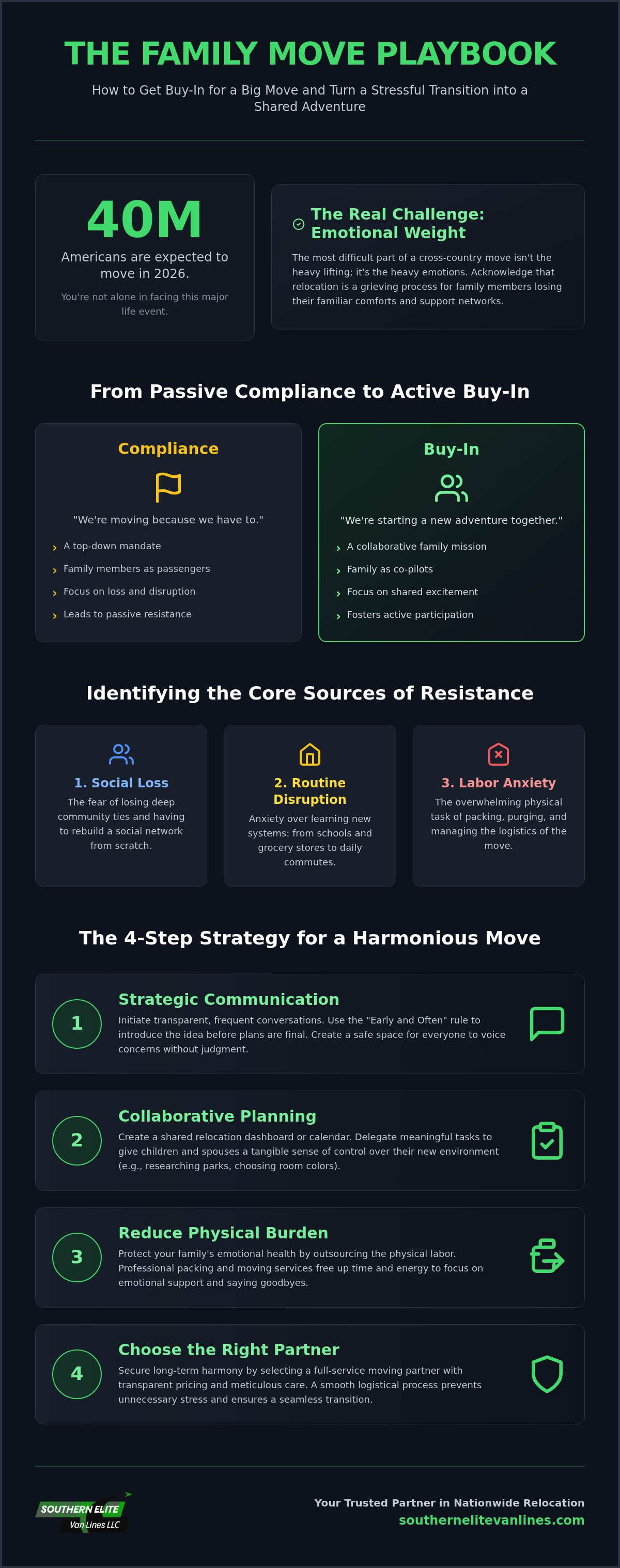
True "Relocation Buy-In" is distinct from passive compliance. Compliance is a teenager packing their boxes because they have to. Buy-in is that same teenager researching the best skate parks or music venues in the new city. It's active participation. You want your family to transition from being passengers in your plan to being co-pilots in a shared journey. This shift only happens when everyone feels their emotional baggage is handled with as much care as their physical belongings.
Resistance manifests differently across the lifespan. Toddlers often react to the physical disruption of their environment with sleep regressions or clinginess. School-aged children fear losing their social standing or being the "new kid." Teens face the most significant challenge, as their identity is often tied to their specific community and peer group. Researching the psychological effects of relocating shows that these reactions are standard responses to the disruption of one's sense of place. Recognizing these stages allows you to address fears with precision rather than frustration.
The Psychology of Stability vs. Growth
Humans possess a biological preference for "home" as a safe harbor. This instinct creates a natural friction between the person initiating the move and those following. As the initiator, you've likely spent weeks processing the benefits. Your family is often several steps behind. Their primary driver is a fear of the unknown. They aren't rejecting the new location; they're protecting the security they currently feel. Bridging this gap requires slowing down the "growth" narrative to honor their need for "stability."
Identifying the Core Sources of Resistance
Resistance usually stems from three specific areas that require your attention:
Social loss: The fear of losing deep community ties and the effort required to rebuild them from scratch.
Routine disruption: The anxiety of learning new systems, from school layouts to local grocery stores and doctors.
Labor anxiety: The overwhelming physical task of packing and purging a lifetime of memories.
By identifying these triggers, you can provide targeted solutions. For example, offering professional packing services can immediately alleviate labor anxiety, allowing your family to focus on saying meaningful goodbyes rather than taping boxes.
Strategic Communication Techniques for Family Buy-In
Effective communication is the bridge between a parent's executive decision and a family's shared vision. Successful relocation depends on the "Early and Often" rule. This strategy eliminates the shock of a sudden announcement by introducing the possibility of change before final plans are set. When you master how to get buy-in from family for a big move, you shift the narrative from a top-down mandate to a collective team project. This approach ensures that by the time the boxes arrive, every family member feels like a stakeholder rather than a passenger.
Utilizing strategic communication techniques involves more than just speaking; it requires active listening. You must create a space where concerns are met with validation instead of immediate solutions. In the 2026 relocation landscape, where moves are increasingly intentional and driven by significant life changes, your tone should remain positive but realistic. Acknowledge that while the transition requires effort, the result is a curated improvement for everyone involved.
Conducting the First Family Meeting
Timing is everything. Choose a neutral, relaxed environment like a Sunday brunch or a quiet evening walk to introduce the topic. Use "We" language to reinforce unity. Instead of saying, "I have to move for work," try, "We have an opportunity to grow in a new city." Your goal for this first meeting is to establish a single "Why" statement that everyone can agree on. This could be as simple as "We are moving to have more space for our hobbies and more time together."
Tailoring the Message to Each Family Member
A single pitch rarely works for the whole household. You must translate the benefits of the move into the specific "language" of each family member:
For partners: Focus on long-term financial security, career trajectory, or the lifestyle goals you've discussed privately.
For young children: Keep it concrete. Discuss the "big new yard," the "cool blue room," or proximity to a specific theme park or playground.
For teenagers: Respect their need for autonomy. Focus on the quality of the new school's programs, local amenities, and your commitment to helping them maintain digital and physical connections with current friends.
By removing the friction of household labor, you can focus entirely on these critical conversations. Choosing full packing services can provide the "gift of time" needed to ensure every family member feels heard and supported throughout the transition.
Creating Shared Ownership Through Collaborative Planning
Ownership is the primary antidote to relocation anxiety. When family members contribute to the roadmap, they stop being victims of a move and start being architects of their future. Establish a "Family Relocation Dashboard," a physical or digital hub where you track milestones and shared goals. This centralized location provides transparency, which is vital for maintaining trust. By visualizing the timeline together, you solve the mystery of how to get buy-in from family for a big move. It turns a chaotic life event into a structured, manageable operation where every voice carries weight.
Modern technology offers tools that weren't available to previous generations of movers. Use 3D scans and virtual tours of your potential new home to help everyone visualize their daily lives. In 2026, most neighborhoods have active digital community groups and social platforms. Research these together to find local hobby groups, sports teams, or niche clubs. This digital immersion helps bridge the gap between the old life and the new one before you even set foot in the new city. It builds a sense of familiarity that softens the impact of the transition.
Don't forget the importance of closure. Plan a "Farewell Tour" of your current favorite spots during the final weeks. Visit the local park one last time, eat at your favorite diner, and take photos with neighbors. This ritual acknowledges the emotional weight of leaving while providing a clear transition point to the next chapter. It ensures that the move feels like a natural progression rather than a sudden rupture in your family's story.
The "New Home" Scavenger Hunt
Assign each family member the task of finding one "must-visit" location in the new city. It could be a specific bakery, a hiking trail, or a specialized hobby shop. Use online maps to walk through the neighborhood virtually as a group. This turns research into a game and ensures that everyone has something personal to look forward to upon arrival. It shifts the focus from what is being lost to what is being gained.
Decision-Making Power for Children
Empower your children by giving them real choices in the planning process. Let them select the layout of their new bedrooms or pick out a specific piece of decor for the new space. Host a "Purge Party" where they decide which toys to donate and which to keep; this gives them a sense of control over their personal belongings. You can also let them choose the "first night" tradition, such as a specific takeout meal or a movie marathon, to make the new house feel like home immediately.
Reducing the Physical Burden to Protect Emotional Health
Emotional resilience is a finite resource. When you spend every evening for six weeks taping boxes and sorting through decades of clutter, your patience for nuanced family discussions evaporates. There is a direct correlation between "moving fatigue" and the frequency of household arguments. Physical exhaustion often masquerades as relocation resentment. One of the most effective ways to understand how to get buy-in from family for a big move is to remove the physical threat of the labor itself. If the relocation feels like a grueling second job, your family will naturally push back against the change.
Positioning professional services as a strategy for family harmony is a sophisticated leadership move. By partnering with experienced long distant movers, you delegate the heavy lifting to experts. This allows you to remain "present" for your spouse and children. Instead of managing a tape gun, you can manage the emotional needs of your household. Professional assistance ensures that the move is a transition you experience together, rather than a chore you survive separately.
The Gift of Professional Packing
Professional packing services offer more than just efficiency; they provide a psychological buffer. Packing is often the stage where the "living in boxes" misery begins, creating a visual reminder of upheaval that lasts for weeks. Experts can compress this disruption into a single, organized day. They apply meticulous care to high-value items, ensuring your family's most cherished belongings arrive safely. This organized transition reduces the ambient stress of the household, allowing for a cleaner emotional break from the old home.
Utilizing Storage to Ease the Timeline
A rushed timeline is a major source of family anxiety. Utilizing short-term or long-term storage allows you to "slow down" the transition for members who feel overwhelmed. You can move non-essential items early to reduce visual clutter in the final weeks. This creates a "staged" move-in process that feels less like a sudden rupture and more like a planned progression. Storage solutions give your family the space to breathe, ensuring that the new house doesn't immediately feel like a warehouse of unopened boxes.
Protect your family’s peace of mind by choosing a partner that prioritizes your emotional well-being as much as your physical assets. You can request a customized moving plan that includes full packing and storage options to keep your family focused on the journey ahead.
Choosing the Right Partner for a Seamless Nationwide Transition
The success of your family's transition depends on the bridge between your promises and the final delivery. You've handled the emotional conversations and collaborative planning; now, you must prove the logistical plan is sound. Choosing a full-service partner isn't just about moving boxes. It's about protecting the trust you've built with your spouse and children. When you hire a professional team, you're signaling that their peace of mind is worth the investment. This level of commitment is the ultimate answer to how to get buy-in from family for a big move because it replaces uncertainty with a structured, reliable operation.
Transparent pricing plays a critical role in maintaining household harmony. Financial stress is a silent driver of family tension. By securing a detailed, inventory-based quote, you eliminate the fear of hidden costs that could derail your family's new beginning. Southern Elite Van Lines acts as a logistical strategist, aligning the physical move with your family's specific emotional needs. We don't just provide a truck; we provide a steady hand that guides you through every state line with precision and care.
Expert Guidance for Long-Distance Logistics
Our nationwide coverage ensures that the high standard of care you receive at your old home continues until the final box is unpacked at your new one. We utilize modern vehicles and premium packing materials to protect the physical embodiments of your family’s memories. This "steady hand" approach is designed to navigate the complexities of interstate regulations and long-haul scheduling. It allows you to remain focused on your family’s emotional adjustment while we manage the operational details. Consistency is the key to an effortless transition that keeps everyone's spirits high.
Your Next Steps for a Stress-Free Move
Transitioning from the planning phase to execution requires a partner that listens. Your first step is requesting a comprehensive, inventory-based quote that reflects the total scope of your household. Schedule a consultation to discuss specific family requirements, such as piano moves or long-term storage needs for heirlooms. This conversation moves the project from a theoretical idea to a concrete, actionable reality. Once the logistics are in place, you can lead your family into their new chapter with absolute confidence. The shared adventure you've promised is finally within reach.
Lead Your Family Toward a New Beginning
Mastering how to get buy-in from family for a big move isn't about winning an argument; it's about building a shared vision for the future. By prioritizing emotional empathy and involving every family member in the planning process, you turn a logistical challenge into a collective milestone. You've learned that reducing the physical burden is essential for protecting your family’s emotional health during this transition. When you lead with transparency and support, the fear of the unknown transforms into the excitement of a new chapter.
Your family deserves a transition that feels intentional and uninterrupted. We provide the nationwide long-distance expertise and full-service packing required to eliminate household labor, allowing you to remain present for the people who matter most. Our climate-controlled storage options ensure your timeline remains flexible and stress-free. Get a Professional Moving Quote to Simplify Your Family Transition and take the first step toward your new home. We are ready to guide you every mile of the way.
Frequently Asked Questions
How do I tell my kids we are moving across the country?
Introduce the news early to allow for significant processing time. Use direct language and focus on the benefits that impact their daily lives, like a larger yard or proximity to a favorite park. Emphasize that while the house changes, the family unit remains a constant safe harbor. Focusing on concrete improvements helps anchor their expectations in a positive reality.
What if my spouse is completely against the move?
Validate their concerns without immediate rebuttal to understand the core of their resistance. This is a critical step in how to get buy-in from family for a big move. Discuss long-term goals and explore compromises, such as a specific timeline or a choice in the new neighborhood. Acknowledging their fears builds the trust necessary to move forward as a unified team.
How can I help my teenagers stay connected to friends after a move?
Support their autonomy by prioritizing digital connectivity and planning return visits or hosting friends in the new location. Acknowledge that their social circle is their primary support system. Provide the tools they need, such as high-speed internet or a dedicated travel budget. This ensures their transition doesn't feel like permanent social isolation or a loss of identity.
Is it better to pack myself or hire professional packers for a family move?
Hiring professional packers is the superior choice for maintaining family harmony and protecting emotional health. It eliminates weeks of physical labor and household disruption. By outsourcing this task, you give your family the gift of time. This allows you to focus on saying goodbyes and preparing for the new chapter instead of managing the stress of endless boxes.
How do I handle the "guilt" of uprooting my family for a job?
Reframe the move as a strategic investment in your family’s collective future rather than a selfish career choice. Guilt often stems from a fear of causing pain, but you can focus on the opportunities for growth this change provides. By leading with confidence and providing a seamless transition, you demonstrate that your career success serves the stability of the entire household.
What are the best ways to research a new city with my family?
Combine digital exploration with personal interests to make the research feel like a shared discovery. Use 3D neighborhood scans and local social media groups to find hidden gems. Assign each family member a specific mission, such as finding the best local pizza or the nearest library. This collaborative approach ensures everyone has a personal reason to feel excited about the destination.
How can a professional moving company reduce family stress?
A professional partner reduces stress by providing a steady hand and a predictable timeline for a complex operation. Our team handles the logistics of nationwide relocation, which removes the threat of physical exhaustion from your household. This is a vital component of how to get buy-in from family for a big move. Professional packing and secure storage solutions ensure that your focus remains on each other.
What should be in a "first-night" box for a family relocation?
Include essential items that provide immediate comfort and functionality in an empty house. Pack toiletries, chargers, basic tools, and a set of clean bed linens for every family member. Don't forget a few favorite snacks and a sentimental item, like a family photo or a child’s favorite toy. This box ensures that your first night in the new home feels like a soft landing.


Comments