
Corporate Relocation Policy Best Practices: The 2026 Strategic Guide
- nadineharoon
- 1 day ago
- 12 min read
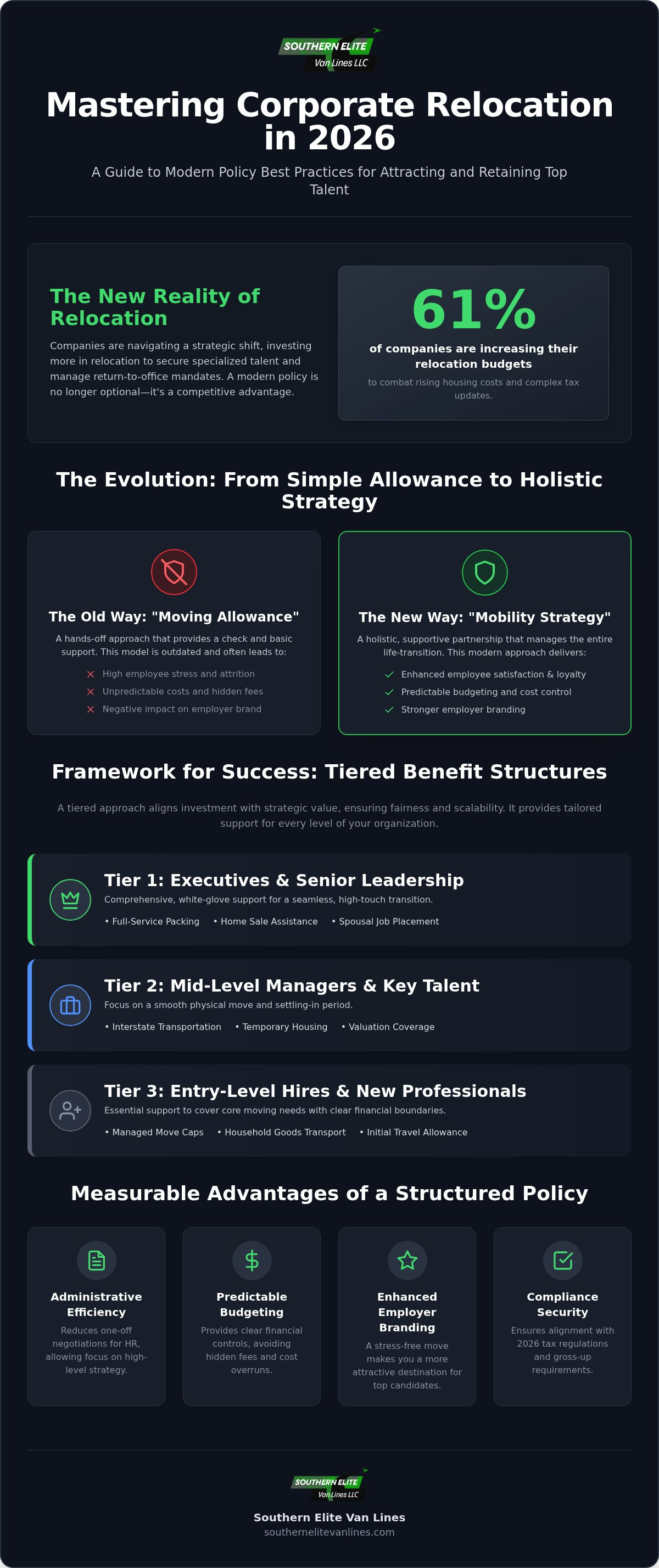
Did you know that 61% of companies are increasing their relocation budgets in 2026 to combat rising housing costs and complex tax updates? While more organizations are moving talent than ever before, many still struggle with high attrition rates and hidden fees that quietly erode their ROI. Implementing corporate relocation policy best practices isn't just about moving boxes. It's about securing your human capital during a vulnerable transition and positioning your brand as a supportive partner from day one.
You likely realize that a rigid, one-size-fits-all approach fails when employees expect personalized support and clear financial transparency. We'll show you how to master these complexities by designing modern relocation policies that scale with your business. This guide provides a clear path through tiered financial structures, the latest 2026 tax compliance requirements, and vendor management strategies that prioritize peace of mind. You'll gain the tools to transform a stressful logistical hurdle into a structured, predictable process that boosts employee satisfaction and protects your bottom line.
Table of Contents
Corporate Relocation Policy: Why It's Critical in 2026
At its core, a corporate relocation policy is a formal framework outlining the benefits, assistance, and reimbursements provided to employees moving for work. It's the blueprint that governs every aspect of a move, from the initial packing to the final delivery at a new residence. In 2026, this document has become a vital strategic tool. Organizations are currently navigating a 61% increase in relocation budgets as they manage the complexities of "return to office" mandates and the ongoing search for specialized national talent. A policy that worked in 2020 won't meet the high-end service expectations of today's workforce.
Effective employee relocation management balances two competing needs: strict financial control and a premium employee experience. If the process feels chaotic or unsupported, you risk losing the very talent you're trying to move. High attrition during the transition is a common pain point that a well-structured policy directly addresses. By integrating corporate relocation policy best practices, you transform a stressful logistical event into a smooth, predictable journey. This reinforces the employee's decision to stay with your firm and positions you as a steady, expert hand during a major life change.
The Shift from "Moving Allowance" to "Mobility Strategy"
Writing a check and wishing an employee "good luck" is no longer a viable strategy for modern talent. Employees today expect a supportive partner who understands that moving a family across state lines is a heavy emotional burden. A Mobility Strategy is a holistic approach to employee life-transitions. This shift acknowledges that true support requires more than just capital. It requires expert logistical guidance, specialized packing services, and the security of knowing that high-value items are handled with meticulous care. By focusing on the person rather than just the payload, companies build immediate trust and long-term loyalty.
Key Benefits of a Well-Defined Policy
Standardization is the cornerstone of any successful relocation program. When you establish clear guidelines, you ensure internal equity across all departments and seniority levels. This prevents the "deal-making" that often leads to compliance issues or resentment between peers. A polished policy serves as a promise of care, telling your employees that you value their peace of mind as much as their professional output.
Following corporate relocation policy best practices also delivers these measurable advantages:
Administrative Efficiency: HR and procurement teams spend less time negotiating one-off requests and more time on high-level talent strategy.
Predictable Budgeting: Clear policies help you avoid the hidden fees and unpredictable costs that often plague unmanaged, long-distance moves.
Enhanced Employer Branding: In a competitive market, offering a sophisticated, stress-free relocation experience makes your company a more attractive destination for top-tier candidates.
Compliance Security: A formal policy ensures you remain aligned with the latest 2026 tax regulations regarding relocation benefits and gross-up requirements.
Core Components and Tiered Structures: A Framework for Success
A structured framework is the difference between a chaotic move and a seamless transition. By adopting corporate relocation policy best practices, organizations can create a scalable system that meets diverse needs without overextending the budget. The most effective models utilize a tiered approach, which segments benefits based on seniority and role complexity. This ensures that your relocation investments align with the strategic value of the talent you're moving.
Tier 1 (Executives): These packages typically offer comprehensive support, including white-glove service, home sale assistance, spousal job placement, and full-service packing.
Tier 2 (Mid-level Managers): This tier focuses on the physical move, providing interstate transportation, temporary housing, and comprehensive valuation coverage for peace of mind.
Tier 3 (Entry-level Hires): Often utilizes managed move caps or specific allowances to cover essential household goods transportation and initial travel.
A major gap in many policies is the failure to account for specialty items. Your policy should explicitly address requirements for piano moves and high-value item crating. Neglecting these details often leads to last-minute stress and unexpected costs for the employee. For complex requirements, partnering with a premium long-distance mover ensures these assets receive the specialized care they deserve from the very start.
Standardizing the Moving Experience
Quality control starts with clear definitions. Your policy must set minimum standards for packing materials and vehicle quality to prevent damage during transit. We define "Full-Service" moving as a comprehensive solution that includes professional packing, loading, transportation, and unpacking with debris removal. Professional packing remains the primary factor in reducing relocation claims. Expert techniques protect fragile items far better than DIY efforts, ensuring the employee's belongings arrive in the same condition they left.
Storage and Transitional Support
Relocations rarely happen in a perfectly straight line. Employees often find themselves between homes, making short-term and long-term storage essential components of a modern policy. Secure, climate-controlled facilities protect sensitive household goods from extreme temperatures and humidity. This flexibility is vital; it prevents employees from making rushed, high-pressure home buying decisions just to avoid storage costs. Providing a "safety net" of storage options allows your team to settle into their new location with confidence and clarity.
Financial Management: Lump Sums, Reimbursements, and Tax Compliance
Managing the financial logistics of a move requires a delicate balance between corporate cost control and employee financial security. When you apply corporate relocation policy best practices, you move beyond simply allocating funds; you select a delivery model that minimizes friction for the transferee. While many companies historically favored lump sum payments for their simplicity, recent 2026 data suggests that only about 19% of relocations now use this method, with the most common range falling between $10,000 and $12,499. Purely financial transfers often force employees to act as their own logistics coordinators, which can lead to significant hidden costs in the form of lost productivity and increased stress.
To alleviate this burden, many premium organizations now prefer the Direct Bill model. In this setup, the company pays long distant movers directly for their services. This approach removes the immediate financial pressure from the employee and ensures that high-quality, vetted carriers handle the transition. It's a strategic choice that positions the employer as a supportive partner rather than just a source of funds, fostering a sense of security from the very first box packed.
Pros and Cons of Common Funding Methods
Lump sum models offer administrative ease but frequently lead to "cheap" moves that backfire. When employees try to save money by hiring cut-rate movers or attempting DIY packing, they significantly increase the risk of damaged goods and post-move frustration. Managed caps provide a middle ground by reimbursing actual expenses up to a limit, but they still require the employee to front the cash. Direct Bill remains the gold standard for high-volume programs because it centralizes procurement and guarantees a higher level of service quality, ensuring the employee arrives at their new office ready to perform on day one.
Navigating 2026 Tax Regulations
Tax compliance is a critical pillar of a modern relocation strategy that protects both the company and the individual. Following the One Big Beautiful Bill Act of July 2025, all employer-paid or reimbursed moving expenses for civilian employees are considered taxable income. These payments are subject to federal withholding at a flat rate of 22%, plus FICA taxes. Because of this, it's essential to include "grossing up" in your policy to cover the additional tax burden for the employee.
According to current 2026 IRS guidelines, nearly all relocation benefits provided to civilian employees must be reported as taxable wages on the employee's Form W-2. Failing to account for this can leave your team with an unexpected tax bill, undermining the goodwill your relocation program intended to build. A transparent policy clearly outlines these tax implications, providing the clarity and professional support your employees need during a complex life change.
Best Practices for Vendor Selection and Service Level Agreements (SLAs)
Your physical logistics partner is the face of your relocation program. While HR theory provides the framework, the actual moving crew delivers the experience. Integrating corporate relocation policy best practices requires looking beyond the bottom line of a quote to examine the operational integrity of the carrier. A failed delivery or a damaged shipment can instantly erase the goodwill built by a generous benefits package. To prevent this, your policy should mandate a vetting process that prioritizes safety ratings, equipment standards, and proven interstate authority.
Effective Service Level Agreements (SLAs) provide the transparency needed to manage expectations. These agreements should clearly define delivery windows, communication protocols, and claim response times. A critical component of a premium service is the assignment of a Single Point of Contact (SPOC). This dedicated coordinator acts as a steady hand for the relocating employee, providing a reliable source of information and reducing the emotional fatigue of the move. Regularly auditing these vendors through employee feedback ensures your partner list remains refined and high-performing.
Criteria for a Premium Moving Partner
A dependable partner must maintain a modern, well-maintained fleet and utilize high-quality packing materials to ensure the safety of every shipment. Nationwide coverage is non-negotiable for interstate moves, as it guarantees consistent service quality across state lines without the risks associated with third-party hand-offs. Furthermore, look for a partner with specific expertise in commercial relocation logistics. This background ensures they understand the precision and timing required for office-based transitions and high-stakes corporate environments.
Steps to Selecting a Corporate Relocation Moving Partner
To secure a partner that aligns with your high standards, follow these methodical steps:
1. Verify Authority: Confirm active DOT and FMCSA licensing for interstate authority to ensure legal compliance and safety.
2. Assess Specialty Capabilities: Ensure the vendor can handle complex tasks like custom crating, climate-controlled storage, and specialty items like pianos.
3. Review Historical Performance: Request corporate references and check safety records to verify a history of reliable service.
4. Establish Pricing Transparency: Require weight-based or flat-rate pricing structures to prevent hidden fees and ensure predictable budgeting.
Selecting the right partner is the final step in protecting your talent investment. If you're ready to provide your employees with a sophisticated and secure moving experience, contact Southern Elite Van Lines to discuss your corporate relocation needs today.
Implementing Your Policy with Southern Elite Van Lines
A policy is only as effective as the team executing it. Southern Elite Van Lines acts as a seamless extension of your HR and relocation department, ensuring that the high standards you've established on paper are reflected in every physical mile of the move. We specialize in the "steady, expert hand" management of complex interstate relocations, where the stakes for employee retention are highest. By integrating corporate relocation policy best practices into our operational flow, we protect your talent investment through meticulous care and absolute transparency.
Our service model is designed to be highly modular. Whether your policy calls for full packing and unpacking services for executive tiers or secure, short-term storage for mid-level managers, we customize our logistics to match your specific framework. This alignment prevents the "service gap" that often occurs when a policy promises support that a vendor cannot deliver. We handle the heavy lifting, specialty items like pianos, and transitional storage needs so your employees can arrive at their new destination refreshed and ready to contribute.
The Southern Elite Advantage for Corporate Clients
Choosing a partner with nationwide reach provides the consistency your organization requires across diverse state lines. We pair this scale with the personalized touch of a dedicated relocation strategist. This expert works directly with your HR team to ensure that every move stays within budget and complies with your internal guidelines. We utilize transparent pricing models that simplify corporate auditing and remove the risk of hidden fees that often complicate relocation financial management.
We believe that high-end service starts with the character of the people on the ground. Every member of our moving team is chosen for their commitment to perfection and moral character. This focus on ethical, expert service provides the security and peace of mind your employees need during a life-changing transition. It's not just about moving boxes; it's about delivering a polished experience that reflects your company's values and commitment to its people.
Ready to Elevate Your Relocation Program?
Transforming your mobility strategy starts with a simple conversation. The next steps for partnering with a Southern Elite Van Lines specialist involve a deep dive into your current policy tiers and volume requirements. We help you refine your logistics to ensure maximum efficiency and employee satisfaction scores. Let us manage the complexities of the physical move so your business stays in motion without interruption. Optimize your corporate relocation with Southern Elite Van Lines today and experience the difference of a premium partnership.
Securing Your Talent Investment in 2026
Designing a mobility strategy that survives the complexities of 2026 requires a shift from simple allowances to a holistic support system. You've seen how a tiered framework and transparent financial models protect your budget while ensuring your team feels valued during high-stakes transitions. By implementing corporate relocation policy best practices, you eliminate the friction that often leads to attrition and unpredictable costs. It's about transforming a logistical hurdle into a competitive advantage for your brand.
The physical move is where your policy meets reality. You need a partner that offers more than just transportation. Southern Elite Van Lines provides the nationwide interstate moving authority and full-service packing capabilities required for a seamless experience. Whether you require secure storage for employees in transition or specialized handling for high-value corporate assets, our team acts as your steady, expert hand. Partner with Southern Elite Van Lines for your next corporate relocation and give your employees the peace of mind they deserve. We're ready to help you build a stronger, more mobile future for your organization.
Frequently Asked Questions
What are the most common components of a corporate relocation package?
A standard package includes household goods transportation, travel reimbursement, and professional packing services. Many organizations now add climate-controlled storage and temporary housing to their core offerings. High-tier executive packages often expand to include home sale assistance and spousal career support. These components ensure a comprehensive transition that addresses both the physical logistics and the emotional needs of the moving family.
How much do companies typically pay for employee relocation in 2026?
Relocation costs depend on the move's distance and the specific services required for each tier. Current data indicates that 61% of companies increased their relocation budgets in 2026 to stay competitive. In cases where organizations use lump sum payments, the most frequent range is between $10,000 and $12,499. These figures help HR managers benchmark their spending against current market trends and rising logistics costs.
Is a relocation allowance considered taxable income for the employee?
Yes, all employer-paid moving expenses for civilian employees are taxable income under current 2026 federal laws. These benefits are subject to federal withholding at a flat rate of 22% plus FICA taxes. To protect the employee's net pay, it's a standard practice to "gross up" these payments. This ensures the employee doesn't face an unexpected financial burden during their professional transition to a new city.
What is the difference between a lump sum and a managed cap policy?
A lump sum policy provides a fixed amount for the employee to spend as they choose. A managed cap policy reimburses actual costs up to a specific limit set by the company. Managed caps are often preferred because they encourage employees to use professional carriers. This approach aligns with corporate relocation policy best practices by ensuring service quality while maintaining strict oversight of the total relocation budget.
How far in advance should a corporate relocation be planned?
We recommend starting the planning process at least 8 to 12 weeks before the move date. This lead time is necessary to secure high-quality long-distance carriers and coordinate specialized services like full packing. Early planning reduces the stress on the employee and gives HR teams enough time to verify all tax compliance and logistical requirements for the upcoming interstate journey.
Can a relocation policy include specialty items like pianos or art?
Yes, sophisticated relocation policies include specific provisions for high-value specialty items. Addressing items like pianos or delicate artwork early allows your moving partner to arrange for custom crating and specialized equipment. This level of detail is a hallmark of corporate relocation policy best practices. It demonstrates a commitment to the employee's peace of mind by protecting their most prized and fragile possessions.
What should be included in a relocation policy for entry-level employees?
Entry-level policies usually cover essential transportation of household goods and initial travel to the new location. Many companies provide a modest lump sum or a managed allowance to cover these basics. Including access to secure storage or partial packing services can be a powerful recruitment tool. It helps new talent focus on their orientation rather than the logistical stresses of a long-distance move.
How do I choose the best moving service for a corporate relocation?
Prioritize carriers with nationwide interstate authority and a strong reputation for safety and reliability. You should verify their DOT and FMCSA licensing to ensure legal compliance for interstate moves. Look for a partner that offers a single point of contact and specialized services like climate-controlled storage. A dependable, expert strategist will guide your employees through the process with calm confidence and absolute transparency.


Comments