
How to Choose a Long Distance Mover: The Definitive 2026 Guide
Over 3.2 million Americans are expected to move across state lines this year, yet many will entrust their entire life's work to a company they've barely vetted. You've likely felt that familiar knot of anxiety when considering a relocation. It's the fear of hidden fees, the confusion between weight-based and cubic feet pricing, or the nightmare scenario of your belongings being held hostage. Understanding how to choose a long distance mover is the most critical step in protecting your transition. We understand that you aren't just moving boxes; you're transitioning your life.
This guide simplifies the vetting process. You'll master the art of evaluating interstate carriers under the latest 2026 USDOT regulations and ELD enforcement standards. We'll explain the 110% rule and the difference between Released Value and Full Value Protection to ensure you're never caught off guard. By the end of this article, you'll have a clear checklist for a secure, transparent, and seamless nationwide relocation. Your peace of mind is our priority as you begin this new chapter.
Key Takeaways
Verify legal credentials by checking USDOT and MC numbers through official portals to ensure your carrier is fully registered with the FMCSA.
Discover the step-by-step process of how to choose a long distance mover by prioritizing operational integrity and inventory exactness over the lowest bid.
Master the nuances of weight-based pricing and the tariff system to avoid unexpected costs during your interstate relocation.
Evaluate the benefits of professional packing and unpacking services to safeguard high-value items and expedite your transition.
Distinguish between basic liability and Full Value Protection to provide your belongings with the highest standard of security.
Table of Contents
Understanding the Landscape of Long-Distance Moving Companies
Long-distance moving is defined by more than just the miles on your odometer. Generally, a relocation is classified as long-distance if it exceeds 100 miles or crosses a state line. This distinction is vital because it shifts the move from local jurisdiction to federal oversight. Understanding how to choose a long distance mover begins with recognizing this legal landscape. The moving industry is highly regulated to prevent the fraudulent "hostage load" scenarios that cause so much anxiety. Every legitimate interstate moving company must maintain active registration with the Federal Motor Carrier Safety Administration (FMCSA), a branch of the Department of Transportation. This registration ensures the company meets strict safety, insurance, and bonding standards before they ever touch your belongings.
Carrier vs. Broker: Why the Distinction Matters
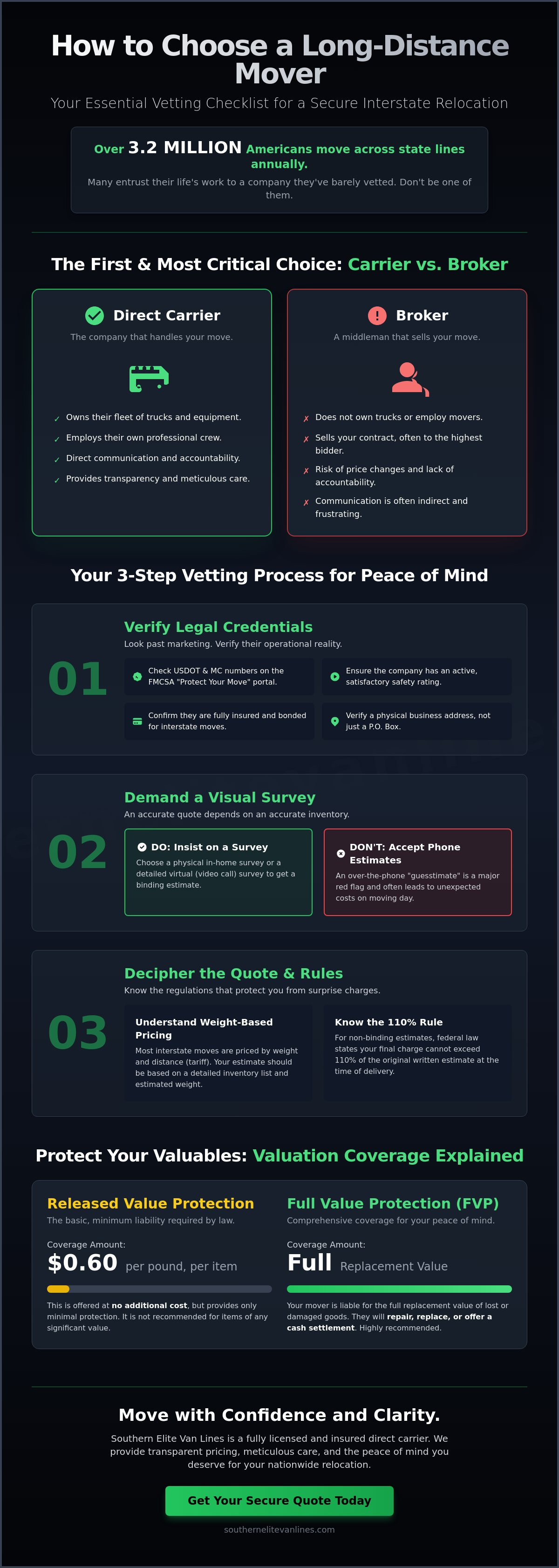
Distinguishing between a carrier and a broker is perhaps the most important step in your vetting process. A carrier is a company that owns its fleet, employs its professional crew, and manages the logistics from start to finish. You have a direct line of communication with the team actually lifting your boxes. In contrast, a broker is a middleman. They don't own trucks or employ movers. Instead, they sell your moving contract to the highest bidder. This often leads to significant price discrepancies on moving day and a frustrating lack of accountability if high-value items, like a piano, are damaged. When you're determining how to choose a long distance mover, look for a company that maintains its own equipment and staff. Direct carriers provide a level of meticulous care and transparency that brokers simply can't match.
Interstate vs. Intrastate Regulations
The rules governing a move across town are vastly different from those governing a move across the country. Interstate moves require specific insurance levels and higher bonding to protect consumers during the high-vibration environment of long-haul transit. For a deeper dive into Understanding the Moving Industry, it's helpful to see how these regulations have evolved to prioritize safety. A professional mover operates within this framework of exactness, ensuring that every mile of your journey is documented and every item is protected under federal law. This regulatory oversight exists because long-distance transit involves higher risks, including temperature fluctuations and extended handling. Choosing a company that embraces these standards provides the peace of mind you need when your entire life is in transit.
Working with a direct carrier simplifies the complex relocation process. You'll avoid the confusion of dealing with multiple third parties and benefit from a more organized, step-by-step operation. This direct relationship fosters trust and ensures your specific needs, whether for residential or commercial moving, are met with professional precision. By focusing on carriers rather than brokers, you're choosing a partner committed to your satisfaction and a successful new beginning.
Essential Criteria for Vetting Professional Interstate Movers
Vetting is the most critical phase of your relocation strategy. It transforms a stressful gamble into a well-planned operation. When you are learning how to choose a long distance mover, you must look past polished marketing to verify operational reality. Start by confirming the company's physical presence and history. A reputable carrier maintains a brick-and-mortar headquarters and a documented track record of successful interstate transitions. You should also verify professional affiliations, such as membership in the American Trucking Associations (ATA), which signals a commitment to industry-wide safety standards and ethical conduct.
Every legitimate interstate mover must display a USDOT number on their website and equipment. Use the official Protect Your Move portal to check the status of this number. This government resource allows you to see the company’s safety rating and insurance status. Beyond basic licensing, you must evaluate how a company protects your assets. Federal law requires movers to offer Released Value Protection at no cost, but this only covers $0.60 per pound per item. For high-value relocations, always prioritize companies that offer Full Value Protection. This comprehensive option ensures the mover is liable for the replacement value of lost or damaged items, providing the security your life's work deserves.
The Importance of Physical or Virtual Surveys
An over-the-phone estimate is a significant red flag for any long-distance move. Professional carriers insist on a meticulous visual survey of every room, closet, and storage area. This process allows the mover to identify heavy furniture, narrow hallways, or specialty items like pianos that require custom handling. A 100% accurate inventory is the only way to guarantee a binding price. Without this visual confirmation, you risk unexpected "overage" fees on moving day when the crew realizes the actual volume of your shipment. If you're preparing for a residential moving project, insist on a walkthrough to ensure your quote is based on facts rather than guesses.
Analyzing Online Reputation and Moral Character
Moral character is the foundation of a successful move. When reviewing online feedback, move beyond simple star ratings and look for detailed accounts of transit times and logistical precision. You can often identify fake reviews by their overly generic language or a suspicious lack of detail. Genuine customers will describe specific crew members or how the company resolved a complex issue. Pay close attention to how a company responds to negative feedback. A professional mover addresses complaints with calm confidence and a clear path toward resolution. This transparency is a hallmark of a dependable expert who values your peace of mind as much as the physical task of moving.
Deciphering Moving Quotes: Weight-Based vs. Flat-Rate Pricing
Understanding the financial structure of an interstate move is essential for maintaining control over your relocation budget. Unlike local moves that typically bill by the hour, long-distance relocations are predominantly calculated based on the total weight of your shipment and the distance it travels. This calculation relies on a "Tariff," which is a comprehensive schedule of rates and rules used by the carrier to determine transportation fees. When you are researching how to choose a long distance mover, you must look for a company that is transparent about its tariff system and how it applies to your specific inventory. This clarity prevents the "sticker shock" that often occurs when homeowners rely on vague, verbal estimates.
A frequent concern for many families is the accuracy of the final weight. Professional carriers address this by weighing the truck at a certified scale before and after loading your belongings. You have the legal right to witness these weigh-ins or request a re-weigh if you suspect a discrepancy. This process is a cornerstone of the Federal Motor Carrier Safety Administration's guide to consumer protection. By following these established protocols, a dependable mover ensures that your final bill reflects the actual work performed, providing a level of exactness that builds immediate trust.
How Long-Distance Costs are Calculated
The final price of your move is a combination of several logistical factors. Weight and mileage form the baseline, but several other components influence the total:
Fuel Surcharges: These fluctuate based on national averages to cover the cost of long-haul transit.
Accessorial Services: This includes specialized tasks like long distant movers handling piano moves, custom crating for antiques, or navigating stairs and elevators.
Valuation Coverage: The level of liability protection you select for your assets.
Strategic inventory management is the most effective way to control these costs. By conducting a meticulous purge of items you no longer need, you directly reduce the shipment weight and, consequently, your total investment.
Avoiding the "Low-Ball" Estimate Trap
In your search for how to choose a long distance mover, be wary of quotes that fall significantly below the industry average. These "low-ball" estimates are often a precursor to the "Hostage Load" scam. In this scenario, an unethical mover provides an unrealistically low price to secure the contract, only to hike the fees once your life’s work is locked in their truck. To protect yourself, always request a "Binding Estimate," which guarantees the total cost based on the surveyed inventory. If you opt for a "Non-Binding Estimate," federal regulation 49 CFR Part 375 dictates that a mover cannot charge you more than 110% of the original estimate at the time of delivery. A polished, professional quote will always include all potential fees upfront, ensuring a transparent and uninterrupted experience.
Evaluating Service Levels: From Partial Packing to White-Glove Relocation
Choosing the right service level is as important as verifying a mover's licensing. Long-distance transit involves high-vibration environments that test the integrity of every box. When you are determining how to choose a long distance mover, you must decide between the economy of self-packing and the security of professional care. Professional packing services aren't merely a convenience; they are a strategic safeguard for your life's work. Expert crews understand how to distribute weight and use padding to ensure your items remain stationary during a cross-country haul.
Beyond the departure, consider the arrival. Unpacking services provide an effortless transition, allowing you to focus on your new beginning rather than a sea of cardboard. For specialized items like fine art or high-value electronics, custom crating offers a level of exactness that standard boxes cannot match. This meticulous care ensures that even the most fragile assets survive the thousands of miles between your old home and your new destination. By tailoring your service level to your specific inventory, you transform a complex logistical task into a managed, professional operation.
The Value of Professional Packing Materials
Standard retail boxes often fail under the weight of a long-haul shipment. Professional crews utilize high-quality, double-walled moving cartons designed specifically for the rigors of interstate travel. This choice is critical for liability; most carriers won't accept damage claims for items they didn't pack themselves, as they cannot verify the internal protection. Industry data suggests that professional packing can reduce damage claims by over 50% compared to self-packed shipments. Investing in professional materials is a simple way to ensure your belongings arrive in the same condition they left.
Secure Storage Solutions for Transitional Moves
Real estate timelines rarely align perfectly. Storage-in-Transit (SIT) becomes necessary when home closing delays occur or your new residence isn't quite ready. A premium van line provides climate-controlled storage facilities to protect wood furniture from warping and electronics from extreme temperature shifts. These warehouses should feature 24-hour security monitoring and organized inventory systems to ensure your belongings remain safe and accessible. If you require a secure environment for your assets during a complex transition, explore our long-term storage options to bridge the gap with confidence.
Making the Final Decision with Southern Elite Van Lines
Selecting a partner for your nationwide relocation is the final, most impactful step in your journey. You've learned the technical requirements and the nuances of pricing, but the ultimate success of your move depends on the character of the people handling your assets. Understanding how to choose a long distance mover leads many to realize that operational integrity is the true differentiator. Southern Elite Van Lines positions itself as the steady, expert hand guiding you through this complex transition. We don't just transport boxes; we manage a high-achieving operation where your peace of mind is the primary metric of success. Our commitment to exactness and meticulous care ensures that your life’s work is treated with the respect it deserves.
A premium carrier offers more than just transportation. We provide an effortless, uninterrupted experience that removes the emotional weight of relocation. By choosing a partner that views the process as a shared journey, you gain a supportive strategist dedicated to your satisfaction. This professional alignment transforms a logistical hurdle into a seamless new beginning. We prioritize clear, logical progressions in our service, ensuring you feel both practically informed and emotionally supported from the initial inquiry to the final delivery at your new residence.
Why Operational Transparency is Our Standard
Transparency is the foundation of trust in the moving industry. Our approach centers on precise inventory management and direct communication, eliminating the ambiguity that often plagues long-haul relocations. We utilize a fleet of modern vehicles and high-quality packing materials to maintain the highest standards of safety. For evidence of our commitment to excellence, we invite you to review the Southern Elite Case Study, which provides documented proof of our service quality in complex nationwide moves. We believe that professional interstate moving requires a level of perfection that only a dedicated carrier can provide.
Starting Your Seamless Relocation Journey
Your transition to a new home or office should be a moment of excitement, not exhaustion. Securing a comprehensive moving estimate is the first step toward a managed, professional operation. Our specialists are ready to provide a meticulous survey of your needs, whether you require full packing services or specialized piano moves. We encourage a proactive approach to booking, especially during peak seasons, to ensure your preferred dates are secured. When you're ready to see how to choose a long distance mover that prioritizes your security, contact us to begin your journey. Trust your relocation to specialists who value moral character and logistical precision above all else.
Secure Your Nationwide Relocation Strategy
Mastering how to choose a long distance mover requires a shift from viewing relocation as a chore to seeing it as a strategic partnership. You now possess the tools to verify USDOT credentials, decipher complex weight-based tariffs, and select service levels that protect your life's work. By prioritizing operational transparency and meticulous care, you've moved beyond the risks of low-ball estimates and middleman brokers. This knowledge ensures that your transition is defined by clarity rather than confusion.
Southern Elite Van Lines stands ready as your FMCSA registered interstate carrier. We specialize in high-value and piano relocation, ensuring that even your most delicate assets receive expert handling. If your timeline requires a pause between homes, our climate-controlled secure storage facilities provide a safe harbor for your belongings. Your journey deserves the steady, expert hand of a professional strategist who values your peace of mind as much as the physical task of moving.
Your new beginning is a significant milestone that should be met with calm confidence. We are here to guide you through every mile of the process, ensuring a seamless and successful relocation. Let's start this journey together.
Frequently Asked Questions
How far in advance should I book a long-distance moving company?
You should aim to book your mover at least 8 to 12 weeks before your desired date if you're relocating during the peak summer months. For off-peak moves between October and April, a lead time of 4 to 6 weeks is generally sufficient. Early booking ensures you secure a spot with a reputable carrier and allows ample time for a meticulous inventory survey. This proactive approach is the best way to avoid the stress of limited availability during busy seasons.
Is it cheaper to move by weight or by the number of boxes?
Interstate relocations are almost exclusively billed by weight rather than the number of boxes. This is a federal standard designed for pricing consistency across the industry. While local moves might use hourly rates or box counts, long-distance carriers use certified scales to determine the actual weight of your shipment. Purging unnecessary items before the move is the most effective way to reduce your total cost since every pound contributes to the final price.
Can I pack my own boxes if I hire a full-service mover?
You can certainly pack your own boxes, but it's important to understand how this affects your valuation coverage. Most carriers won't accept liability for damage to items inside boxes they didn't pack themselves because they can't verify the internal protection. If you're learning how to choose a long distance mover, consider the trade-off between saving on labor and the increased risk to your belongings during high-vibration transit. Professional packing often provides the best security for high-value items.
What is the difference between a binding and a non-binding moving estimate?
A binding estimate guarantees the total cost of your move based on the items listed during the initial survey. In contrast, a non-binding estimate is a projection that can change based on the final weight of your shipment. Under federal law, if you have a non-binding estimate, the mover cannot demand more than 110% of the quoted price at the time of delivery. Any remaining balance is billed later, giving you 30 days to pay the difference.
How do I verify if a moving company is a carrier or a broker?
You can verify a company's status by entering their USDOT number into the FMCSA’s official portal. The registration details will explicitly state whether the company is authorized as a "Motor Common Carrier" or a "Broker." A carrier owns its fleet and employs its own crew; a broker simply sells your contract to another company. This distinction is vital for ensuring direct accountability and clear communication throughout your relocation process.
Does my homeowners insurance cover my belongings during a state-to-state move?
Most standard homeowners insurance policies provide limited or no coverage for items while they are in transit between states. Some policies might cover specific perils like fire or theft but won't cover breakage due to shifting during transit. You should contact your insurance provider to confirm your specific coverage details. Most families find that opting for Full Value Protection from their mover is the most secure way to protect their assets during the journey.
What items are long-distance movers not allowed to transport?
Movers are prohibited by safety regulations from transporting hazardous materials, including propane tanks, paint thinners, fireworks, and ammunition. Perishable items like frozen food or plants are also typically excluded from long-haul transit due to the risk of spoilage or infestation. You should personally transport irreplaceable items such as family heirlooms, legal documents, and jewelry. This ensures your most valuable personal items remain under your direct supervision at all times.
How long does a cross-country move typically take from pickup to delivery?
A cross-country move generally takes between 7 and 21 days from the date of pickup to the final delivery. This timeline depends on the total distance, the time of year, and whether your shipment is on a consolidated truck with other customers' goods. Your carrier will provide a specific delivery window in your contract. Understanding these logistics is a key part of knowing how to choose a long distance mover that fits your specific timeline and relocation needs.


Comments