
How to Calculate Long Distance Moving Costs: A Comprehensive 2026 Guide
- nadineharoon
- 5 hours ago
- 13 min read
The lowest moving quote in your inbox is often the most expensive mistake you'll ever make. While a bargain price feels like a win during the initial planning stages, it frequently masks a lack of transparency that leads to stressful, unexpected surcharges on moving day. It's completely normal to feel overwhelmed by the technicalities of weight-based pricing or the fear of your belongings being held until you pay a surprise balance. You deserve a transition that's defined by precision and peace of mind rather than logistical guesswork.
This guide empowers you to master exactly how to calculate long distance moving costs with the confidence of an industry insider. We'll demystify the variables of interstate relocation pricing, ensuring you can secure an accurate and transparent estimate that holds firm from start to finish. By understanding federal protections and the critical differences between binding and non-binding agreements, you'll transform a complex process into a well-ordered, predictable plan. We'll walk through a clear framework for predicting your expenses, evaluating professional quotes with a critical eye, and using practical methods to lower your final bill while maintaining a premium standard of care.
Table of Contents
The Mechanics of Long Distance Moving Cost Calculations
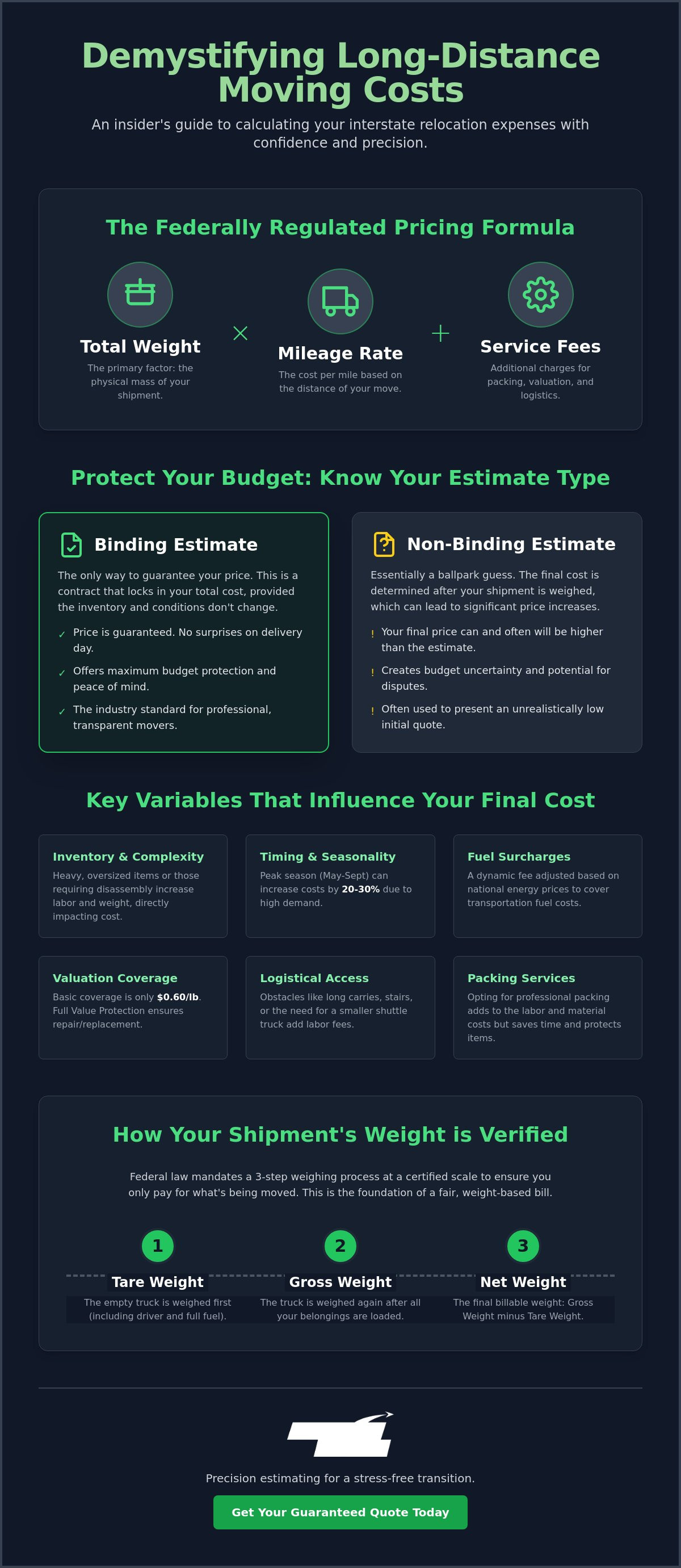
Understanding how to calculate long distance moving costs begins with a simple, federally regulated formula: (Total Weight x Mileage Rate) + Service Fees. Unlike local relocations that typically charge by the hour, interstate moves rely on the physical mass of your shipment and the distance it travels. This distinction exists because long-haul logistics involve complex scheduling, fuel consumption, and strict labor regulations that hourly rates simply cannot account for. Central to this process is the Tariff, a published schedule of rates and charges that every legitimate carrier must maintain and provide upon request. Within this framework, Linehaul Charges represent the basic fee for transporting your goods from your old home to your new destination. This structure provides a transparent foundation for how moving costs are determined across state lines, ensuring every customer pays a fair rate based on actual logistics.
Weight vs. Volume: Which Methodology Matters?
Professional van lines prioritize weight over volume because it offers the highest level of accuracy and consumer protection. While some operators might quote by cubic feet, 2026 industry standards favor weight-based transparency to prevent the disputes common with volume-based pricing. To provide an initial estimate, consultants use a Cube Sheet. This tool translates your inventory of furniture and boxes into an estimated weight before a single item is lifted. This allows for surgical precision in your initial quote and prevents the "space-filling" tactics that can occur when pricing is based on how a truck is packed rather than what it contains.
The Weighing Process: Gross, Tare, and Net
The most critical step in verifying your final bill occurs at a certified scale. Federal law requires movers to weigh their vehicles to ensure you only pay for the items actually transported. This process is methodical and highly regulated. It starts with the Tare Weight, which is the weight of the empty truck, including the driver and a full tank of fuel. Once your household goods are loaded, the driver returns to the scale to record the Gross Weight. The difference between these two figures is the Net Weight, the exact poundage used to finalize your bill. This figure is documented on your Bill of Lading, providing a verifiable receipt of the work performed. In 2026, the FMCSA has tightened oversight on these weighing procedures to ensure every consumer receives a fair, weight-verified experience. By insisting on a weight-based model, you align yourself with a system designed for accountability and professional excellence.
Primary Variables Influencing Your Interstate Moving Quote
While weight and distance form the foundation of your estimate, several specific variables determine the final figure on your contract. To accurately master how to calculate long distance moving costs, you must account for the logistical nuances of both your current residence and your new destination. In 2026, fuel surcharges remain a dynamic factor, as carriers adjust rates based on national energy price indexes to ensure consistent service levels. Beyond the fuel, labor requirements fluctuate based on the complexity of your inventory. A home filled with heavy, oversized furniture or items requiring disassembly demands more man-hours than a minimalist space. Timing also plays a critical role. Moving during the peak season, which runs from May through September, can increase your base costs by 20% to 30% due to high demand. Finally, consider your valuation coverage. While federal law requires a basic "Released Value Protection" at no cost, it only covers items at $0.60 per pound. For comprehensive peace of mind, many families opt for Full Value Protection, which typically costs around 1% of the total shipment value but ensures your belongings are repaired or replaced at market value.
Logistical Accessorial Charges Explained
Surprise fees often stem from "accessorial charges," which are costs associated with logistical hurdles that prevent a standard loading process. If a 53-foot tractor-trailer cannot park within a reasonable distance of your front door (typically 75 feet), a "Long Carry Fee" is applied to compensate for the additional labor. Similarly, vertical transport via multiple flights of stairs or elevators in high-rise buildings incurs specific surcharges. In some historic neighborhoods or narrow residential streets, a "Shuttle Service" becomes necessary. This involves transferring your goods from a smaller truck to the larger long-haul trailer because the larger vehicle cannot safely navigate the local roads. Identifying these factors early during a consultation with professional long distance movers prevents these logistical realities from becoming "hidden" costs on moving day.
Professional Packing and Material Costs
The level of service you choose regarding packing significantly impacts your bottom line. You can opt for full packing services, where experts secure every item, or partial services for just your most fragile belongings. For high-value assets like artwork, antiques, or specialized piano moves, custom crating is often a necessary investment. These wooden crates are built to the exact dimensions of the item, providing a level of stability that standard cardboard cannot offer. Investing in high-quality packing materials is not just about convenience; it's a strategic choice to ensure your household goods survive the vibrations and shifting of a 1,000-mile journey without damage.
Binding vs. Non-Binding Estimates: Protecting Your Budget
The greatest source of anxiety in interstate relocation is the fear that the final bill will eclipse the initial quote. This uncertainty often stems from a misunderstanding of estimate types. When you're learning how to calculate long distance moving costs, the type of contract you sign is just as important as the bottom-line number. A Binding Estimate is a legal agreement that locks in your total cost based on a documented inventory. If you move exactly what is listed, your price remains unchanged regardless of the final weight recorded at the scales. This provides a level of financial certainty that is essential for a stress-free transition.
The "Binding Not-To-Exceed" (BNTE) estimate represents the gold standard for consumer protection. It functions as a price ceiling. If your shipment weighs less than the initial estimate, you pay the lower amount. If the shipment weighs more, the mover honors the original quote. Conversely, a Non-Binding estimate is merely a projection. It provides a rough idea of what you might pay but offers no legal price certainty. For long-distance moves, where weight variables can shift significantly, relying on a non-binding quote often introduces unnecessary risk to your moving budget.
How to Ensure Your Estimate is Accurate
Precision starts with a visual inspection. Any reputable carrier will insist on a virtual or in-home walkthrough to assess the volume and weight of your belongings. Casual "over-the-phone" quotes without a detailed inventory list are major red flags. These estimates lack the surgical accuracy required for interstate logistics and often lead to disputes on moving day. You must document every item, from the contents of your attic to the heavy appliances in your garage. This meticulous record ensures your binding agreement remains a valid, enforceable shield for your finances.
What Can Legally Change Your Final Price?
A binding quote is a contract based on specific facts. If you add a sectional sofa or twenty extra boxes after the agreement is signed, the mover has the legal right to revise the price. Requesting additional services, such as full packing services or temporary storage, on the day of the move will also trigger legitimate price adjustments. For those using non-binding estimates, the FMCSA 110% rule provides a vital safety net. This federal regulation states that a mover cannot demand more than 110% of the original estimate at the time of delivery. Any balance exceeding that 110% must be billed to you with a 30-day window to pay. Mastering these nuances is the final step in understanding how to calculate long distance moving costs without falling victim to unexpected price hikes.
Strategic Ways to Reduce Your Moving Inventory and Costs
Because weight is the primary driver of your final bill, the most effective strategy for managing your budget is reducing the physical volume of your shipment. Every pound you subtract from your inventory directly reduces the linehaul charges on your final bill. Weight is money. A successful long distant movers strategy begins long before the first box is taped. It starts with a ruthless, surgical evaluation of everything you own. You must decide if an item is worth the cost of hauling it across several state lines.
Before your consultant arrives for an estimate, evaluate your belongings through the lens of the weight-to-value ratio. This concept is simple. If the cost to transport an item exceeds its replacement value or its emotional significance, it should not go on the truck. Large, heavy items made of inexpensive materials, such as particle-board bookshelves or aging mattresses, are often the first things to cut. By removing these high-weight, low-value items, you create immediate savings that no discount or negotiation can match.
When you analyze how to calculate long distance moving costs, you'll find that timing is almost as influential as weight. Most people prefer to move during the first or last weekend of the month to align with lease expirations or home closings. This high demand drives prices upward. If your schedule allows, booking your move for a Tuesday or Wednesday in the middle of the month can lead to more favorable rates. Carriers often have more flexibility during these windows, and that flexibility translates into savings for you.
Packing also presents a significant opportunity for cost control. While full-service packing provides the highest level of convenience and safety, self-packing your non-fragile items like clothes and books can lower your total investment. You must calculate the real ROI of your time. If spending three weekends packing boxes saves you a significant amount, it's a worthwhile trade. However, for high-value items, professional packing remains the safest choice to ensure your goods arrive in pristine condition.
The Systematic Inventory Purge
Professional organizers recommend the "One Year Rule" for a successful relocation purge. If you haven't used an appliance or worn a piece of clothing in the last twelve months, you likely won't miss it in your new home. Focus on selling high-weight items like old gym equipment or heavy oak desks through online marketplaces. This generates cash that can fund your moving expenses while simultaneously lowering your quote. For items that don't sell, donation strategies provide a dual benefit. You support a local charity and receive a tax deduction that can further offset your relocation costs.
Flexible Delivery Windows
If your arrival dates are flexible, ask about "consolidated shipping." This allows the carrier to combine your shipment with others traveling the same route, maximizing truck space and lowering the cost for everyone involved. While direct delivery is faster, consolidated linehaul rates are often much more budget-friendly. In cases where your new home isn't ready for immediate occupancy, utilizing transitional storage can prevent the need for multiple local moves. This keeps your goods in a secure, professional environment until your closing date is finalized.
Ready to see how a streamlined inventory can lower your quote? Reach out to our experts at Southern Elite Van Lines for a transparent, weight-based estimate tailored to your specific needs.
Why Precision Estimating Matters at Southern Elite Van Lines
At Southern Elite Van Lines, we believe transparency is the bedrock of a successful relocation. You've learned how to calculate long distance moving costs through weight and distance, but the execution of that formula requires a partner who values precision as much as you do. We eliminate the guesswork by adhering to strict, weight-based calculations that leave no room for hidden surcharges or last-minute surprises. Our commitment to moral character and exactness ensures that the price you are quoted is the price you can depend on throughout your journey.
Our expert consultants don't just eyeball a room; they utilize advanced digital inventory tools to catalog your belongings with surgical accuracy. This technology translates your physical items into precise weight estimates, ensuring the initial quote you receive is a true reflection of the logistical requirements of your move. This level of exactness provides a sense of security from the very first interaction, as it removes the "rounding up" errors common with less sophisticated operators. We provide a steady, expert hand to guide you through what is often a complex and emotional process.
The Southern Elite advantage combines the logistical reach of a nationwide carrier with the personalized touch of premium service. Whether you require full packing services for a complex estate or specialized care for high-value items, our team manages every detail with meticulous care. We project an image of being more than just a service provider; we are a supportive partner dedicated to your peace of mind. By choosing a carrier that prioritizes precision, you ensure your transition is defined by momentum and clarity rather than stress and uncertainty.
Our Full-Service Relocation Philosophy
A long-haul journey puts significant stress on household goods, which is why our philosophy centers on meticulous care. We operate a modern fleet equipped with the latest suspension and tracking technology to ensure a smooth transit across state lines. Our trained crews are experts in secure loading techniques, treating every heirloom with the respect it deserves. To ensure an effortless experience, every client is paired with a dedicated move coordinator. This strategist manages your budget and timeline, acting as a supportive partner who prevents the logistical clutter from overwhelming your daily life. This methodical approach ensures your belongings arrive safely and on schedule.
Get Started with a Professional Moving Quote
Securing a reliable price is the first step toward a successful move. We've simplified the process of scheduling your virtual or in-person walkthrough to provide the immediate clarity you need. Before your consultation, it's helpful to identify which items will stay and which will go, as this helps our team provide the most competitive weight-based quote. Having a clear idea of your required services, such as unpacking services or short-term storage, allows us to build a comprehensive plan from day one. Request your precision moving estimate from Southern Elite Van Lines today and experience a higher standard of relocation excellence.
Embark on Your Next Chapter with Confidence
Navigating an interstate move shouldn't be a journey into the unknown. By mastering the fundamental formula of weight and mileage, you've gained the clarity needed to evaluate every quote with professional scrutiny. You now understand that a Binding Not-To-Exceed estimate is your strongest shield against budget fluctuations, and that a strategic inventory purge is the most direct path to significant savings. When you understand exactly how to calculate long distance moving costs, the process shifts from a source of stress to a well-managed logistical operation.
At Southern Elite Van Lines, we provide the steady, expert hand you need for a seamless transition. Our certified weight-based billing ensures total transparency, while our expert packing services provide maximum safety for your most cherished belongings. With nationwide coverage and dedicated move coordinators guiding every step, you're never alone in this process. We're committed to your peace of mind and a perfect start in your new home. Secure Your Professional Long-Distance Moving Estimate today and let us handle the heavy lifting with the precision you deserve. Your new beginning is waiting, and we're ready to help you get there effortlessly.
Frequently Asked Questions
How much does it cost to move a 3-bedroom house long distance in 2026?
The national average for a 3-bedroom home relocation spanning 1,000 miles typically ranges from $5,500 to $10,000 in 2026. These figures depend heavily on the total weight of your belongings and the specific logistics of your route. Since interstate moves are federally regulated by weight, your final bill reflects the physical mass of your shipment rather than an hourly rate. We recommend a visual inventory to ensure your quote is as precise as possible.
What is the cheapest way to move furniture across the country?
Utilizing a moving container service or a one-way truck rental is generally the most budget-friendly method for cross-country transport. Moving containers can be 30% to 40% cheaper than full-service carriers because you provide the loading labor yourself. While this reduces the financial cost, it increases your physical responsibility. You must decide if the savings outweigh the convenience and safety of having professional crews secure your furniture for the long-haul journey.
Do moving companies charge more for heavy items like pianos or gun safes?
Yes, carriers apply specialized surcharges for exceptionally heavy or delicate items such as pianos and gun safes. These pieces require reinforced equipment and additional manpower to transport safely without risking damage to the item or your property. Identifying these specialized needs during your initial consultation ensures your estimate remains accurate. This proactive approach prevents surprise fees on moving day and allows our strategists to prepare the necessary equipment for a safe transition.
Is it cheaper to buy new furniture or pay to move the old stuff?
It's often more economical to sell low-value, high-weight items and buy new ones at your destination. When you evaluate how to calculate long distance moving costs, you should compare the shipping cost of an item against its current replacement value. If a heavy, aging sofa costs more to haul than a new one would cost to deliver, purging it is the smarter financial choice. This systematic reduction in weight directly lowers your final moving bill.
How much should I tip long-distance movers for a multi-day trip?
Standard industry practice suggests tipping $20 to $50 per person for each day of the move. For a multi-day interstate trip, you can provide this at the end of the loading phase and again at delivery. While tipping isn't mandatory, it's a meaningful way to recognize the meticulous care and physical effort required for a successful relocation. Providing refreshments throughout the day is also a common and appreciated gesture of support for the crew.
What are "accessorial charges" and how can I avoid them?
Accessorial charges are fees for services beyond standard loading and transport, such as long carries, stair fees, or shuttle services. You can avoid many of these by ensuring the moving truck has clear, close access to your entrance at both locations. Communicating logistical hurdles like narrow streets or broken elevators early allows your coordinator to include these in a binding estimate. This transparency prevents unexpected costs from surfacing during the final billing process.
Does the time of year really affect my moving quote that much?
Seasonal demand significantly impacts pricing, with peak season moves costing up to 30% more than winter relocations. The window from May through September is the most expensive time to move due to high volume across the industry. Scheduling your transition between October and April often results in more competitive rates and greater availability. If your timeline is flexible, moving during the off-peak months provides the best value for your relocation budget.
Can I get a flat-rate price for an interstate move?
A Binding Estimate functions as a flat-rate price for your interstate move, provided your inventory remains unchanged. This legal agreement guarantees the total cost based on the specific items listed in your contract, regardless of the final weight. It's the most reliable way to secure budget certainty and protect yourself from price hikes. Always insist on a binding agreement after a thorough walkthrough to ensure your final bill matches your initial expectations perfectly.


Comments