
How to Avoid Hidden Moving Fees: A 2026 Guide to Transparent Relocation
Precision is the only true path to price certainty when you are planning a relocation. While many people fear their belongings might be held hostage for extra cash, most surprise costs actually stem from inventory gaps rather than pure dishonesty. Understanding how to avoid hidden moving fees starts with closing those gaps before the first box is even packed. It's about transforming a stressful, uncertain process into a well-planned operation with a clear, fixed outcome.
You deserve a moving experience where the final bill matches your initial estimate exactly. We understand the frustration that comes with inconsistent pricing and complex industry jargon like accessorial charges. In this 2026 guide, we provide professional strategies to decode your quotes and identify unlisted charges early. You will learn how to leverage the latest federal protections, such as the 110% rule for non-binding estimates and the mandatory use of USDOT numbers, to ensure you are choosing a reputable partner for your residential or long distance move. From decoding inventory lists to verifying carriers in the MOTUS system, we provide the clarity you need for a seamless, transparent transition.
Key Takeaways
Learn to distinguish between binding and non-binding estimates to ensure your contract holds legal weight under federal regulations.
Discover how to avoid hidden moving fees by identifying common accessorial charges like stair fees and long carries before signing.
Use precise inventory audits and virtual surveys to close the documentation gaps that often lead to unexpected operational adjustments.
Understand the psychology behind low-ball bids and why the most inexpensive initial quote can often become the most costly.
Explore how a flat-rate pricing philosophy provides price certainty and peace of mind for your next residential or commercial relocation.
Table of Contents
The Psychology of Moving Quotes: Why Estimates Often Change
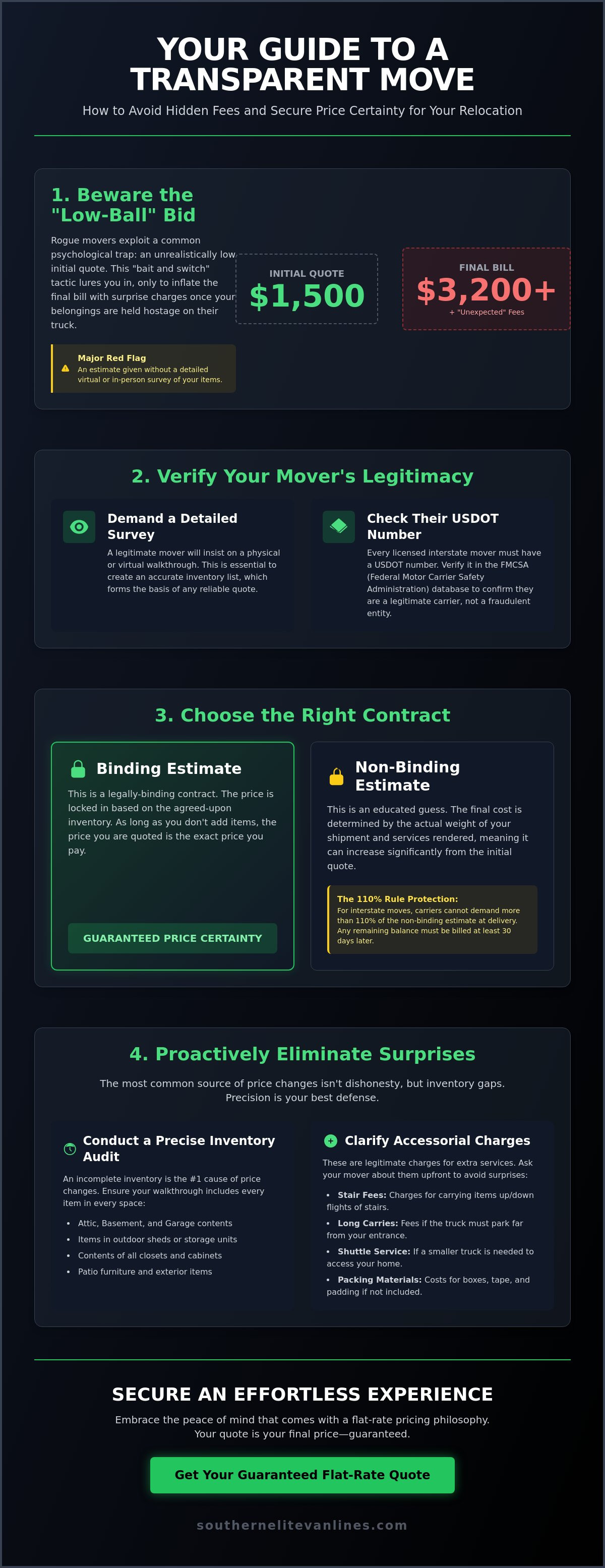
Choosing the lowest bid often feels like a victory for your budget, but in the moving industry, it is frequently the first step toward a ballooning final bill. This "bait and switch" phenomenon relies on a simple psychological trap: consumers naturally gravitate toward the most optimistic scenario. Rogue movers exploit this by providing low-ball estimates that omit essential services, only to reveal the true cost once your belongings are already loaded onto the truck. Understanding how to avoid hidden moving fees starts with recognizing that an unusually low price is often a red flag rather than a bargain.
The emotional toll of moving day surprises cannot be overstated. When your entire life is packed into a trailer, you are in a vulnerable position. Transparency alleviates this relocation stress by replacing uncertainty with a well-defined plan. Professional residential and long distance moving requires a high standard of pricing exactness. While a local move might allow for minor logistical flexibility, interstate relocation demands a level of precision that accounts for every mile and every pound. Trust is the currency of this industry, and it is built through detailed, honest communication during the initial consultation.
The Rise of the 'Rogue Mover' in 2026
Digital advertisements in 2026 make it easier than ever for unlicensed entities to appear professional. These "rogue movers" often use generic "instant" quotes to capture leads without ever seeing the items they are expected to transport. If a company refuses to perform a physical or virtual home walkthrough, consider it a major warning sign. Legitimate carriers must provide a clear paper trail. Always verify a company's credentials by checking their USDOT number via the FMCSA database. As of late 2025, this number is the sole federal identifier for interstate carriers, making it easier for you to confirm you are dealing with a licensed professional rather than a broker with no trucks of their own.
Operational Variables vs. Hidden Costs
It is vital to distinguish between predatory pricing and legitimate operational adjustments. Not every price increase is a "hidden fee." In many cases, a quote changes because the initial inventory was incomplete or the weight was underestimated. Professional movers base their projections on how moving costs are determined, which typically includes the weight of the shipment, the volume of goods, and the distance traveled. To ensure your final bill remains predictable, follow these steps during your consultation:
Provide a complete inventory: Don't forget to show the contents of your attic, basement, or storage shed.
Disclose logistical challenges: Mention if the truck cannot park near your door or if there are multiple flights of stairs.
Ask for a "Binding" estimate: This contract type locks in the price based on the inventory provided, which is the most effective way of how to avoid hidden moving fees.
Precision is your best defense against unexpected costs. By setting a baseline for professional expectations early, you transform the moving process into a shared journey with a supportive partner.
Binding vs. Non-Binding Estimates: Choosing the Right Contract
The document you sign before your move dictates your financial reality on delivery day. While many people focus on the bottom-line number, the specific contract type is what actually governs your final bill. Understanding the legal distinctions between these documents is the most effective way of how to avoid hidden moving fees. While an estimate provides a projection of costs, the Bill of Lading serves as your official contract of carriage. If these two documents don't align, you may face unexpected financial hurdles during your transition. Precision in paperwork is the only way to ensure your initial quote remains your final price.
The Non-Binding Estimate Trap
A non-binding estimate is essentially an educated guess. It lacks a legal ceiling, meaning your final cost depends entirely on the actual weight of your shipment and the services performed. For long distance moving, this uncertainty can be incredibly stressful. Federal regulations under 49 CFR Part 375 offer some protection through the 110% rule. This rule states that for interstate moves, a carrier cannot demand more than 110% of the non-binding estimate amount at the time of delivery. Any remaining balance must be billed at least 30 days later. While this prevents your items from being held hostage for the full amount, it doesn't actually lower the total cost. You still owe the money; you just get a short grace period to pay it. Because of this, non-binding quotes are rarely the right choice for families seeking total price transparency.
The Security of a Binding-Not-To-Exceed Quote
The binding-not-to-exceed estimate is widely considered the gold standard for consumer protection. This contract type guarantees that you will not pay more than the quoted price, provided your inventory remains the same. If your shipment happens to weigh less than the original estimate, your final bill actually decreases. It offers the ultimate safety net for your budget. To secure this level of certainty, you must provide a meticulous inventory list during your initial consultation. Every box, appliance, and piece of furniture must be accounted for to ensure the quote remains valid. Before signing, always verify that every agreed-upon service, from full packing services to piano moves, is explicitly listed in writing. Reviewing your consumer rights and responsibilities will help you confirm that your contract meets federal standards. If you are looking for a partner who values exactness, consider how Southern Elite approaches every relocation with a commitment to documented accuracy.
Requesting a specific contract type is your right as a consumer. Don't settle for verbal promises or vague paperwork. Demand a written binding-not-to-exceed estimate to lock in your pricing. This proactive step ensures that your relocation remains a shared journey of trust rather than a source of financial surprise. By choosing the right contract, you maintain control over your move from the first box to the final delivery. It's the most professional way to manage a complex logistical event while protecting your peace of mind.
Common Accessorial Charges: Identifying Fees in the Fine Print
Accessorial charges are the supplementary services that extend beyond the basic loading, transportation, and unloading of your goods. While the base rate covers the transit, these specific fees account for the unique logistical demands of your home or office. Learning how to avoid hidden moving fees requires a meticulous review of these line items before you sign your contract. Most homeowners are surprised by these costs because they assume a standard quote covers every physical obstacle. In reality, precision in disclosing your home layout is the only way to prevent these charges from appearing on your final invoice.
Fuel surcharges and line-haul fees also play a significant role in your final cost. These charges fluctuate based on the national energy market and the total distance of your relocation. Unlike predatory hidden costs, these are industry-standard adjustments that a reputable mover will explain clearly during your consultation. If a semi-truck cannot reach your front door due to narrow streets or low-hanging branches, a "Shuttle Service" fee will apply. This involves transferring your belongings to a smaller vehicle to complete the delivery. Identifying these needs early ensures your budget remains intact.
Logistical Obstacles and Their Costs
Logistical fees often stem from the physical distance our team must travel while carrying your items. A "Long Carry" fee typically applies if the distance from the truck tailboard to your front door exceeds 75 feet. You can measure this yourself with a simple tape measure to provide exact data during your quote. Similarly, stair fees and elevator wait times account for the additional labor hours required to move items between floors. If you have specialized items, such as piano moves or large safes, these Bulky Item fees must be documented upfront. To stay informed about your rights, you should consult the official Protect Your Move portal provided by the FMCSA.
Packing and Material Surcharges
The level of preparation you choose directly impacts your final bill. Opting for full packing services provides the highest level of security but comes with associated material and labor costs. If you prefer partial packing services, ensure you understand which boxes the movers will handle and which you will manage yourself. High-value or fragile items often require custom crating, which involves building wooden containers for maximum protection. While valuation coverage isn't technically a fee, it is a vital budget line item that protects your assets during transit. Understanding these nuances is a key part of how to avoid hidden moving fees and ensures a shared journey toward a successful relocation.
The Inventory Audit: How Precision Prevents Unexpected Costs
The inventory list serves as the blueprint for your entire relocation. It is the single most important document in your moving file because it dictates the weight, volume, and labor hours required for your move. Mastering the accuracy of this list is the most practical way to learn how to avoid hidden moving fees. When a mover provides a quote, they are essentially betting on the data you provide. Any discrepancy between the initial list and the items on the truck can lead to "weight creep," where your final bill rises because you added extra boxes or furniture after the contract was signed.
Virtual surveys have become a standard tool in 2026, offering a convenient way to document your home without an in-person visit. However, your camera must capture every detail to be effective. Open every closet door and point the lens into every corner. southern elite van lines utilizes this meticulous inventorying process to provide a level of accuracy that protects your budget from the start. By documenting every piece of furniture and every stack of boxes, we eliminate the guesswork that often leads to price fluctuations.
Conducting a Room-by-Room Pre-Quote Audit
Success begins with a thorough walkthrough before you even request a quote. Identify high-volume items like heavy oak desks or exercise equipment that significantly impact weight-based pricing. Don't overlook the "Forgotten Zones" such as attics, garages, and crawl spaces. These areas often contain bulky items that can skew an estimate if left out of the initial audit. We recommend creating a clear "Do Not Move" list for items you plan to sell or discard. This prevents you from paying to transport goods that won't have a place in your new home. This simple step ensures your quote remains focused only on what truly needs to be moved.
The Final Walkthrough Strategy
On moving day, perform a final walkthrough with the crew lead to confirm that every item loaded onto the truck matches your signed inventory sheet. If you have last-minute additions, address them immediately rather than waiting for the final bill. This allows the mover to update the paperwork while maintaining the integrity of your binding estimate. The Bill of Lading serves as your final receipt of services and should reflect the agreed-upon inventory. It's your legal protection against unauthorized charges. To ensure your next relocation is handled with this level of expert care, reach out to Southern Elite for a comprehensive moving consultation.
Securing an Effortless Experience: The Southern Elite Standard
Relocation represents more than just the transport of physical goods; it is the beginning of a new chapter. At Southern Elite, we believe that this transition should be defined by calm confidence rather than financial anxiety. Our flat-rate philosophy serves as the ultimate answer to how to avoid hidden moving fees. By providing a single, all-inclusive price based on a meticulous assessment of your needs, we remove the variables that often lead to mid-move price hikes. This approach transforms the moving process from a source of stress into a shared journey where your peace of mind is our primary objective.
Working with a long distant movers specialist provides a level of expertise that local-only companies simply cannot match. Nationwide relocation involves complex logistics, from varying state regulations to the demands of long-haul transportation. Our team understands these nuances and builds them into your initial quote. This consistency ensures that whether you are moving across state lines or across the country, the standard of service remains elite. We manage every detail, from piano moves to transitional storage, with a level of exactness that safeguards your schedule and your budget.
A Shared Journey Toward a New Beginning
Every successful relocation requires a skilled strategist. Our personalized move coordinators act as your dedicated advocate, ensuring that every aspect of your residential or commercial moving plan is transparent and well-documented. They guide you through the complexities of transitional logistics, including our secure short-term and long-term storage options. Our pricing model reflects an unwavering commitment to exactness and moral character, ensuring that every relocation begins with a foundation of absolute truth. This high-end service model ensures that you never feel like just another stop on a route, but rather a valued partner in a meticulously planned operation.
Your Next Steps Toward a Transparent Move
Achieving a move without surprises requires a proactive start. Preparing for your comprehensive virtual or in-home estimate is the first step in how to avoid hidden moving fees. During this consultation, we identify every potential logistical hurdle, from elevator access to custom crating needs for fragile items. Utilizing our full packing services further secures your final price, as it allows our experts to manage the inventory volume with professional precision. This eliminates the risk of "weight creep" and ensures that your final bill aligns perfectly with your expectations. When you are ready to experience a relocation defined by safety, perfection, and reliability, we are here to lead the way.
Request your transparent, no-obligation moving quote today and take the first step toward an effortless relocation experience.
Take Control of Your Relocation Journey
A transparent relocation is built on the foundation of meticulous preparation and honest communication. By mastering the inventory audit and choosing the right binding contract, you eliminate the variables that often lead to financial surprises. Understanding how to avoid hidden moving fees empowers you to focus on the excitement of your new beginning rather than the fine print of a bill. You now possess the professional strategies needed to decode every quote and identify unlisted charges before they impact your budget.
Southern Elite Van Lines specializes in long-distance interstate relocations, providing the steady, expert hand you need for a seamless transition. We pair our flat-rate philosophy with premium services, including professional packing with high-quality materials and climate-controlled secure storage solutions. Our team remains committed to ensuring your final invoice reflects the exactness and moral character of our initial estimate. Secure your transparent, flat-rate moving quote from Southern Elite Van Lines and experience a move defined by reliability and absolute peace of mind. Your journey toward a successful, stress-free home transition is ready to begin.
Frequently Asked Questions
What is a 'Long Carry' fee and how can I avoid it?
A 'Long Carry' fee is a charge applied when the distance between the moving truck and your front door exceeds a specific distance, usually 75 feet. You can avoid this by ensuring the movers have a clear parking space as close to the entrance as possible. Measuring the distance yourself during the estimate phase helps provide the precise data needed for an accurate quote and prevents surprises on moving day.
Is it normal for a moving company to ask for a large deposit upfront?
No, it is not standard for reputable moving companies to demand a large cash deposit before your relocation begins. Most professional carriers collect the majority of the payment upon delivery or through a small, reasonable booking fee to secure your date. A request for a significant upfront payment is often a red flag for a "rogue mover" or an unlicensed broker with no physical fleet.
Can a moving company legally charge more than the written estimate?
A moving company's ability to charge more than the estimate depends entirely on the contract type you signed. Under federal law, a binding estimate is a fixed price that cannot change unless the scope of work or inventory changes. For non-binding estimates, the 110% rule prevents carriers from demanding more than 10% over the original quote at the time of delivery, with the remainder billed later.
How do fuel surcharges work for long-distance moves in 2026?
Fuel surcharges in 2026 are calculated as a percentage of the total transportation cost, fluctuating based on the Department of Energy's national average diesel price. These surcharges ensure that long distance moving remains viable during energy market shifts. A transparent mover will list this as a specific line item in your quote rather than hiding it within the base rate or loading fees.
What happens if I add more items to my shipment after receiving a binding quote?
Adding items to your shipment after receiving a binding quote will typically void the original price guarantee. The mover must either issue an addendum to the existing contract or provide a new estimate to account for the additional weight and volume. This is a critical step in how to avoid hidden moving fees because it ensures all documentation remains accurate before the truck arrives at your home.
Are elevator fees and stair fees the same thing?
Elevator fees and stair fees are distinct charges that address different logistical challenges. Stair fees are applied per flight of stairs, accounting for the physical labor involved in multi-story homes. Elevator fees cover the additional time required to wait for and operate elevators in high-rise buildings. Disclosing these details during your virtual survey allows for a more precise and honest initial quote.
How do I verify if a moving company is a legitimate carrier or just a broker?
You can verify a company's status by searching their USDOT number on the FMCSA's official database. Legitimate carriers are authorized to transport goods and own their own fleet, while brokers are only licensed to sell your move to a third party. Identifying a direct carrier is a key strategy for how to avoid hidden moving fees and ensuring direct accountability throughout your relocation.
What is the difference between basic liability and full-value protection?
Basic liability is a no-cost coverage that pays a set rate, usually 60 cents per pound, regardless of an item's actual value. Full-value protection is a more comprehensive option where the mover is responsible for the replacement value or repair of lost or damaged goods. Choosing the right coverage level provides essential financial security for your high-value assets during a residential or commercial move.


Comments