
21 Essential Questions to Ask Long Distance Movers Before Hiring in 2026
With over 7,000 complaints filed with the FMCSA annually regarding estimate disputes and final charges, the difference between a seamless relocation and a logistical nightmare often comes down to a single conversation. You've likely felt that familiar pang of anxiety when thinking about your belongings crossing state lines. It's natural to worry about hidden fees or whether your movers are truly who they claim to be. You deserve a transition that feels like a new beginning, not a series of stressful hurdles. By knowing the right questions to ask long distance movers, you can effectively filter out unreliable brokers and identify the professional carriers committed to excellence.
Mastering your cross-country relocation starts with knowing exactly how to vet for licensing, pricing transparency, and operational standards. We've developed this guide to help you secure a predictable, damage-free move that stays on schedule. You'll learn how to verify a carrier's USDOT number and understand the latest 2026 federal financial requirements for brokers. This meticulous checklist covers 21 essential inquiries that will transform your moving experience from a source of stress into a well-coordinated journey managed by experts.
Key Takeaways
Identify the crucial differences between moving brokers and direct carriers to ensure you're working with the team physically handling your possessions.
Secure your budget by mastering the nuances of binding estimates, protecting you from the unexpected costs often associated with non-binding quotes.
Prepare the right questions to ask long distance movers regarding valuation coverage to ensure your high-value items receive the protection they deserve.
Gain clarity on delivery timelines by distinguishing between spread dates and guaranteed arrival windows for a more predictable transition.
Evaluate the moral character and technical skill of your moving crew through specific vetting techniques for background checks and professional training.
Table of Contents
Verifying Legitimacy: Licensing and the Broker vs. Carrier Dilemma
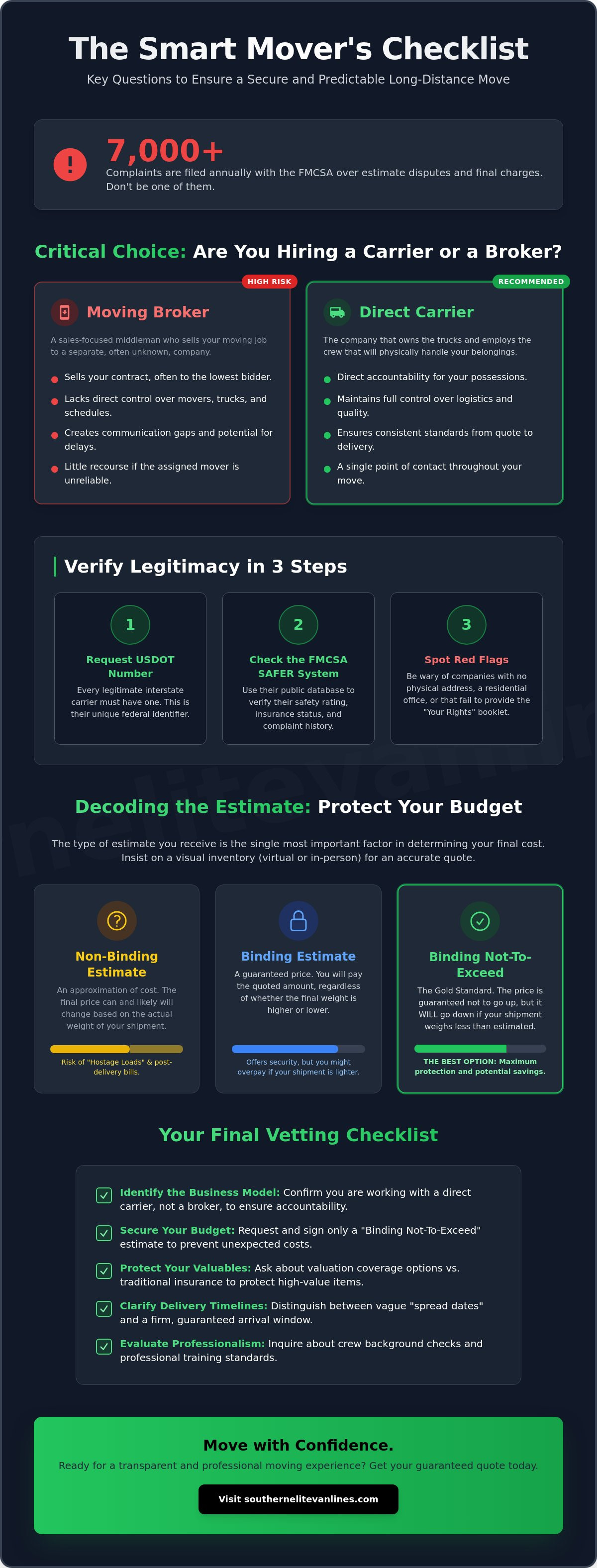
Professionalism starts with transparency. When you begin your search, one of the most critical questions to ask long distance movers is whether they're a carrier or a broker. A carrier owns the trucks and employs the crews. A broker is a middleman who sells your job to someone else. This distinction dictates who's responsible for your piano or your heirloom furniture. You want a team that maintains control over every mile of the journey.
Direct carriers offer a level of accountability that brokers simply can't match. When you hire a carrier, you're entering a direct agreement with the people who will physically move your life. This vertical integration ensures that the standards promised during your initial quote are the same standards practiced on moving day. For a broader moving industry overview, it's clear that the shift toward direct carrier relationships has become the gold standard for consumer protection. It eliminates the "lowest bidder" mentality that often leads to damaged goods or service failures.
Verification is a straightforward process if you know where to look. The Federal Motor Carrier Safety Administration (FMCSA) maintains the SAFER system. This database is public. You can enter a company's USDOT number to see their safety rating, insurance status, and historical complaint data. If a company doesn't have a physical office address listed or uses a residential location, consider it a significant red flag. Legitimate operations maintain professional facilities to support their long distance moving and storage infrastructure. They don't hide behind a PO Box.
The Risks of Hiring a Moving Broker
A broker often functions as a sales office rather than a logistics provider. They frequently sell contracts to the lowest bidder to maximize their commission. This practice creates a dangerous gap in communication. Since the broker doesn't control the driver's schedule, you might face unexpected delays without any direct point of contact. If the assigned mover fails to show up on loading day, you have very little recourse, as the broker has already collected their fee. You're left stranded while two different companies point fingers at each other.
The Importance of a Valid MC (Motor Carrier) Number
While the USDOT number is the sole federal identifier as of 2026, understanding a company's historical MC number still provides insight into their longevity. The FMCSA phased out MC numbers for new registrations in late 2025 to simplify tracking, but legacy numbers help you verify how long a company has operated in interstate commerce. You must ensure your mover has active interstate authority to transport household goods. Check their safety record for recurring violations. A history of "hostage load" complaints or unauthorized price hikes is a clear sign to look elsewhere. Confirming these credentials ensures your mover adheres to the 110% rule on non-binding estimates and mandatory arbitration requirements.
Decoding the Estimate: Binding vs. Non-Binding Agreements
Financial clarity is the foundation of a stress-free relocation. Federal law requires every interstate mover to provide you with a copy of the "Your Rights and Responsibilities When You Move" booklet before the contract is signed. If a company skips this step, they're already signaling a lack of professionalism. When reviewing your quote, one of the most vital questions to ask long distance movers is which specific type of estimate they're providing. A non-binding estimate is merely an approximation. While the 110% rule limits what you must pay at delivery, the mover can still bill you for the remainder after 30 days. This uncertainty often leads to "hostage load" scenarios where costs balloon unexpectedly once your items are already in transit.
A binding estimate offers more security, but the "Binding Not-to-Exceed" estimate is the true gold standard for consumer protection. This agreement guarantees you won't pay more than the quoted price, but if your shipment weighs less than the initial projection, your final bill actually decreases. Expert resources often highlight these specific questions to ask movers to ensure you aren't overpaying for unused capacity. To get an accurate figure, a physical or virtual walkthrough of your home is non-negotiable. Estimates provided over the phone without a visual inventory are notoriously unreliable and frequently lead to disputes on moving day.
Identifying Potential Hidden Fees
Transparency means knowing every possible cost before the truck arrives. Ask about accessorial charges that might apply to your specific origin or destination. Common fees include long carry charges if the truck cannot park near your entrance, or shuttle services if a full-sized tractor-trailer cannot navigate narrow residential streets. You should also verify if there are additional costs for stair or elevator access in multi-story buildings. Securing a professional residential moving quote ensures you have these protections in writing before the first box is taped.
How Weight and Volume Impact Your Final Bill
Legitimate carriers determine costs based on the actual weight of your belongings rather than just the space they occupy. The driver must weigh the truck at a certified scale both before and after loading your items. You have the legal right to observe this weighing process. Always request the official Weight Ticket to verify the numbers against your contract. Be wary of companies that quote solely by cubic footage. This method is prone to manipulation and lacks the strict federal oversight associated with weight-based billing.
Operational Logistics: Managing the Long-Haul Timeline
Precision in timing is what separates a premium carrier from a discount broker. When you're moving across the country, you aren't just renting a truck; you're participating in a complex logistical operation. One of the most important questions to ask long distance movers involves their delivery timing. Most carriers use a "delivery spread," which is a window of several days during which your items might arrive. While a "guaranteed delivery date" provides absolute certainty, it often comes with a higher price point. Understanding how your mover manages this window helps you plan your travel and temporary housing with confidence.
Long-haul logistics often involve consolidated shipping. To keep costs manageable, carriers frequently combine multiple residential shipments onto a single 53-foot trailer. This doesn't mean your items are at risk; it simply means the driver must navigate several stops along a strategic route. Drivers also must adhere to strict federal Hours-of-Service regulations, which limit driving time to 11 hours after 10 consecutive hours off duty. These safety protocols are non-negotiable and ensure your belongings are handled by a well-rested professional. A carrier that ignores these rules is a liability you can't afford. High-quality communication during this phase is the primary marker of a professional service provider.
Shipment Tracking and Real-Time Updates
Gone are the days of wondering where the truck is located. Modern carriers utilize GPS tracking to monitor their fleet's progress across state lines. A dedicated move coordinator acts as your single point of contact, bridging the gap between you and the driver. You should expect a structured communication cadence, including check-in calls at the point of origin, updates during transit, and a final confirmation 24 hours before the truck reaches your new home. This transparency alleviates the anxiety of the "black hole" period when your goods are in the middle of the country.
Storage-in-Transit (SIT) Solutions
Sometimes, life doesn't align perfectly with a moving schedule. If your new home isn't ready or a closing date shifts, you'll need Storage-in-Transit (SIT). This is a specialized service where your shipment is held in a secure, climate-controlled warehouse until you're ready for final delivery. Unlike standard self-storage, SIT keeps your items within the carrier's chain of custody, maintaining accountability. Ensure you ask about the security measures at these facilities and how the additional storage fees are calculated within your contract. Most professional carriers offer both short-term and long-term storage options to accommodate these common real estate delays.
Protection and Accountability: Valuation vs. Insurance
Protecting your assets across thousands of miles requires a clear understanding of liability. Many people confuse "valuation" with "insurance," but they're legally distinct. Valuation refers to the level of liability a mover assumes for your belongings. When considering questions to ask long distance movers, the specifics of their protection plans should be at the top of your list. By federal law, every mover must provide Released Value Protection at no extra cost. This basic coverage is set at a federal minimum of $0.60 per pound per item. While this offers some baseline security, it's often insufficient for high-value electronics or antique furniture.
Full Value Protection (FVP) provides a more comprehensive safety net. Under FVP, the mover is responsible for the replacement value of any lost or damaged items. If a 100-pound television worth $1,500 is damaged under basic released value protection, you'd only receive $60 in compensation. FVP ensures the item is repaired, replaced, or that you receive a cash settlement for its current market value. Some homeowners find that third-party moving insurance is a necessary addition if they have specific items that exceed the carrier's standard liability limits. You have nine months from the date of delivery to file a written claim for loss or damage, giving you ample time to inspect your belongings thoroughly. Securing professional residential moving services ensures that your inventory is handled with the meticulous care required for high-value transit.
The Claims Process and Dispute Resolution
The Bill of Lading is the most important document in your relocation. It's the official contract between you and the mover, and it serves as a receipt for your goods. If a dispute arises regarding loss, damage, or charges, all interstate movers must offer neutral arbitration. For claims of $10,000 or less, this arbitration is mandatory for the mover. This system is designed to provide a fair, cost-effective way to resolve issues without the need for lengthy legal battles. Always document any damage on the high-value inventory sheet at the moment of delivery to streamline the resolution process.
Inventory Management Standards
Precision in inventory management is the foundation of accountability. Professional crews use a tagging system where every individual item or box receives a unique, color-coded sticker and a corresponding entry on the inventory list. During delivery, you play a critical role in the "check-off" process. As the movers bring items into your new home, you should verify each tag number against the master list. This methodical approach ensures nothing is left behind on the trailer. A detailed inventory isn't just a list; it's your primary evidence if you ever need to file a claim for a missing or damaged item.
Vetting Professionalism: Beyond the Paperwork
While licensing provides the legal framework for your relocation, the moral character of the crew determines the actual quality of your experience. You're inviting strangers into your home to handle your most personal possessions across state lines. One of the final questions to ask long distance movers should focus on their specific hiring and safety standards. Premium carriers conduct rigorous background checks and regular drug testing for every employee on the payroll. This ensures that the individuals loading your life onto a truck meet the highest standards of integrity. Professional training programs also play a vital role in success. A crew trained in specialized techniques for piano moves and high-value furniture protection will always outperform a group of untrained laborers.
Interpreting online reviews requires a discerning eye. Look for patterns in how a company handles adversity rather than focusing solely on the star rating. A professional carrier will have a documented history of resolving issues transparently and fairly. Industry awards from reputable moving and storage associations serve as additional markers of excellence and operational precision. When you're ready to finalize your choice, selecting a premium nationwide mover ensures that these high standards are maintained from the first phone call to the final box being unpacked in your new home.
Employee vs. Day Laborer Models
Many discount companies rely on temporary day labor to reduce their overhead. This practice introduces significant risk, as these workers often lack the specialized training and accountability of full-time staff. You should ask whether the crew is comprised of actual employees who are covered by the company's workers' compensation and liability insurance. Consistent, uniformed crews project a sense of order and competence. The driver leading your move should have specific experience in long-haul routes and be able to demonstrate a track record of safe, timely deliveries over several years.
Moral Character and Company Culture
A company's culture is often reflected in the responsiveness and transparency of its sales team. If they're slow to answer questions or vague about pricing before you sign a contract, expect that behavior to continue once they have your deposit. Longevity in the industry is a testament to a carrier's ability to navigate the complexities of interstate logistics successfully. Finally, trust your intuition during the consultation process. A mover should prioritize your peace of mind as much as the physical task of transportation. If the interaction feels like a high-pressure sales pitch rather than a supportive partnership, it's a clear sign to look elsewhere.
Securing Your Cross-Country Future
A successful relocation isn't a matter of luck; it's the result of meticulous vetting and clear communication. You now have the tools to distinguish between direct carriers and brokers, ensuring your possessions stay in the same hands from start to finish. By prioritizing binding estimates and comprehensive valuation, you've protected your budget and your assets from the uncertainties of the long haul. Remember that the moral character of your moving crew is just as vital as their technical skill. By mastering these questions to ask long distance movers, you've positioned yourself for a transition that is as seamless as it is secure.
Southern Elite Van Lines provides the steady, expert hand you need for a stress-free move. With professional, background-checked crews and secure, climate-controlled storage solutions, we offer comprehensive nationwide coverage tailored to your specific needs. We value your peace of mind as much as the physical safety of your belongings. Request a Transparent, Flat-Rate Quote from Southern Elite Van Lines today and begin your new chapter with absolute confidence. Your journey deserves the highest standard of care, and we're ready to deliver it.
Frequently Asked Questions
What is the most important question to ask a long distance mover?
The most critical inquiry is determining whether you are speaking with a direct carrier or a moving broker. Ask for their USDOT number immediately to verify their authority. A carrier owns the equipment and employs the crew, while a broker simply sells your contract to a third party. This distinction is the foundation for all other questions to ask long distance movers. It ensures you know exactly who is responsible for your items throughout the journey.
Can a moving company change the price after the truck is loaded?
A mover cannot change the price of a binding estimate unless you add items or services after the contract is signed. However, if you have a non-binding estimate, the final cost depends on the actual weight of your shipment. Under federal regulation 49 CFR Part 375, movers can't collect more than 110% of a non-binding estimate at delivery. Any remaining balance must be billed 30 days later, giving you time to review the charges.
How do I verify if a moving company is a broker or a carrier?
You can verify a company's status by entering their USDOT number into the FMCSA's SAFER system online. This database explicitly states whether a company has "Motor Common Carrier" or "Broker" authority. Additionally, look for a physical warehouse address rather than a PO Box. Legitimate carriers operate out of professional facilities to support their long distance moving and storage operations. If a company only provides a residential address, they are likely a broker.
What is a binding not-to-exceed estimate?
A binding not-to-exceed estimate is the most consumer-friendly contract in the moving industry. It guarantees that you won't pay more than the quoted price, even if your shipment weighs more than expected. If your belongings weigh less than the initial projection, your final bill decreases accordingly. This agreement provides a fixed budget for your relocation while allowing for potential savings. It's the preferred choice for customers who value transparency and financial certainty.
How much should I tip long distance movers in 2026?
Gratuities for professional movers remain a personal decision, but industry standards suggest 5% to 10% of the total move cost distributed among the crew. For a long-haul journey, many customers prefer a daily rate of $40 to $60 per mover. This gesture acknowledges the physical labor and meticulous care required to transport a household across state lines. You should provide tips individually to each crew member to ensure the team feels personally appreciated for their hard work.
What items are long distance movers not allowed to transport?
Federal safety regulations prohibit movers from transporting hazardous materials, including ammunition, propane tanks, paint thinners, and aerosol cans. Most carriers also refuse to move perishable food items or live plants, as these can attract pests or die during the long transit period. You should keep high-value personal items like jewelry, passports, and prescription medications with you. Professional crews will provide a full list of "non-allowables" during your initial consultation to prevent loading delays.
How long does a cross-country move typically take?
A cross-country relocation typically takes between 10 and 21 days from the date of loading. This timeline accounts for the thousands of miles traveled and mandatory federal driver rest requirements. Since most long-distance shipments are consolidated on a single trailer with other households, the truck may make several stops along the route. Your move coordinator will provide a delivery spread, which is a window of days when you can expect your belongings to arrive.
Is it better to get a weight-based or volume-based quote?
You should always prioritize a weight-based quote over a volume-based estimate. Weight-based billing is the industry standard for interstate moves and is strictly regulated by federal law. The mover must weigh the truck at a certified scale, providing you with a Weight Ticket as proof of accuracy. Volume-based quotes, which rely on cubic footage, are often less precise and easier to manipulate. Choosing a weight-based carrier ensures a more transparent and legally protected pricing structure.


Comments