
Healing and Hope: Understanding the Feeling of Loss After Leaving a Home
What if the most challenging part of your move isn't the heavy lifting, but the heavy heart you carry as you lock the door for the last time? You've likely spent weeks coordinating logistics in a May 2026 market where 25.6% of homes still sell above list price, yet the emotional weight caught you off guard. It's common to feel a deep sense of guilt for not being purely happy about your new chapter. This feeling of loss after leaving a home is a documented psychological transition called relocation grief. It affects your identity just as much as your zip code; acknowledging it is the first step toward a seamless transition.
At Southern Elite Van Lines, we believe your peace of mind is just as important as your physical cargo. We're here to validate that your emotions are a natural part of the journey. This guide will help you understand why relocation grief happens and provide professional strategies to navigate the change with confidence. You'll learn actionable ways to say goodbye to your old space and follow a clear framework for building a new sense of belonging. Your journey starts with honoring where you've been so you can fully embrace where you're going.
Key Takeaways
Recognize that your home is a vessel for memories, making it a vital anchor for your personal identity and security.
Practice proactive emotional closure rituals weeks before your move to ensure you aren't processing grief in the middle of a chaotic transition.
Validate that the feeling of loss after leaving a home is a normal psychological response, not a sign that you've made the wrong decision.
Leverage professional logistics to eliminate decision fatigue, giving you the mental bandwidth necessary to focus on your family's emotional well-being.
Reframe your relocation as a personal evolution and prioritize "nesting" in your new space to build an immediate sense of belonging.
Table of Contents
Understanding Relocation Grief: Why Leaving a Home Feels Like a Personal Loss
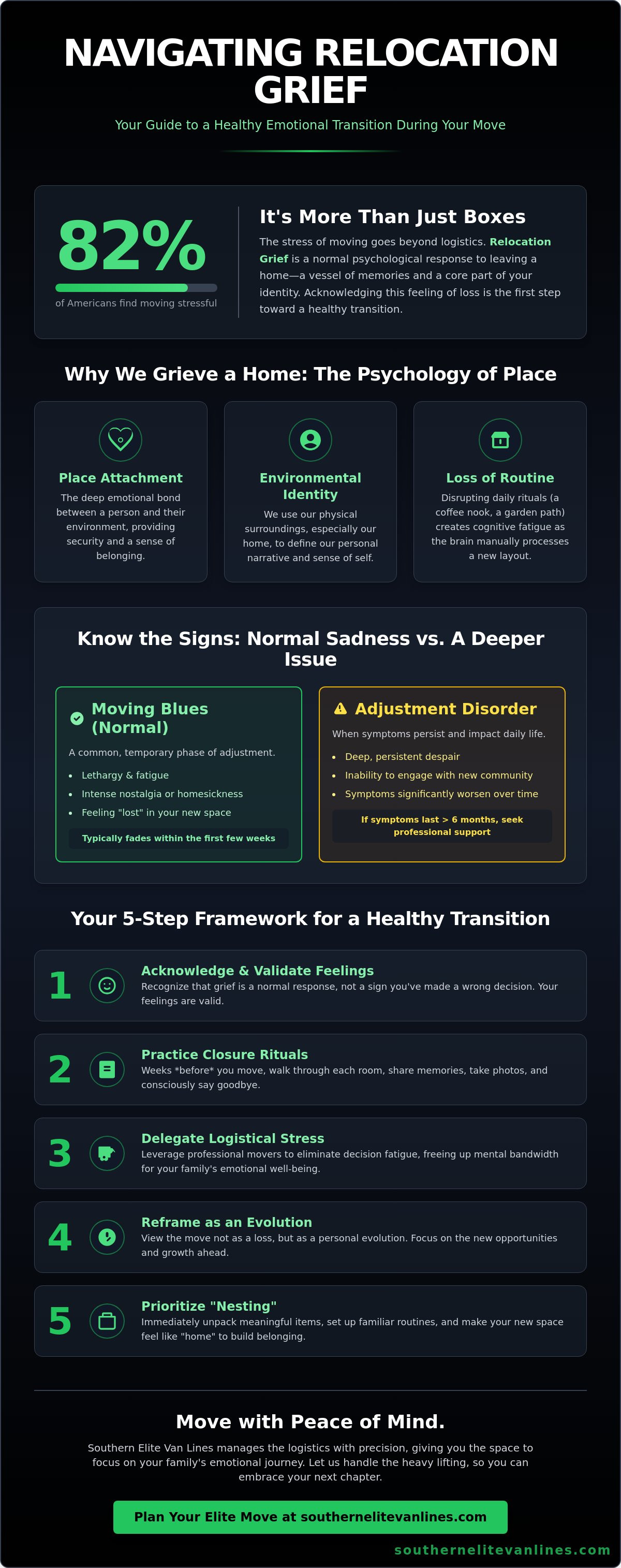
Moving involves more than just the logistical coordination of boxes and trucks. It's a significant life transition that often triggers a complex emotional response known as relocation grief. While industry reports from sources like JK Moving suggest that 82% of Americans find the moving process inherently stressful, the emotional impact often goes deeper than mere logistical anxiety. This feeling of loss after leaving a home is a normal psychological reaction to losing a primary source of stability. Your home functions as a vessel for memories, holding the physical echoes of every milestone, celebration, and quiet moment of rest. When you lock that door for the last time, it's natural to experience a sense of bereavement similar to losing a loved one.
Even when a move represents a positive step, such as a career promotion or a transition into a dream house, the grief remains valid. You might feel a strange contradiction: guilt for not being purely happy despite your success. This "uprooting" effect is particularly intense during nationwide moves across state lines. You aren't just changing your zip code; you're detaching from the physical environment that has served as your predictable anchor in an unpredictable world. Acknowledging this loss is the first step toward a healthy emotional recovery.
The Difference Between Sadness and Relocation Depression
It's common to experience the "moving blues" during the first few weeks in a new environment. You might feel lethargy, intense nostalgia, or a persistent sense of being "lost" even when standing in your new living room. These feelings typically fade as you establish new routines. However, if these symptoms persist or worsen, they can transition into a clinical adjustment disorder. If you find yourself unable to engage with your new community or feel a deep sense of despair that lasts beyond six months post-move, it's time to seek professional support. Early intervention helps ensure your relocation remains a positive evolution rather than a source of long-term distress.
Why Long-Distance Relocation Intensifies the Feeling of Loss
Long-distance moves compound grief because they often sever ties with established support networks simultaneously. Many people subscribe to the "geographic cure" myth, believing that a new city will automatically erase old stresses or bring instant fulfillment. In reality, the psychological bond of Place attachment is a fundamental human need for security and safety. When that bond is broken by thousands of miles, the feeling of loss after leaving a home becomes more acute. You lose the familiar landmarks and sensory cues that define your daily life. At Southern Elite Van Lines, we recognize that managing these emotional variables requires the same precision and care as handling your most fragile heirlooms. By providing a seamless, elite moving experience, we give you the mental bandwidth to process these changes without the added weight of logistical chaos.
The Psychology of Place: How Our Identity is Rooted in Our Environment
Your sense of self is inextricably linked to the walls around you. This concept, known as Environmental Identity, suggests that we use our physical surroundings to define our internal narrative. A home serves as a predictable anchor in an unpredictable world, providing a sanctuary where you maintain total control. With 3.98 million existing-home sales occurring annually as of March 2026, millions of individuals are currently navigating this profound shift in their personal identity. The feeling of loss after leaving a home often stems from the Endowment Effect. This psychological principle explains why we overvalue the spaces we inhabit for years; we perceive the loss of our established home as more significant than the potential gain of a new one. Place attachment is the emotional bond between person and setting.
The 'Loss of Routine' as a Catalyst for Grief
Small daily rituals form the backbone of our mental health. When you move, you lose the specific coffee nook or the familiar garden path that signaled the start of your day. Your brain feels fatigued because it must manually process a new floor plan that was previously handled by your subconscious "autopilot." This cognitive load is a primary driver of relocation stress. Recreating these routines in your new space is the first step toward reclaiming your identity. Choosing a premium residential moving service ensures your belongings arrive with the precision needed to set up these rituals immediately, reducing the time you spend in a state of flux.
Social Displacement and the Fear of the Unknown
Relocation often involves social displacement. You lose your "third places," such as the local gym, the neighborhood park, or the corner cafe where the staff knows your order. This loss of social capital creates genuine anxiety about the unknown and the fear of starting from zero in a new state. You aren't just moving boxes; you're relocating your entire social ecosystem. We reassure our clients that while the location changes, your identity remains portable. The character and integrity you brought to your old neighborhood will naturally take root in your new elite community. By focusing on a seamless transition, you protect your emotional energy for the important work of building new connections.
Practical Strategies for Emotional Closure Before You Move
Emotional closure isn't a passive event that happens once the truck pulls away. It's a proactive strategy you should begin at least four weeks before your long distant movers arrive. By actively managing the transition, you mitigate the feeling of loss after leaving a home. This structured approach transforms a chaotic exit into a meaningful milestone. It's especially vital for vulnerable family members. Children and elderly relatives often rely on physical cues for security. Involving them in these rituals provides the emotional bandwidth they need to process the change before the physical environment shifts.
Creating a 'Legacy of Memories'
The fear of forgetting is a primary driver of relocation grief. You can neutralize this by establishing a "House Tour" ritual. Walk through every room together and voice one specific, joyful memory tied to that space. This verbal acknowledgment helps the brain categorize the experience as a completed chapter. For a more permanent record, utilize digital preservation. Create a high-quality video tour of the empty home or a professional photo book. We also recommend the "Memory Box" concept. Choose one physical item, such as a garden stone or a spare key, to serve as a tangible link to the property’s spirit. This practice acknowledges that while you're leaving the structure, the essence of your experiences remains with you, softening the feeling of loss after leaving a home.
The Power of a Proper Goodbye
Finality requires intentionality. Rather than a standard farewell party, host a "See You Soon" gathering. This shifts the focus from the pain of departure to the promise of future connection. It reframes the move as an expansion of your network, not a contraction. Another powerful tool is writing a "passing of the torch" letter to the house or the new owners. Sharing the history of the home, like the best spot for morning sun or the neighbor who always has extra flour, provides a sense of continuity. Finally, complete a local "bucket list" during your last 30 days. Visit the corner cafe one last time or walk your favorite trail. Ensuring no lingering regrets about the old location allows you to step into your new home with a clear mind and an open heart.
Reducing Relocation Stress: How Logistical Precision Protects Your Mental Health
Logistics and emotions are not separate silos; they are deeply intertwined. When you're navigating a move in a May 2026 market characterized by a 4.1 month supply of housing inventory and shifting buyer leverage, the sheer volume of tactical decisions can lead to acute decision fatigue. This mental exhaustion leaves you with zero energy to process the feeling of loss after leaving a home. When your brain is occupied with box counts and truck dimensions, it cannot engage in the necessary work of emotional closure. By delegating these complex tasks to Southern Elite Van Lines, you reclaim the emotional bandwidth required to heal. Our precision ensures that your relocation remains a positive evolution rather than a traumatic core memory.
A chaotic move often results in damaged sentimental items, which can feel like a secondary bereavement. Breaking a family heirloom during a state-to-state transition exacerbates the existing sense of loss. Professional packing isn't just about safety; it is about protecting the physical manifestations of your history. We provide the structural integrity needed to move your life without fracturing the memories attached to your belongings. This seamless execution allows you to focus on your family's well-being while we handle the heavy lifting.
The Role of Professional Packing in Emotional Stability
Seeing your life dismantled and placed into generic boxes is a significant psychological trigger. Our white-glove service softens this transition by maintaining a highly organized, methodical environment. We utilize strict inventory integrity, ensuring every item is accounted for and handled with care. This order provides a sense of control during a period of inherent flux. To ensure immediate comfort, we recommend "first-night" boxes. These containers should hold your most essential comforts, from high-end linens to specific kitchen tools, allowing you to establish a sense of "home" within hours of arrival. This proactive step prevents the initial "unfamiliarity shock" from overwhelming your recovery process.
Eliminating Uncertainty Through Expert Transport
The "liminal space" of relocation-the time when your belongings are between two fixed points-is often the most anxious period for our clients. We eliminate this uncertainty through real-time tracking and dedicated support. Knowing that your possessions are in secure, climate-controlled storage or in transit with a team that values precision provides a psychological safety net. This transparency reduces the anxiety of the unknown, allowing you to step into your new chapter with confidence. We position ourselves as more than a service provider; we are a supportive partner in your elite transition. Contact our team today to discover how our tailored moving solutions can protect your peace of mind throughout your journey.
Transitioning with Confidence: Moving Toward Your Next Elite Chapter
Your new residence is not a replacement for your past; it is a sophisticated evolution of your journey. While the feeling of loss after leaving a home can linger like a quiet shadow, it serves as a powerful indicator of the deep roots and meaningful connections you established. In the May 2026 housing market, where active listings have increased by 9.1% year over year, you have a unique opportunity to curate a space that perfectly aligns with your current ambitions. This new chapter is a blank canvas. It is an invitation to design an Elite lifestyle from the ground up, unencumbered by the logistical weight of your previous environment. By reframing this transition as growth, you transform grief into momentum.
Nesting Strategies for Your New Home
Psychological comfort begins with intentional nesting. We recommend prioritizing "comfort zones," such as the master bedroom or the primary living area, within the first 48 hours of your arrival. Establishing these sanctuaries provides an immediate refuge from the inevitable sea of boxes. To ease the sensory transition, incorporate familiar elements like a specific candle scent or a favorite playlist that defined your old space. Once your interior is secured, begin a "tactical hunt" for your new favorite spots. Identifying the best local espresso or the quietest walking trail transforms an unfamiliar zip code into a personal domain. This proactive exploration accelerates the process of place attachment, helping the feeling of loss after leaving a home fade more quickly.
Building Your New Support Network
Building a sense of belonging in a new state requires a strategic approach. Adopt a commercial relocation mindset by networking early and often within your new community. Just as a business establishes local partnerships, you must cultivate social capital through consistent, small interactions. Be patient with yourself; building a genuine "home" feeling typically takes between 6 and 12 months. This timeline is normal and expected. As you settle in, remember that your identity is portable. The integrity and sophistication you brought to your old neighborhood are already present in your new one, ready to take root in this next chapter.
The transition to a new home should be a celebration of your achievements, not a source of exhaustion. Let Southern Elite Van Lines handle the heavy lifting while you focus on your family's transition. Our white-glove service ensures your belongings arrive with the precision and care you deserve, giving you the freedom to focus entirely on the emotional work of starting your next elite chapter.
Embrace Your New Beginning with Confidence
You now possess the psychological framework to navigate this transition with authority and grace. Recognizing that your home serves as a vital anchor for your identity helps normalize the feeling of loss after leaving a home. By utilizing proactive closure strategies and intentional nesting, you transform a period of upheaval into a clear, structured path forward. Relocation is a shared journey; you don't have to carry the logistical or emotional weight alone.
Southern Elite Van Lines offers nationwide coverage for seamless transitions and maintains elite standards in packing and secure transit. Our dedicated support teams manage every complexity of your move so you can focus entirely on building a new sense of belonging in your new community. Your journey starts with a partner who values your peace of mind as much as your physical cargo.
Start your stress-free journey with a free quote from Southern Elite Van Lines today.
Your next elite chapter is ready to be written. We're ready to guide you home with precision and care.
Frequently Asked Questions
Is it normal to cry after moving into a new home?
Yes, crying is a natural physiological release for the intense stress and grief associated with major life changes. Even when a move is a positive step, the sudden absence of familiar surroundings triggers a mourning response. It's an honest acknowledgment of the transition you're experiencing. You aren't just losing a building; you're processing the end of a significant life chapter.
How long does the feeling of loss last after leaving a home?
Most individuals begin to feel settled within 3 to 6 months, though full place attachment typically takes about 12 months to develop. The feeling of loss after leaving a home is a temporary phase of adjustment as your brain maps a new environment. If these emotions persist beyond the 6-month mark without any improvement, seeking professional guidance is a proactive step for your well-being.
What is relocation depression and should I be worried?
Relocation depression is a form of situational adjustment disorder characterized by persistent sadness, lethargy, and social withdrawal following a move. While the "moving blues" are common, you should monitor for symptoms that interfere with daily functioning. Professional support becomes necessary if you find yourself unable to establish a basic routine or connect with others after 90 days in your new location.
How can I help my children cope with the loss of their old home?
You can help children by validating their sadness and giving them age-appropriate control over their new environment. Allow them to pack a "treasure box" of special items that stay with them during transit. Research indicates that maintaining consistent routines, like a specific 7:00 PM bedtime story, provides the stability they need to process the change while their physical world is in flux.
Can a professional moving company really reduce the emotional stress of a move?
Yes, a professional partner reduces stress by eliminating decision fatigue and protecting your physical history. When you delegate the logistical precision of packing and transport to an elite team, you preserve your mental energy for emotional recovery. This allows you to focus on your family's needs instead of worrying about the complexities of a May 2026 housing market and transit risks.
What are the best ways to say goodbye to a house I've lived in for years?
Effective goodbyes involve intentional rituals like a final "memory walk" through each room or writing a letter to the next occupants. These actions provide the brain with the necessary signal to close one chapter and open the next. Capturing high-resolution photos of the empty space ensures your memories remain portable even after you've handed over the keys to the new owners.
Why do I feel regret after moving even though I wanted to leave?
Regret often stems from the "Endowment Effect," where we instinctively overvalue what we possess compared to potential gains. Even if you chose to leave for a promotion or a larger home, your brain still registers the loss of the familiar as a threat. This feeling of loss after leaving a home doesn't mean you made a mistake; it simply means you're adjusting to a new reality.
How do I start feeling 'at home' in a completely new state?
Start by establishing "anchor points" in your new community, such as a favorite local cafe or a specific park. Engaging in local events within the first 30 days helps build the social capital necessary for a sense of belonging. Prioritize "nesting" in your primary living spaces immediately to create a sensory environment that feels secure and tailored to your elite lifestyle.


Comments