
Georgia Moving Services: The 2026 Guide to Stress-Free Relocation
- nadineharoon
- Aug 2
- 16 min read
What if the biggest threat to your Georgia relocation isn't the distance, the logistics, or even the moving day itself, but the moment you realize your moving company never told you the full story? Hidden fees buried in the fine print, fragile heirlooms packed without care, and interstate regulations that nobody bothered to explain: these are the real obstacles standing between you and a fresh start. Finding trustworthy georgia moving services that handle every detail with precision and transparency is not just a preference; it's a necessity.
You already know that moving is stressful. That feeling is valid. A relocation involves your most valuable possessions, your time, and often your finances, all moving simultaneously toward an uncertain outcome. The anxiety is real, and it deserves a real solution.
This guide gives you exactly that. You'll learn how to identify premium movers who offer honest pricing, professional packing, secure storage, and seamless long-distance transport, so you can step into your next chapter with confidence rather than dread. From evaluating service offerings to understanding what separates a reliable mover from a costly mistake, everything you need is ahead.
Table of Contents
Understanding the Landscape of Georgia Moving Services
The Georgia relocation market in 2026 looks nothing like it did a decade ago. Population growth across metro Atlanta, Savannah, and the surrounding corridors has driven demand for professional moving services to new heights, and the industry has responded with a wider spectrum of options than ever before. That variety is both an opportunity and a risk. Knowing exactly what you're hiring, and what protections come with it, separates a smooth transition from a costly ordeal.
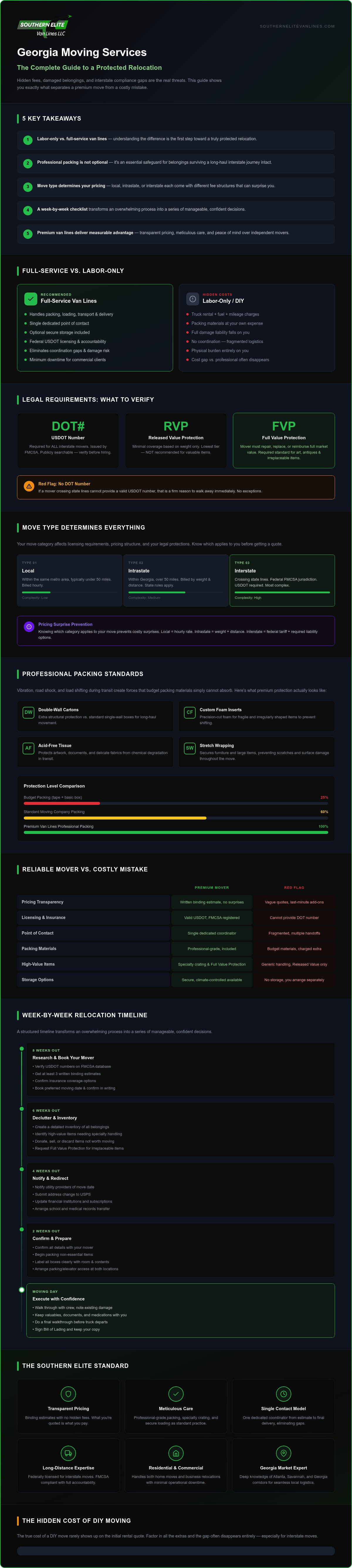
At the most basic level, georgia moving services fall into two broad categories: labor-only assistance and full-service van lines. Labor-only providers supply workers who help load and unload a truck you've rented yourself. It sounds economical until you account for the truck rental cost, fuel, mileage charges, liability for damage, and the physical and logistical burden placed entirely on you. Full-service van lines, by contrast, handle every stage of the process, from packing and loading to transport, delivery, and optional storage, under a single coordinated operation.
For long-distance and interstate moves, that distinction becomes even more critical. A mover crossing state lines operates under federal jurisdiction, not just Georgia state rules. That changes everything about how they must be licensed, insured, and held accountable.
The Legal Requirements for Movers in Georgia
Any moving company operating across state lines is required by federal law to hold a valid USDOT number issued by the Federal Motor Carrier Safety Administration (FMCSA). This number is publicly searchable and confirms that the carrier meets minimum safety and insurance standards. Before hiring any interstate mover, look up their DOT number on the FMCSA's official database. If a company can't provide one, that's a firm reason to walk away.
Insurance requirements differ depending on the nature of the move. Residential relocations require carriers to offer two liability options at minimum: Released Value Protection, which provides minimal coverage based on weight, and Full Value Protection, which obligates the mover to repair, replace, or reimburse the full current market value of any item lost or damaged during transit. For high-value moves involving art, antiques, or irreplaceable items, Full Value Protection isn't optional; it's the standard you should insist on.
Commercial relocations carry additional layers of complexity, often requiring certificates of insurance that meet building management requirements at both origin and destination addresses.
Full-Service vs. Self-Service Relocation
The true cost of a DIY move rarely shows up on the initial rental quote. Factor in packing materials, equipment rental, fuel, potential vehicle damage liability, and the hours of physical labor involved, and the gap between self-service and professional narrows considerably. For interstate moves, it often disappears entirely.
Full-service providers like Southern Elite Van Lines assign a dedicated point of contact who manages your move from first estimate to final delivery. That single-contact model eliminates the coordination gaps where damage and miscommunication typically occur. For commercial clients, it also minimizes operational downtime, because a professional logistics team can plan, execute, and complete a business relocation on a timeline that keeps disruption to a minimum.
Understanding these distinctions is the foundation every informed relocation decision rests on. The right georgia moving services provider doesn't just move boxes; they manage risk, protect your assets, and deliver a structured experience built around your specific needs.
Core Components of a Premium Georgia Relocation
The difference between a move that goes smoothly and one that doesn't often comes down to what happens before the truck leaves the driveway. Transport is the visible part of the process. The decisions made around packing, loading, storage, and specialty handling are where a premium relocation is actually built or broken.
Advanced Packing and Crating Techniques
Standard cardboard boxes and a roll of tape are not adequate protection for a long-haul interstate journey. Vibration, road shock, and load shifting during transit create forces that budget packing materials simply can't absorb. Professional-grade georgia moving services use double-walled cartons, custom foam inserts, acid-free tissue, and stretch wrapping as standard tools, not upgrades.
For fragile or irregularly shaped items, custom crating is the appropriate solution. A wooden crate built specifically around a piece of sculpture, a large mirror, or an oversized display case distributes pressure evenly and eliminates internal movement entirely. This is a fundamentally different level of protection than placing an item in a generic box with padding around it.
Professional inventory management ties the entire process together. Every item is logged, labeled, and cross-referenced against a detailed manifest before the truck moves an inch. That documentation serves two purposes: it confirms that nothing is left behind, and it provides a verified baseline if any damage claim needs to be assessed later. It's a safeguard that benefits you at every stage.
Secure loading is equally deliberate. Heavier items anchor the base of the load, lighter cartons fill upper positions, and furniture blankets prevent surface contact between hard edges. Cargo straps are positioned at calculated intervals to eliminate shifting during cornering or braking. The goal is a load that arrives in exactly the same condition it left.
Secure Storage Solutions in Georgia
Real estate timelines rarely align perfectly with moving schedules. A closing delay, a gap between leases, or a staged delivery plan can leave you needing a secure intermediate solution. Both short-term and long-term storage options serve distinct needs here, and knowing which applies to your situation prevents rushed decisions.
Climate control is non-negotiable for certain categories of belongings. Wood furniture warps under humidity fluctuations. Electronics degrade in extreme heat. Fabrics and upholstery absorb moisture and develop mold in unregulated environments. A climate-controlled warehouse maintains consistent temperature and humidity levels year-round, which matters considerably in Georgia's warm, humid climate.
Modern storage facilities also operate with layered security protocols: monitored access points, surveillance systems, and controlled entry that limits who can reach your inventory. Your belongings aren't simply placed in a unit and forgotten; they're held within a managed environment built around protection.
For high-value items like grand pianos, fine art, or antique furniture, specialty moving requires an additional layer of expertise. Piano moves, for example, involve precise disassembly, padded transport rigging, and careful reassembly at the destination. These aren't tasks that benefit from improvisation. If you're planning a complex relocation involving pieces like these, explore Southern Elite Van Lines' specialty moving services to understand how each category is handled with the care it deserves.
Local vs. Long-Distance: Choosing the Right Move Type
The category your move falls into determines everything: how you'll be charged, which regulations apply, and what level of logistical coordination your mover must provide. Getting this wrong at the planning stage leads to pricing surprises that no one wants to discover on moving day.
Here's how the three categories break down:
Local moves typically cover distances under 50 miles within the same state. Most carriers charge an hourly rate based on crew size and truck capacity.
Intrastate moves cross longer distances but remain within Georgia's borders. Pricing structures vary by carrier, but state-level regulations govern the transaction.
Interstate moves cross state lines entirely. Federal FMCSA regulations apply, and pricing shifts from hourly labor rates to a weight-based model tied to your shipment's total pounds and the distance traveled.
That pricing shift is significant and widely misunderstood. When you hire a crew for a local move, you're paying for time. When you hire an interstate carrier, you're paying for the physical weight of your belongings multiplied by the mileage. Knowing this in advance lets you make informed decisions about what to bring, what to sell, and how to structure your inventory before the estimate is finalized.
The logistical requirements also scale considerably once you cross state lines. Interstate carriers must coordinate delivery windows, comply with federal hours-of-service rules for drivers, and maintain documentation that satisfies both origin and destination state requirements. This is why choosing a mover with a genuine national network matters. A carrier with established routes, regional hubs, and vetted delivery partners can execute a Georgia-to-anywhere relocation with the same precision as a move across town. One without that infrastructure is improvising, and that's a risk you don't need to take on.
Evaluating Moving Quotes and Estimates
Two types of estimates exist in this industry, and the difference between them is consequential. A non-binding estimate is a projection, not a promise. Your final bill can exceed it if the actual shipment weight or services differ from what was initially assessed. A binding estimate locks the price based on the agreed scope of work, protecting you from unexpected charges as long as the inventory doesn't change significantly.
For long-distance moves, always request a binding estimate. Low-cost quotes from interstate carriers deserve particular scrutiny. If a price looks dramatically lower than competitors, it's worth asking how it's structured: whether it's based on an actual in-home assessment or a rough phone estimate, and what triggers additional charges. Bait-and-switch pricing is a documented problem in the long-distance moving industry, where low initial quotes expand once your belongings are loaded and in transit.
If you're planning a nationwide relocation and want a deeper breakdown of how to vet interstate carriers, compare service tiers, and protect yourself contractually, the 2026 guide to long distant movers covers the full picture with the specificity that decision deserves.
Commercial Relocation Strategy
Moving a business across the country introduces variables that residential moves don't carry. Equipment must be inventoried, IT infrastructure must be safely disconnected and reinstated, and the entire operation needs to resume function at the destination with minimal delay. Every hour of downtime has a measurable cost, which means the logistics plan isn't just a moving document; it's a business continuity document.
Expert commercial georgia moving services approach this through detailed pre-move planning: phased loading schedules, dedicated account management, and coordinated delivery timelines that align with your operational calendar rather than working against it. For large commercial inventories, weight-based fee structures also provide a meaningful advantage, giving businesses a transparent, auditable cost tied directly to what's being moved rather than open-ended hourly estimates that expand with complexity. That clarity makes budget approval straightforward and eliminates the financial ambiguity that often complicates corporate relocation decisions.
Step-by-Step Checklist for Your Georgia Relocation
A successful move isn't built on moving day. It's built in the weeks before it, through decisions that compound into either a smooth transition or a chaotic scramble. The following timeline gives you a structured sequence that converts an overwhelming process into a series of clear, manageable actions.
Eight weeks out: Start with a full inventory assessment of every room. Walk through your home methodically and document what you own, what you're keeping, and what you're not. This isn't just an organizational exercise; it directly determines the accuracy of your weight-based estimate. Inaccurate inventories produce inaccurate quotes, and that gap shows up as an unwelcome surprise at delivery. Request initial quotes from georgia moving services providers during this window, while you still have time to compare options without pressure.
Six weeks out: Declutter deliberately. Donate, sell, or discard anything you won't want at the destination. Every item removed from the inventory reduces the weight-based cost of your interstate move. Finalize your packing service selection during this phase, whether full-service packing or a partial arrangement where professionals handle fragile categories and you manage the rest.
Four weeks out: Confirm your moving dates in writing and coordinate any storage requirements. If there's a gap between your departure and your destination's availability, arrange climate-controlled storage now rather than under deadline pressure.
Move day: Stay present for the loading process. Walk through each room with your moving coordinator after loading is complete, and sign off on the final inventory manifest only after verifying it against your personal records. That document is your protection if any claim needs to be filed later.
Preparing Your Inventory for Transit
A comprehensive inventory list serves two purposes: it drives accurate weight estimation and it creates a verified baseline for your shipment. Room by room, log furniture dimensions, electronics, and any items requiring specialty handling. High-value pieces, including antiques, artwork, or instruments, should be flagged separately so your coordinator can assign the appropriate crating and handling protocols from the start. If you're uncertain whether to choose full packing services or handle portions yourself, consider this: professionally packed items are typically easier to process under Full Value Protection if damage occurs, because the packing standard is documented and verifiable.
Managing the Logistics of a Nationwide Transition
Utility coordination across state lines requires earlier action than most people expect. Contact providers at both origin and destination addresses at least three to four weeks out to schedule shut-offs and new service activations. Gaps in service, particularly internet and climate control, compound quickly when you're managing a long-distance transition.
Pack a dedicated "first-night" box that travels with you, not on the truck. Include essentials: medications, phone chargers, a change of clothes, basic toiletries, and any documents you'll need immediately. It's a small preparation that eliminates a disproportionate amount of arrival-day stress.
The moving coordinator role in a premium relocation experience is what separates a structured transition from a fragmented one. As detailed in the Southern Elite Van Lines case study on premium nationwide relocation, a dedicated coordinator manages every handoff point in the process, from packing supervision to delivery confirmation, so nothing falls through the gaps between stages.
Ready to put this checklist into motion with a team that manages every detail? Connect with Southern Elite Van Lines to begin your Georgia relocation plan with the structure and support your move deserves.
The Southern Elite Standard for Georgia Moves
Local independent movers serve a purpose. For a short hop across town, a small crew and a rented truck can get the job done. But the moment a move crosses state lines, the variables multiply in ways that local operators simply aren't equipped to manage: federal compliance requirements, weight-based pricing structures, multi-state delivery coordination, and the kind of accountability that only comes from operating within a genuine national network. That's precisely where the premium van lines model proves its value, and where Southern Elite Van Lines delivers a measurably different experience.
The foundation of that difference isn't just operational capacity. It's character. Every stage of a Southern Elite relocation is built around three principles: moral integrity in how the company communicates, exactness in how it plans, and meticulous care in how it handles everything entrusted to it. Those aren't marketing phrases; they're the operational standards that determine whether your belongings arrive intact and your timeline holds.
Personalized Relocation Planning
Every household move has a different shape. A family relocating from Atlanta to the Pacific Northwest carries different priorities than a professional moving from Savannah to Chicago with a tight corporate deadline. Southern Elite Van Lines assigns a dedicated moving strategist to each client, someone who learns the specifics of your situation and builds a plan around it rather than fitting you into a generic template.
That strategist coordinates your packing and storage selections based on your actual timeline, not an assumed one. If you need short-term storage while a closing date shifts, that's arranged in advance. If partial packing services make more sense than full-service packing for your inventory, that's the recommendation you'll receive. The modern fleet supporting these moves is maintained to handle long-haul interstate transport with the same precision applied to every other stage of the process, protecting your goods from Georgia to any destination nationwide.
Commitment to Transparency and Reliability
Pricing surprises are one of the most common complaints in the moving industry. Southern Elite Van Lines addresses this directly through flat-rate and weight-based pricing models that are explained clearly before any agreement is signed. You know what you're paying, why you're paying it, and what triggers any adjustment. That transparency runs from the first quote through to the final box placed at your destination.
For businesses navigating the additional complexity of a commercial relocation, the same standards apply with added logistical depth. The commercial relocation guide outlines how Southern Elite approaches business moves with the operational precision that minimizes downtime and protects continuity.
Choosing the right georgia moving services provider isn't just a logistical decision. It's a decision about who you trust with the things that matter most. Southern Elite Van Lines brings the national reach, the Georgia-based expertise, and the steady, expert hand that makes that trust well-placed.
Your Next Chapter Starts with the Right Move
A successful Georgia relocation doesn't happen by accident. It's built on choosing georgia moving services that bring genuine expertise to every stage, from the first inventory assessment to the final box placed at your destination. The difference between a stressful move and a seamless one comes down to who's managing the details.
Three things matter most when you're ready to commit: nationwide coverage that handles your transition no matter the destination, specialized packing that protects your most valuable belongings in transit, and secure climate-controlled storage that keeps your timeline flexible when real estate schedules don't cooperate.
Southern Elite Van Lines delivers all three under a single coordinated operation, with transparent pricing and a dedicated team that treats your move with the care it deserves. You've done the research. Now it's time to put the right team behind your relocation.
Request your premium moving quote from Southern Elite Van Lines and take the first confident step toward your fresh start.
Frequently Asked Questions About Georgia Moving Services
How much do Georgia moving services typically cost for a long-distance move?
Long-distance moves from Georgia are priced using a weight-based model tied to your shipment's total pounds and the miles traveled, not an hourly rate. That means the cost varies significantly depending on your inventory size and destination. The most reliable way to get an accurate figure is through an in-home assessment that produces a binding estimate, which locks your price based on the agreed scope of work rather than leaving room for post-loading surprises.
Avoid making decisions based on phone quotes alone. A low number generated without a physical inventory review is a projection at best and a sales tactic at worst. Request a binding estimate, understand what triggers any adjustments, and compare carriers on that basis.
Are Georgia moving companies required to be licensed and insured in 2026?
Any mover crossing state lines must hold a valid USDOT number issued by the Federal Motor Carrier Safety Administration. This is a federal requirement, not optional, and it's publicly verifiable through the FMCSA's online database. Before signing anything with an interstate carrier, look up their DOT number and confirm their registration is active. If a company can't provide one, that's a clear signal to move on.
Insurance requirements apply on top of licensing. Interstate carriers must offer at minimum two liability options: Released Value Protection and Full Value Protection. For moves involving high-value belongings, Full Value Protection is the standard worth insisting on. Always verify current compliance status directly with the FMCSA rather than relying solely on what a company tells you.
What is the difference between a local move and an interstate move in Georgia?
Local moves typically cover distances under 50 miles within Georgia and are usually billed at an hourly rate based on crew size and truck capacity. Interstate moves cross state lines entirely, shifting the pricing model to weight-based calculation and bringing federal FMCSA regulations into play. That regulatory shift changes how the carrier must be licensed, how liability is handled, and how your delivery window is coordinated.
Intrastate moves, which cover longer distances but remain within Georgia's borders, sit between these two categories. The pricing structure varies by carrier for intrastate jobs, but state-level rules govern the transaction rather than federal ones. Knowing which category your move falls into before you request quotes prevents the kind of pricing confusion that tends to surface at the worst possible moment.
Can a Georgia moving service handle specialized items like pianos or antiques?
Yes, but not every provider is equipped to do it properly. Piano moves require precise disassembly, padded transport rigging, and careful reassembly at the destination. Antiques and fine art often need custom wooden crating built specifically around the piece to distribute pressure evenly and eliminate internal movement during transit. These aren't tasks that benefit from a generalist approach.
When evaluating georgia moving services for specialty items, ask directly about their handling protocols for each category. A provider worth trusting will describe a specific process, not a general reassurance. Southern Elite Van Lines offers piano moves and specialty handling as part of its service lineup, with dedicated protocols for items that carry both financial and sentimental value.
How far in advance should I book my move from Georgia?
For long-distance and interstate relocations, booking eight weeks out gives you the time needed to complete a proper inventory assessment, compare binding estimates, and finalize packing and storage arrangements without deadline pressure. Summer months and end-of-month dates fill quickly across the industry, so earlier is consistently better if your timeline is flexible.
If your move is time-sensitive or involves a corporate deadline, communicate that clearly at the first point of contact. A premium provider can often accommodate tighter timelines through structured planning, but that conversation needs to happen early. Waiting until four weeks out for a complex interstate move limits your options and your negotiating position.
Do Georgia movers offer climate-controlled storage for transitional periods?
Reputable full-service providers offer both short-term and long-term storage options, and climate control is essential in Georgia's warm, humid climate. Wood furniture warps under humidity fluctuations, electronics degrade in heat, and fabrics can develop mold in unregulated environments. A climate-controlled warehouse maintains consistent temperature and humidity year-round, which matters for virtually every category of household goods.
Southern Elite Van Lines offers climate-controlled storage solutions for clients who need a secure intermediate option between departure and delivery. If your closing date shifts or your destination isn't ready, having storage arranged in advance rather than under pressure is the practical move. Confirm availability and access protocols before signing your moving agreement.
Is professional packing worth the cost for a nationwide relocation?
For a long-distance move, professional packing is one of the most cost-effective decisions you can make. Road vibration, load shifting, and the physical demands of a multi-day transit create forces that standard packing can't reliably absorb. Professional crews use double-walled cartons, custom foam inserts, and stretch wrapping as standard tools, not premium add-ons, and every item is logged against a detailed manifest before the truck moves.
There's also a practical insurance benefit. Professionally packed items are typically easier to process under Full Value Protection if damage occurs, because the packing standard is documented and verifiable. Partial packing services are a reasonable middle ground if budget is a consideration, where professionals handle fragile and high-value categories while you manage the rest.
What should I look for in a moving quote to avoid hidden fees?
Start by distinguishing between a binding and a non-binding estimate. A non-binding estimate is a projection that can increase if the actual shipment weight or services differ from the initial assessment. A binding estimate locks the price based on the agreed scope, protecting you from unexpected charges as long as your inventory doesn't change significantly. For interstate moves, always request the binding version.
Beyond estimate type, scrutinize what triggers additional charges. Common sources of surprise costs include stair carries, long carries from truck to door, elevator fees, and fuel surcharges that weren't disclosed upfront. A trustworthy provider explains every line item clearly before you sign. If a quote arrives without that breakdown, ask for it in writing, and treat any reluctance to provide it as a meaningful warning sign.


Comments