
Decoding Your 2026 Moving Quote Breakdown: A Guide to Transparent Pricing
- nadineharoon
- Aug 12
- 12 min read
Over 3,000 people annually fall victim to "hostage load" scams, where dishonest movers demand extra cash before releasing belongings. It's a chilling statistic that highlights the vulnerability many feel during a relocation. When you receive a complex moving quote breakdown, it can feel like you're reading a foreign language rather than a financial plan. We understand that this confusion creates unnecessary anxiety during an already emotional transition. You deserve a partner who views a quote as a logistical blueprint, not a hidden trap.
This guide provides the clarity you need to ensure your 2026 relocation is seamless and surprise-free. We'll show you exactly how professional movers calculate your costs, from the nuances of weight-based pricing to specific fees for specialty items like pianos or safes. By the end of this article, you'll have a clear understanding of every line item on your estimate. This knowledge empowers you to build a predictable moving budget and gives you the confidence that you're investing in a high-standard, secure service. We'll explore the difference between binding and non-binding estimates, the impact of the federal 110% rule, and how to verify a mover's credentials using their USDOT number.
Table of Contents
Understanding the Anatomy of a Professional Moving Quote
A professional moving quote is far more than a simple price tag written on a notepad. It's a formal, legal estimate of the services and transportation required to move your life from one point to another. Many budget movers might offer a verbal estimate over the phone, but these are never sufficient for a long-distance move. Without a written document, you lack legal protection if the price changes on moving day. A legitimate moving quote breakdown relies on a clear understanding of how moving costs are determined, which is rooted in two critical documents: the Tariff and the Bill of Lading. The Tariff is the mover's published schedule of rates and rules that they're legally required to follow. The Bill of Lading is the final contract that mirrors your initial quote, serving as your receipt and the official agreement for the relocation.
The Difference Between an Estimate and a Final Contract
Think of the estimate as your logistical map. It outlines the plan based on the information provided during your initial consultation. However, the Bill of Lading represents the execution. It's the document you sign when the movers arrive, and it must align with the terms of your original quote. Federal regulations for interstate moves provide a safety net, ensuring that movers can't arbitrarily hike prices beyond specific legal limits. A detailed inventory list is the foundation of this process. Every box, sofa, and lamp must be accounted for to ensure your moving quote breakdown is accurate. If an item isn't on the inventory, it isn't covered by the initial price, which is why precision is vital from the very beginning.
In-Home vs. Virtual Surveys: Ensuring Accuracy
Accuracy begins with a visual inspection. Professional estimators use either in-home visits or virtual video surveys to see exactly what needs to be moved. Guessing your inventory is a recipe for price shocks. An expert eye identifies logistical challenges that a phone call might miss, such as narrow stairwells, long walking distances to the truck, or the need for custom crating for fragile art. These surveys allow the mover to allocate the right size truck and the correct number of personnel. By identifying these hurdles early, you ensure the quote you receive is a realistic reflection of the effort required, leading to a predictable budget and a calmer experience.
Core Components: Calculating Weight, Distance, and Labor
A comprehensive moving quote breakdown relies on three primary pillars: weight, distance, and labor. For long-distance relocations, movers calculate the cost of transportation based on the total weight of your items and the mileage between your origin and destination. This distance factor accounts for more than just fuel. It includes highway tolls and the driver's regulated hours on the road under federal safety guidelines. Labor costs represent the expertise required to load a trailer strategically, ensuring that weight is distributed evenly to prevent shifting during transit. This process isn't just about heavy lifting; it's about the sophisticated spatial planning needed to maximize trailer space while protecting delicate surfaces. Additionally, you'll see a fuel surcharge on your estimate. This fee fluctuates based on national diesel averages, ensuring the carrier can maintain a modern, reliable fleet for your journey.
How Weight is Verified: The Role of Certified Scales
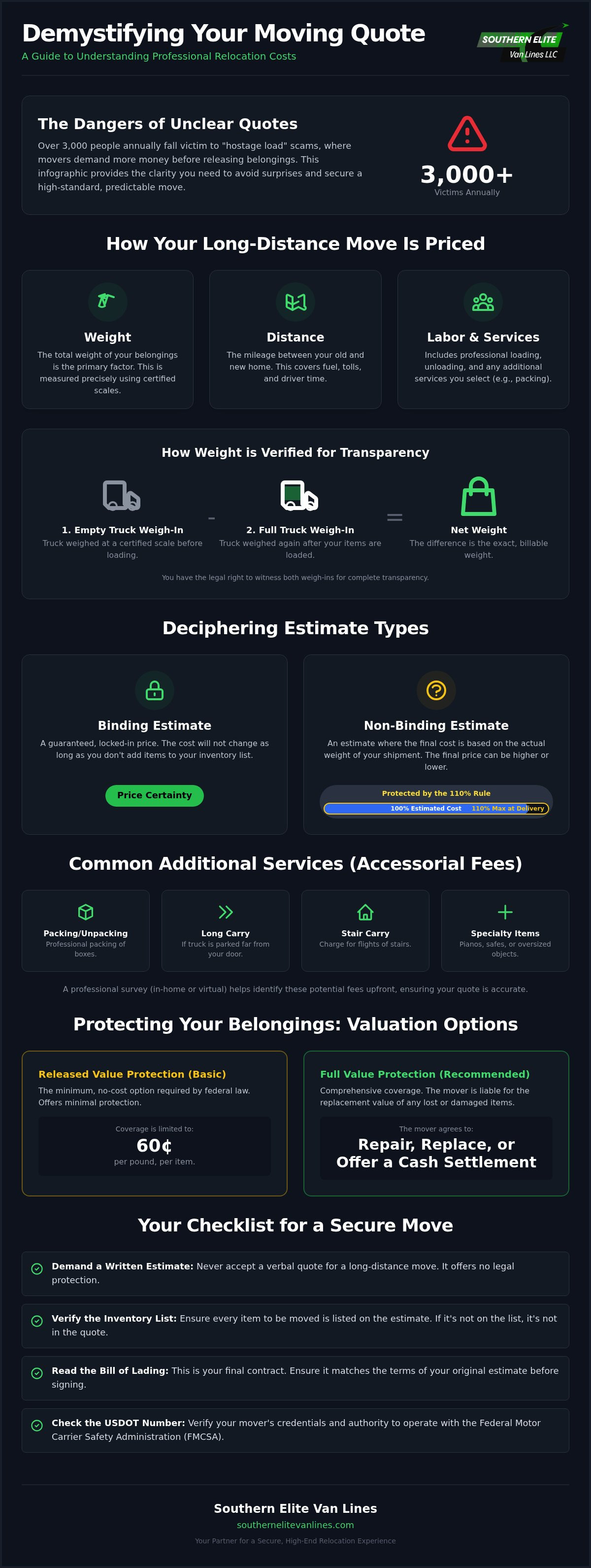
Federal law dictates a specific process for verifying the weight of your shipment to prevent unfair billing. The mover first weighs the truck "empty" with a full tank of gas and all necessary equipment on board. After your belongings are loaded, the truck is weighed again "full" at a certified scale. You have the legal right to witness both of these weighings to ensure total transparency. Net Weight is the total weight of your goods alone, calculated by subtracting the empty weight from the full weight. This precise measurement prevents overcharging and provides a verifiable basis for your final moving quote breakdown. It's a methodical approach that replaces guesswork with exact data.
Valuation Coverage: Protecting Your Investment
Many people confuse valuation with insurance, but they are distinct concepts in the moving industry. Released Value Protection is the basic coverage required by federal law, which typically limits the mover's liability to 60 cents per pound per item. For a premium relocation, this minimal coverage is rarely sufficient. While insurance is a contract with a third party, valuation is a level of liability that the moving company assumes. Full Value Protection offers a higher standard of care, ensuring that the mover is responsible for the replacement value of lost or damaged items. Southern Elite Van Lines prioritizes the safety of your belongings through high-quality packing and meticulous handling. Selecting the right coverage level is a vital step in securing your peace of mind. If you want to ensure your high-value items receive the attention they deserve, it's wise to discuss customized packing solutions with your relocation specialist early in the process.
Deciphering Estimate Types: Binding vs. Non-Binding
A reliable moving quote breakdown is only as strong as the legal framework supporting it. Understanding the different types of estimates is vital because they determine who carries the financial risk if the shipment's weight varies. A non-binding estimate offers the most flexibility for the carrier but represents the highest risk for you. In this scenario, the mover provides an educated guess based on their survey, but the final price depends entirely on the actual weight recorded at the scales. If your belongings weigh more than anticipated, your final bill will increase accordingly. While this can be useful if you're still decluttering, it lacks the price certainty that many families require for a stress-free transition.
A binding estimate provides a locked-in price based on a specific inventory of items. This option ensures that as long as your inventory doesn't change between the walkthrough and moving day, your price remains constant. For those seeking the ultimate level of protection, the "Binding-Not-to-Exceed" estimate is the gold standard in 2026. This type of quote sets a guaranteed price ceiling; however, if your shipment's actual weight is lower than the estimate, your final cost is reduced. It combines the security of a fixed budget with the potential for savings, making it the preferred choice for complex, high-value relocations where precision and fairness are paramount.
The 110% Rule for Non-Binding Estimates
Federal law provides a critical safeguard for consumers who choose non-binding estimates. Known as the 110% Rule, this regulation states that a mover cannot demand more than 110% of the original estimate at the time of delivery. If the actual weight of your shipment exceeds the estimate, the carrier must still unload your belongings once you pay that 110%. Any remaining balance above that amount is then billed to you at least 30 days after the move is complete. This rule is a powerful tool that prevents "hostage load" situations, ensuring that you aren't forced into an immediate financial crisis on your doorstep. It provides a necessary layer of security while allowing for the inherent variability of weight-based pricing.
Why Binding Estimates Require a Finalized Inventory
Binding agreements are strictly tied to the items documented during your initial survey. Adding even a single piece of furniture or several extra boxes after the quote is signed can technically void the binding nature of the agreement. Honesty during the walkthrough is essential for an accurate moving quote breakdown. You must be transparent about the contents of your attic, garage, and any off-site storage units to avoid price adjustments later. Expert long distant movers use sophisticated digital inventory tools to record every item with exactness. This technology ensures the price you see on your estimate is the price you pay, allowing you to focus on your new beginning rather than unexpected costs.
Accessorial Fees: Identifying "Hidden" Costs Before They Happen
Accessorial fees often surprise families, but they shouldn't. These charges cover services beyond the basic transport of your goods from point A to point B. A thorough moving quote breakdown lists these clearly, ensuring you aren't blindsided on delivery day. For instance, if the moving truck cannot park within 75 feet of your front door, a "long-carry" fee applies to compensate for the extra time and physical labor involved. Similarly, "stair fees" account for the added complexity of navigating multiple flights of stairs. In narrow city streets or neighborhoods with low-hanging trees, a "shuttle service" might be required. This involves transferring your belongings from the large interstate trailer to a smaller vehicle that can safely reach your doorstep. These fees reflect the real-world logistical hurdles that movers must overcome to ensure your items arrive safely.
Professional Packing and Material Costs
Packing is more than just placing items in boxes; it's a strategic effort to safeguard your life's work. Full packing services involve professionals handling every room in your home, while partial packing allows you to manage non-fragile items yourself. Custom crating is essential for high-value pieces like pianos, delicate artwork, or ornate mirrors. Professional materials prevent costly damage during interstate transit. Using heavy-duty dish packs, specialized wardrobe boxes, and high-tensile tape ensures that your shipment remains intact over hundreds of miles of highway. Investing in these materials early saves you from the emotional and financial cost of damaged heirlooms later.
Storage-in-Transit (SIT) vs. Long-Term Storage
Sometimes, your new residence isn't ready the moment the truck arrives. Storage-in-Transit (SIT) provides a temporary, secure solution, typically for up to 90 days. This service includes the cost of unloading your items into a climate-controlled facility and reloading them when you're ready for final delivery. For more complex moves, such as commercial relocation, transitional storage is often a strategic necessity to manage office equipment or inventory during a staggered opening. Unlike long-term storage, SIT is designed for items that are already "in motion." Including these potential needs in your moving quote breakdown ensures your budget remains intact even if your closing date shifts.
Ready to see a transparent view of your upcoming move? Request a detailed estimate from Southern Elite Van Lines today to ensure every logistical detail is accounted for without surprises.
Securing a Premium Relocation with Southern Elite Van Lines
Relocation is a complex, emotional journey that requires more than just a truck and a crew; it demands a partner who values your peace of mind as much as the physical safety of your belongings. Southern Elite Van Lines positions itself as that steady, expert hand, guiding you through every phase of a nationwide move with calm confidence. We believe that trust is built through transparency, which is why we provide a meticulous moving quote breakdown for every client. Our commitment to a "No Hidden Fees" policy isn't just a marketing claim. It's a fundamental part of our moral character as a premium service provider. By accounting for every logistical detail during the initial consultation, we eliminate the price hikes that often plague budget relocations, allowing you to focus on your new beginning with total financial clarity.
Our nationwide coverage ensures that whether you're moving across state lines or across the country, you receive the same high standard of service. We pair this broad capability with personalized customer support that treats your move as a shared journey. You aren't just another shipment on a manifest. You're a client who deserves a sophisticated, uninterrupted experience. Our relocation specialists are trained to handle the nuances of high-end moves, providing a level of care that transforms a stressful life event into a well-planned operation. We encourage you to request a comprehensive, transparent quote today to see how our methodical approach creates a predictable, secure relocation strategy tailored to your specific needs.
The Southern Elite Difference: Precision and Care
We maintain a modern vehicle fleet equipped with the latest safety technology to ensure every shipment arrives in pristine condition. Precision is our standard, and we reinforce this through the use of premium packing materials designed for long-haul transit. Our relocation specialists undergo rigorous professional training, focusing on exactness and the meticulous handling of delicate items. This dedication to perfection provides the peace of mind that only comes from knowing your life's work is in capable hands. We don't just move boxes; we manage a sophisticated logistical process with a focus on effortless execution and superior quality.
Next Steps: How to Start Your Quote Process
Starting your journey toward a seamless move is a straightforward, organized process. We recommend scheduling a virtual or in-home survey as your first step. This allows our estimators to view your space and identify any logistical challenges early, ensuring your moving quote breakdown is as accurate as possible. To prepare for this walkthrough, we advise creating a finalized inventory list of all items in your home, including those in attics, basements, or garages. Being thorough at this stage prevents surprises on moving day and locks in your pricing. Visit the Southern Elite Van Lines homepage today to request your free estimate and take the first step toward a relocation defined by transparency and excellence.
Step Into Your New Chapter With Financial Clarity
Your relocation represents a significant milestone, and it deserves a foundation built on trust and precision. By mastering the nuances of your moving quote breakdown, you've moved from uncertainty to authority. You now understand how weight, distance, and specialized labor intersect to create a fair price. You also know how to spot the logistical fees that ensure your items navigate narrow streets or multiple staircases safely. This knowledge is your best defense against surprises on moving day. It transforms a complex contract into a predictable roadmap for your transition.
Southern Elite Van Lines is ready to serve as your expert guide throughout this entire process. We combine nationwide interstate moving expertise with an A+ commitment to transparent pricing. Our team provides professional packing and climate-controlled storage solutions to protect your investment every step of the way. We believe that a successful move begins with a clear, honest plan that respects your budget and your peace of mind.
Request your transparent, no-obligation moving quote from Southern Elite Van Lines today.
We look forward to helping you start your journey with the confidence and security you deserve.
Frequently Asked Questions
What is a "long-carry" fee and how can I avoid it?
A long-carry fee is a charge applied when movers must transport your belongings over a distance exceeding a standard limit, typically 75 feet, between the truck and your home. You can avoid this by securing a parking permit or reserving a space directly in front of your door. Providing clear access allows the team to work efficiently and prevents this logistical charge from appearing on your final bill.
Can my moving quote change after the movers arrive?
Your quote can change if the scope of work shifts after the movers arrive. If you've added furniture since the survey or require extra packing services, the price will be adjusted to reflect the new inventory. To maintain a predictable budget, ensure your initial walkthrough is as thorough as possible and communicate any changes to your relocation specialist before the team arrives on-site.
Is valuation coverage the same thing as moving insurance?
Valuation is not insurance; it represents the level of liability the moving company assumes for your shipment. While insurance is a separate policy you buy from an agent, valuation is a contractual agreement between you and the mover. You'll choose between basic protection or more comprehensive coverage during your moving quote breakdown to ensure your high-value items receive the appropriate standard of care.
How is the fuel surcharge calculated for a long-distance move?
Fuel surcharges are calculated as a percentage of the total transportation charges and fluctuate based on the national average price of diesel. Movers use current data from the Department of Energy to set these rates. This system allows carriers to manage volatile energy costs fairly without constantly renegotiating base rates, providing a transparent way to account for the actual expense of long-distance transit.
What is a "shuttle service" and why is it on my quote?
A shuttle service appears on your quote when a full-sized interstate trailer cannot safely reach your home due to narrow streets, low bridges, or local weight restrictions. In these cases, movers use a smaller truck to transport your items between the residence and the larger trailer. This fee covers the specialized equipment and the additional labor required to handle your belongings during the transfer process.
Does the time of year affect my moving quote breakdown?
Seasonality plays a major role in your moving quote breakdown, as demand for professional movers peaks between May and September. During these busy months, limited availability often leads to higher rates for labor and equipment. Planning your relocation for the late fall or winter can result in lower costs and more flexible timing, as carriers have more resources available to dedicate to your journey.
What items are considered "non-allowables" that won’t be on the quote?
Non-allowables are hazardous or personal items that movers cannot legally or safely transport, such as propane tanks, paint, and ammunition. Perishable food items and plants also fall into this category. Because these items aren't permitted on the truck, they won't be included in your weight or service estimate. You should plan to transport these materials, along with jewelry and essential documents, in your personal vehicle.
How do I compare two quotes that use different pricing structures?
Start by verifying that both companies are using the same estimated weight and inventory list. If one quote is significantly lower, check if they've omitted accessorial fees like packing or long-carry charges. Ensure you're comparing similar estimate types, as a binding quote might appear higher than a non-binding one but offers more price certainty. Focus on the total value and the mover's reputation for transparent dealings.


Comments